MCX
MCX Trading in India: Complete Beginner's Guide to Gold, Silver, Crude Oil and Commodity Futures
Learn how MCX trading works in India. Understand gold, silver, crude oil, contract sizes, margins, futures, options, expiry and commodity trading risks.
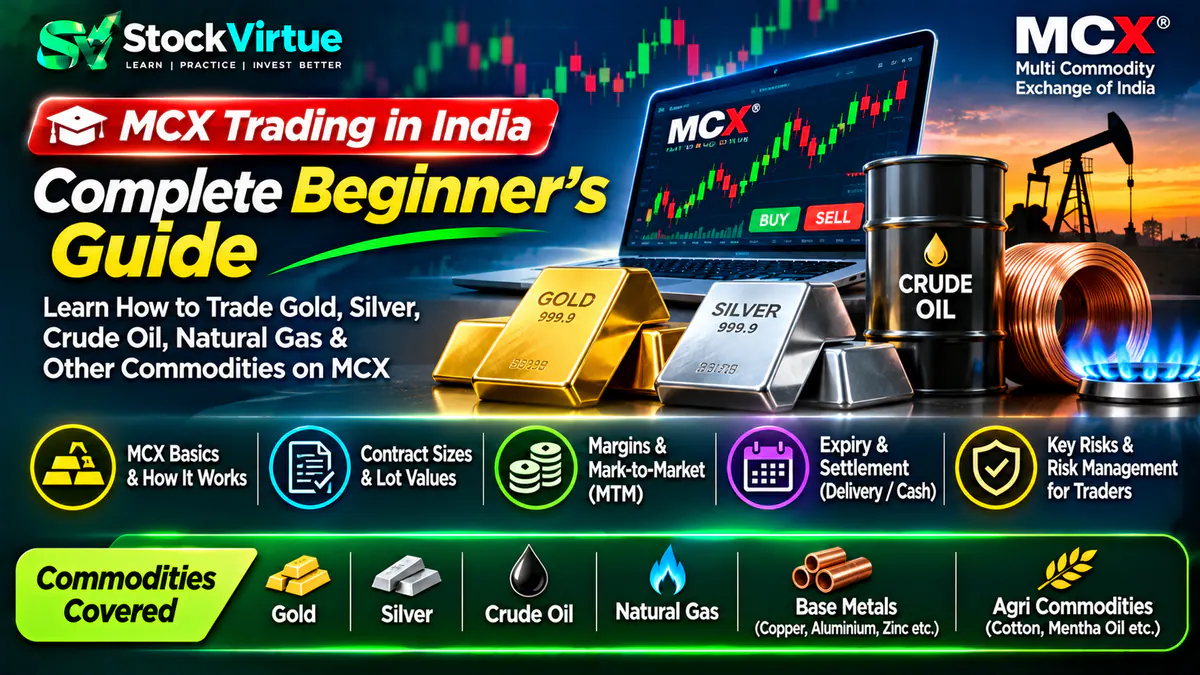
The Indian commodity market provides opportunities to participate in price movements across precious metals, energy products, base metals and agricultural commodities. From gold and silver to crude oil and natural gas, commodity prices are influenced by global demand, supply, currency movements, economic conditions and geopolitical developments.
In India, the Multi Commodity Exchange of India (MCX) is one of the major platforms for trading commodity derivatives.
However, commodity trading is different from purchasing physical gold, silver or other commodities. Traders generally participate through exchange-traded futures and options contracts, which have specific quantities, expiry dates, margin requirements and settlement conditions.
For beginners, understanding these features is essential before entering the market.
This guide explains how MCX works, which commodities are traded, how contract sizes and margins operate, how prices move and what risks traders should understand.
1. What is MCX?
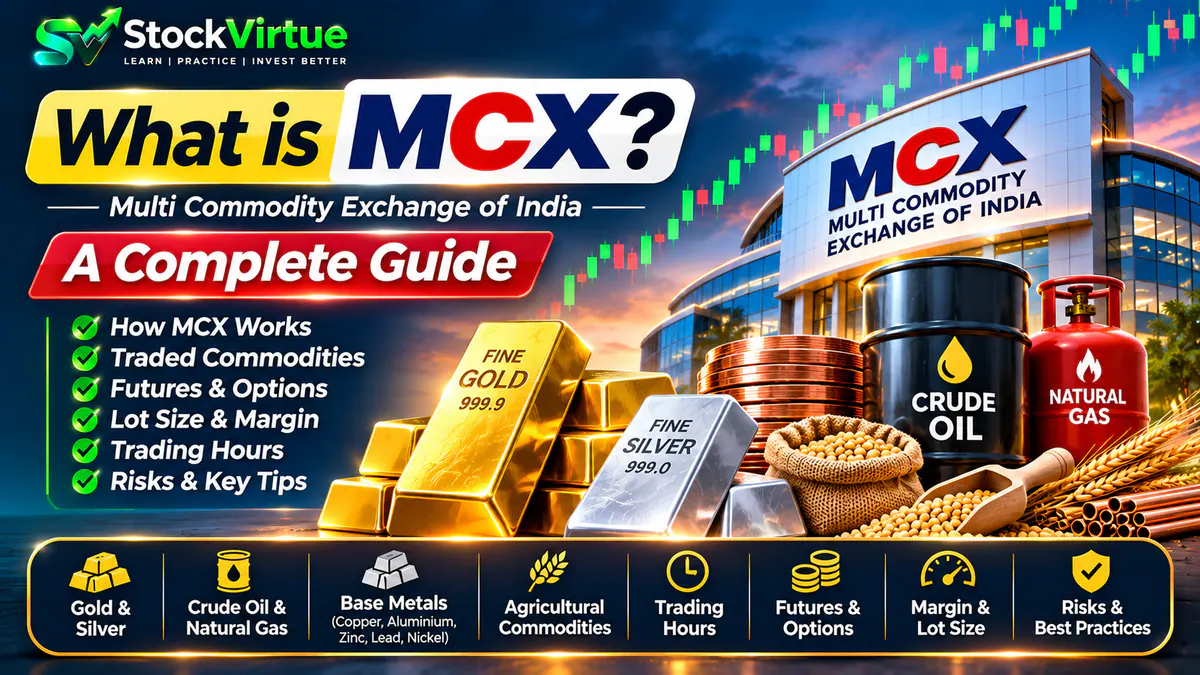
The Multi Commodity Exchange of India Limited (MCX) is an electronic commodity derivatives exchange regulated by the Securities and Exchange Board of India (SEBI).
It provides a platform where eligible market participants can trade exchange-listed commodity derivative contracts.
MCX offers contracts across several commodity categories:
Bullion: Gold and silver.
Energy: Crude oil and natural gas.
Base metals: Copper, aluminium, zinc, lead and nickel.
Other permitted commodities: Products such as cotton, mentha oil and other exchange-listed agricultural or industrial commodities.
MCX is not a physical commodity shop. When a trader buys a futures contract, the trader is entering into an exchange-traded derivative contract with defined specifications.
The exchange publishes contract details, including trading unit, quotation, tick size, expiry, delivery conditions and other requirements.
2. How does commodity trading work?
Commodity trading allows participants to take positions based on expected changes in commodity prices.
Consider a simple example.
Suppose gold is trading at ₹1,30,000 per 10 grams in an illustrative market scenario.
A trader expects gold prices to increase and purchases a gold futures contract.
If the contract price rises, the trader may benefit from the price movement. If the price falls, the trader may incur a loss.
The trader does not necessarily need to purchase the full underlying quantity by paying its entire value upfront. Futures trading involves margin requirements and daily mark-to-market adjustments.
This is why futures can create substantial exposure with a comparatively smaller initial margin.
Important: Margin is not a discount or a maximum possible loss. A trader can lose more than the initial margin deposited.
3. What commodities can you trade on MCX?
MCX provides contracts across several major market categories.
A. Bullion market: Gold and silver
Gold and silver are among the most widely followed commodities in India.
Their prices are influenced by:
International bullion prices.
US dollar movements.
Interest-rate expectations.
Inflation expectations.
Central-bank gold purchases.
Geopolitical developments.
Domestic demand and currency movements.
MCX offers multiple gold contract sizes designed for different market participants.
MCX gold contract | Underlying quantity |
|---|---|
Gold | 1 kg |
Gold Mini | 100 grams |
Gold Ten | 10 grams |
Gold Guinea | 8 grams |
Gold Petal | 1 gram |
These quantities describe the underlying contract units, not the margin payable to open a position. Traders must check the applicable contract specifications and available expiry months before trading.
Silver contracts also have their own contract sizes and specifications, which should be verified on the MCX website.
B. Energy market: Crude oil and natural gas
Energy commodities are closely connected to international economic activity.
Crude oil prices respond to:
OPEC+ production decisions.
US inventory reports.
Global fuel consumption.
Geopolitical developments.
Shipping and transportation disruptions.
US dollar movements.
Global economic growth expectations.
Natural gas prices are influenced by weather, storage inventories, production, electricity demand and international supply conditions.
MCX provides crude oil and crude oil mini contracts, as well as natural gas-related contracts.
The exact contract unit, quotation, tick value and expiry must be checked against the relevant exchange specification.
C. Base metals
Base metals are important to manufacturing, construction, infrastructure and industrial production.
Examples include:
Commodity | Major demand areas |
|---|---|
Copper | Electrical equipment, power and construction |
Aluminium | Automobiles, packaging and infrastructure |
Zinc | Galvanising and industrial applications |
Lead | Batteries and manufacturing |
Nickel | Stainless steel and battery-related applications |
These commodities can be influenced by global manufacturing activity, mining supply, inventories, trade policies and currency movements.
4. Understanding MCX contract sizes and lot values
One of the most important concepts in commodity trading is the contract quantity.
A commodity's market price may be quoted per kilogram, gram, barrel or another unit. The actual exposure depends on the exchange-defined contract quantity.
Example: Understanding a gold contract
Assume the following hypothetical price:
Gold price: ₹1,30,000 per 10 grams.
Gold contract quantity: 1 kilogram.
Quantity: 1,000 grams.
The approximate contract value would be:
₹1,30,000 × 100 = ₹1,30,00,000.
<text weight="semibold" color="success">Illustrative contract value: ₹1.30 crore</text>
This is why the full-size gold contract may represent substantial exposure.
Smaller contracts such as Gold Mini, Gold Ten, Gold Guinea and Gold Petal have smaller underlying quantities.
For example, at the same hypothetical gold price:
Contract | Quantity | Illustrative value |
|---|---|---|
Gold | 1 kg | ₹1,30,00,000 |
Gold Mini | 100 g | ₹13,00,000 |
Gold Ten | 10 g | ₹1,30,000 |
Gold Guinea | 8 g | ₹1,04,000 |
Gold Petal | 1 g | ₹13,000 |
These are theoretical notional values, not live MCX prices or margin amounts. Actual contract specifications, price quotations and available expiry months must always be verified.
5. What is margin in MCX trading?
Commodity futures generally require traders to deposit margin rather than the entire notional contract value.
Margin is a risk-control mechanism that helps ensure participants can meet potential trading losses.
For example, assume:
Hypothetical contract value: ₹10,00,000.
Illustrative initial margin: 10%.
Initial margin amount: ₹1,00,000.
The trader may be required to deposit ₹1 lakh to establish the position, subject to the actual exchange and broker requirements.
However, this does not mean the maximum possible loss is ₹1 lakh.
If the market moves against the position, additional funds may be required. The broker may also square off positions under its risk-management policy if sufficient margin is unavailable.
Actual margins can change because of volatility, exchange requirements, additional margins and broker-specific risk controls.
6. What is tick size and tick value?
A tick is the smallest permitted price movement in a particular contract.
Every exchange-listed commodity contract has a specified tick size.
Suppose a hypothetical contract has:
Contract quantity: 100 units.
Tick size: ₹1 per unit.
A one-tick movement would change the contract value by ₹100.
If the market moves 10 ticks in the trader's favour, the gross price-based gain would be ₹1,000 before brokerage, taxes and other charges.
The actual tick size and value differ across commodities and contracts. Always consult the latest MCX contract specification.
7. How do you make a profit or loss in commodity futures?
Futures trading generally involves buying or selling a contract based on the expected price movement.
Example 1: Buying a futures contract
Assume a hypothetical contract has a quantity of 100 units.
Buy price: ₹500 per unit.
Sell price: ₹510 per unit.
Price difference: ₹10.
Contract quantity: 100.
Gross profit:
₹10 × 100 = ₹1,000.
Example 2: Selling a futures contract
Assume the trader expects the price to decline.
Sell price: ₹500 per unit.
Buy-back price: ₹490 per unit.
Price difference: ₹10.
Contract quantity: 100.
Gross profit:
₹10 × 100 = ₹1,000.
If the price instead rises to ₹510, the trader would incur a gross loss of ₹1,000.
These examples exclude brokerage, taxes, exchange charges and other applicable costs.
8. What is mark-to-market settlement?
Futures positions are subject to mark-to-market (MTM) settlement.
This means gains and losses arising from daily price changes are calculated and settled according to the exchange's clearing and settlement framework.
Consider a hypothetical futures position:
Trading day | Contract price | Daily movement | Daily P&L |
|---|---|---|---|
Entry | ₹500 | — | — |
Day 1 | ₹505 | +₹5 | +₹500 |
Day 2 | ₹498 | -₹7 | -₹700 |
Day 3 | ₹502 | +₹4 | +₹400 |
Assume a contract quantity of 100 units.
The cumulative price movement from ₹500 to ₹502 represents a gross gain of ₹200, before charges.
Daily settlement is important because traders must maintain sufficient funds to meet losses as they occur.
A position that appears profitable over a longer period can still require additional funds during an adverse intermediate price movement.
9. What are commodity futures and options?
MCX provides futures and options contracts, subject to the products and expiry months currently available.
Futures
A futures contract creates an obligation according to the contract terms.
Traders can buy or sell a futures contract to participate in price movements.
Futures positions are subject to margin and mark-to-market requirements.
Options
An option gives its buyer a right, but not an obligation, to exercise the contract according to its terms.
The buyer pays a premium to acquire that right.
The option seller receives the premium but assumes obligations and margin requirements under the applicable rules.
Important option concepts include:
Call option.
Put option.
Strike price.
Premium.
Expiry.
Intrinsic value.
Time value.
Implied volatility.
Commodity options have product-specific settlement and expiry provisions. Traders should understand whether an option is cash-settled or subject to devolvement into an underlying futures position under the applicable contract rules.
10. What affects commodity prices in India?
MCX commodity prices are influenced by both domestic and international developments.
Gold and silver
US dollar strength or weakness.
US interest rates and bond yields.
Inflation expectations.
Central-bank purchases.
Jewellery and investment demand.
Geopolitical uncertainty.
Rupee-dollar exchange rate.
Crude oil
OPEC+ production policy.
US crude inventory data.
Global transportation demand.
Geopolitical tensions.
Shipping disruptions.
Economic growth.
Refinery activity.
Copper and industrial metals
Chinese industrial demand.
Global manufacturing activity.
Mine production.
Warehouse inventories.
Infrastructure spending.
Energy-transition demand.
Agricultural commodities
Monsoon conditions.
Crop production.
Weather events.
Government policies.
Export and import restrictions.
Global food demand.
Understanding these drivers is important because commodity prices can move sharply following unexpected economic or geopolitical developments.
11. MCX trading timings
MCX operates on exchange trading days, subject to its published holiday calendar and product-specific schedules.
The exchange's published schedule generally includes:
A special order-cancellation session before normal trading.
A normal trading session beginning at 9:00 AM.
Different closing times depending on commodity category and international market timing.
Internationally referenceable non-agricultural commodities such as bullion, metals and energy products may trade until 11:30 PM or 11:55 PM depending on the daylight-saving period.
Agricultural commodities have different trading hours.
Always check the current MCX trading calendar and session timings before placing an order.
12. What happens when an MCX contract expires?
Every futures and options contract has an expiry date.
As expiry approaches, traders must understand the applicable settlement conditions.
Depending on the commodity and contract, settlement may involve cash settlement, physical delivery or option devolvement into an underlying futures contract.
Physical delivery contracts require particular attention.
A retail trader who does not intend to take delivery should understand the broker's square-off policy, tender period, delivery intention requirements and exchange expiry rules.
Never assume that every MCX contract automatically settles in cash.
Check the relevant contract specification and broker's expiry policy well before the final trading session.
13. What are the biggest risks in commodity trading?
Commodity derivatives can be highly volatile and are not suitable for every investor.
Leverage risk
A small initial margin can represent a much larger contract value. Even a relatively small adverse price movement can create a substantial loss.
Overnight risk
International markets may move while the Indian market is closed. Prices can reopen at significantly different levels.
Expiry risk
Delivery requirements and expiry-related price movements can create additional risks.
Liquidity risk
Some contracts may have lower trading volumes or wider bid-ask spreads, making it difficult to enter or exit positions at expected prices.
Currency risk
International commodity prices and the rupee-dollar exchange rate can both influence domestic prices.
Margin risk
Volatility can result in higher margin requirements or additional funds being required.
14. How can beginners learn MCX trading safely?
Beginners should focus on understanding contracts and managing risk before using real money.
A structured learning process can include:
Learn how futures and options work.
Understand the contract quantity and quotation.
Calculate notional exposure.
Learn margin and mark-to-market settlement.
Study expiry and delivery conditions.
Observe commodity price movements.
Practise with virtual money.
Review every simulated trade.
Paper trading is useful for understanding order placement, price movements and risk management without risking actual trading capital.
However, simulated results cannot fully reproduce real-world slippage, liquidity, broker execution, margin calls or emotional pressure.
15. How StockVirtue helps you understand commodity trading
StockVirtue is designed to help learners understand Indian financial markets through virtual trading.
Instead of immediately risking real money, users can practise trading concepts with simulated funds and learn how market movements affect their positions.
For commodity education, learners should focus on:
Understanding commodity contract quantities.
Observing gold, silver and energy price movements.
Practising buy and sell orders.
Calculating virtual profit and loss.
Understanding exposure and position sizing.
Learning how price volatility affects a trading position.
The purpose of simulation is to build knowledge and disciplined decision-making, not to promise profits or replicate every operational feature of a live commodity broker.
Frequently Asked Questions
1. What is the full form of MCX?
MCX stands for Multi Commodity Exchange of India Limited.
2. Is MCX regulated by SEBI?
Yes. MCX operates as a recognised commodity derivatives exchange under the applicable Indian securities-market regulatory framework.
3. Can beginners trade gold on MCX?
Eligible clients can access exchange-listed gold derivatives through a registered broker, subject to applicable requirements. Beginners should understand contract size, margin, expiry and delivery conditions first.
4. What is the difference between Gold and Gold Mini?
The standard MCX Gold contract has an underlying quantity of 1 kg, while Gold Mini has an underlying quantity of 100 grams. Other smaller gold contracts are also listed, subject to current availability.
5. Do I need to pay the full contract value?
Futures trading generally involves depositing applicable margin rather than paying the entire notional contract value upfront. Additional funds may be required when the market moves against the position.
6. Can I hold an MCX futures position until expiry?
That depends on the contract's settlement and delivery conditions. Traders must understand tender periods, delivery requirements and broker policies before expiry.
7. Is MCX trading risk-free?
No. Commodity derivatives involve leverage, volatility, liquidity and settlement risks. Losses can exceed the initial margin deposited.
Final takeaway
MCX provides an important platform for participating in India's commodity derivatives market.
Gold, silver, crude oil, natural gas and industrial metals each have different market drivers, contract specifications and risk characteristics.
For beginners, understanding the underlying quantity, notional value, margin, tick size, MTM settlement and expiry conditions is more important than simply predicting whether prices will rise or fall.
Learning these concepts before entering a real trade can help build a stronger foundation for responsible market participation.
StockVirtue — Learn | Practice | Invest Better
Disclaimer: This article is educational and does not constitute investment advice or a recommendation to trade. Commodity derivative trading involves substantial risk. Contract specifications, available expiries, margins, tick sizes, settlement rules and trading hours can change. Always consult the latest MCX circulars and contract specifications and your SEBI-registered broker before trading.