Gold & Silver
Gold Price Today: Bullion Crashes to 14-Month Low as Strong US Dollar and Fed Rate Hike Fears Trigger Heavy Selling
Gold falls to a 14-month low as a stronger US dollar and Fed rate hike fears trigger heavy selling. Check MCX gold prices, silver trends and the impact on Indian investors.
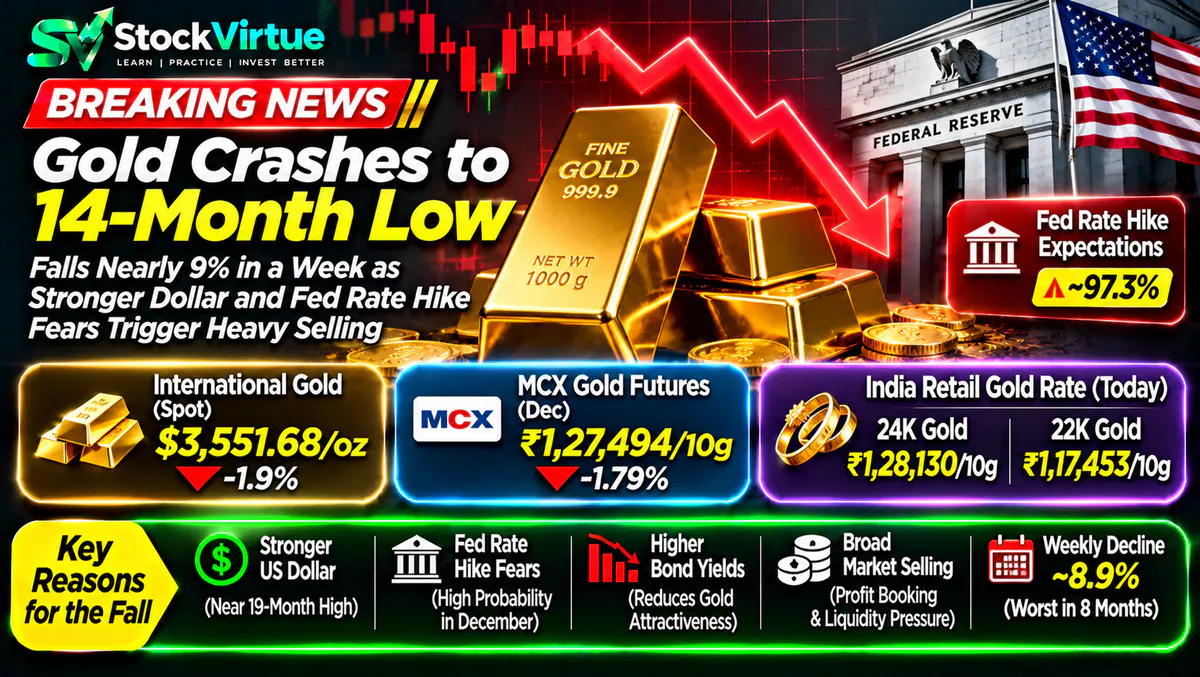
Gold prices extended their sharp decline on Friday as a strengthening US dollar and growing expectations of another Federal Reserve interest-rate hike triggered fresh selling across international bullion markets.
International spot gold dropped to its lowest level since September 2025, putting the precious metal on track for its steepest weekly decline in eight months.
The weakness has also reached India's commodity market. MCX gold futures for December delivery were trading around ₹1.27 lakh per 10 grams in early trading, reflecting continued pressure on domestic bullion prices.
The latest decline is particularly significant because gold has traditionally been considered a safe-haven asset during periods of financial uncertainty. However, the current market is showing that interest-rate expectations, currency movements and investor positioning can outweigh safe-haven demand.
For Indian investors, the fall could influence jewellery prices, gold investment products, bullion traders and commodity futures positions.
1. Gold price today: International bullion extends its decline
International gold prices came under fresh pressure on Friday. According to Reuters, spot gold fell 1.9% to approximately $3,551.68 per ounce during Friday's reported trading session. The metal had touched its lowest level since September 2025.
Gold was also heading towards a weekly decline of approximately 8.9%, its steepest weekly fall in eight months. December US gold futures experienced an even sharper decline during the reported session.
International gold market snapshot – November 20
Indicator | Reported price / movement |
|---|---|
Spot gold | $3,551.68 per ounce |
Daily movement | -1.9% |
Weekly movement | Approximately -8.9% |
December US gold futures | Fell 3.6% |
Market trend | Strong selling pressure |
Figures are reported market observations and can vary by trading time and data provider. They are not guaranteed closing prices.
The decline suggests that investors are reassessing their exposure to precious metals as expectations of tighter US monetary policy increase.
2. MCX gold price today: Indian bullion market under pressure
The international sell-off has also affected India's domestic gold market.
MCX December gold futures were quoted near ₹1,27,494 per 10 grams in early trading around 7:56 AM IST, down approximately ₹2,320 or 1.79% from the previous close.
Another early-morning market update reported the contract near ₹1,27,548 per 10 grams. These figures are early-session observations, not the final settlement price.
Indian gold price snapshot
Gold category | Reported price |
|---|---|
MCX December gold futures | Around ₹1,27,500 per 10 grams |
24K retail reference – India | Around ₹1,28,130 per 10 grams |
22K retail reference – India | Around ₹1,17,453 per 10 grams |
The retail reference prices were reported around 6:10 AM IST and may differ by city, jeweller, taxes and making charges.
The MCX futures price and retail jewellery rate are not directly interchangeable. Futures prices represent a specific delivery contract, while retail rates include local market pricing and other costs.
3. Why is gold falling so sharply?
Three major factors are contributing to the latest decline.
A. Strong US dollar puts pressure on bullion
The US dollar has strengthened towards a 19-month high.
Gold is internationally priced in dollars. When the dollar appreciates, gold becomes more expensive for buyers using other currencies.
This can reduce international demand and place downward pressure on bullion prices.
The relationship is not always direct, but the current dollar rally is an important factor behind the gold sell-off.
B. Federal Reserve rate hike expectations are increasing
The second major factor is the changing outlook for US monetary policy.
Investors are increasingly expecting the Federal Reserve to raise interest rates in December as policymakers remain concerned about inflation.
According to market pricing reported on Friday, investors were assigning approximately a 97.3% probability to a 25-basis-point rate increase, with a smaller probability of a 50-basis-point increase.
Higher interest rates generally reduce the attractiveness of gold because bullion does not generate interest income.
When interest-bearing assets offer higher returns, investors may prefer them over non-yielding assets such as gold.
C. Higher bond yields and forced selling
The market is also experiencing broader selling pressure.
When investors face losses or tighter liquidity conditions across financial markets, they may sell profitable or liquid positions to raise cash.
This process can affect gold even when geopolitical uncertainty remains elevated.
Analysts have also pointed to higher yields and momentum-driven selling as contributing factors.
4. Why is gold not acting like a safe-haven asset?
One of the most interesting developments in the current market is the weakness of gold despite falling global equities.
Normally, investors may increase their exposure to gold during periods of geopolitical uncertainty, economic instability or stock-market volatility.
However, safe-haven demand is only one of several factors influencing bullion.
The current environment includes:
A stronger US dollar.
Expectations of higher US interest rates.
Elevated bond yields.
Investor repositioning and forced liquidation.
Continued uncertainty about inflation.
These forces are currently outweighing some of the demand that gold might otherwise receive from global uncertainty.
This does not mean that gold has permanently lost its safe-haven role. It shows that its price can respond differently depending on the dominant economic and financial conditions.
5. Silver also falls as precious metals face broad selling
Gold is not the only precious metal experiencing pressure. Silver prices also declined sharply during Friday's early trading.
Spot silver was reported near $42.29–$42.74 per ounce across different market updates, with one report showing a decline of more than 4.7%.
Platinum and palladium were also trading lower.
Precious metals snapshot
Metal | Reported price | Market direction |
|---|---|---|
Gold | Around $3,552–$3,607/oz | Sharp decline |
Silver | Around $42.29–$42.74/oz | Under pressure |
Platinum | Around $1,343/oz | Lower |
Palladium | Around $908/oz | Lower |
Prices reflect different reported observation times and should not be treated as simultaneous live quotes.
Silver can experience greater price volatility than gold because it has both investment and industrial demand.
A weakening global economic outlook can therefore create additional pressure on silver through concerns about industrial consumption.
6. What does falling gold mean for Indian buyers?
A decline in international gold prices can eventually influence domestic jewellery prices, but the impact is not always immediate or equal across India.
Several factors determine the final price paid by consumers:
International gold prices.
The rupee-dollar exchange rate.
Import duties and other applicable taxes.
Domestic supply and demand.
Local jeweller margins.
Making charges and GST.
For Indian jewellery buyers, the current correction may create opportunities to compare prices and plan purchases.
However, buyers should not assume that a further decline is guaranteed.
Gold can recover quickly if the dollar weakens, interest-rate expectations change or geopolitical risks increase.
7. Which Indian gold-related stocks should investors watch?
Changes in gold prices can influence several listed companies, but the impact differs depending on their business models.
Company | Business | What investors should monitor |
|---|---|---|
Titan Company | Jewellery and watches | Jewellery demand, margins and inventory |
Kalyan Jewellers | Jewellery retail | Sales volumes, margins and inventory |
PC Jeweller | Jewellery retail | Business performance and financial position |
Senco Gold | Jewellery retail | Consumer demand and operating margins |
Muthoot Finance | Gold-backed lending | Gold collateral values and loan growth |
Manappuram Finance | Gold-backed lending | Gold loan portfolio and credit quality |
Jewellery companies
Lower gold prices can improve affordability for consumers and potentially support jewellery demand.
However, jewellery companies also manage significant inventory.
A sharp price movement can create inventory valuation effects and influence working-capital requirements.
Gold loan companies
Companies such as Muthoot Finance and Manappuram Finance use gold jewellery as collateral for loans.
Changes in gold prices can affect the value of collateral supporting their loan portfolios.
However, the impact on profitability also depends on loan growth, lending rates, credit quality and operating costs.
Investors should not assume that falling gold prices automatically make every gold-related stock attractive.
8. MCX gold traders: Important factors to monitor
For commodity traders, the next direction of gold prices will depend heavily on international developments.
The following indicators deserve close attention:
US dollar index: Continued dollar strength could create further pressure on internationally priced bullion.
US Treasury yields: Higher yields may reduce the attractiveness of non-yielding gold.
Federal Reserve commentary: Any change in the expected December interest-rate decision could trigger volatility.
US economic data: Inflation, employment and consumer confidence indicators can influence monetary-policy expectations.
Geopolitical developments: Unexpected escalation could restore safe-haven demand.
Rupee-dollar movement: A weaker rupee can cushion the impact of falling international gold prices for Indian buyers.
Why MCX prices may behave differently
Indian gold futures are influenced by international bullion prices, currency movements, import costs, domestic demand and contract-specific factors.
Consequently, a decline in international gold prices does not always translate into an identical percentage decline on MCX.
Traders should also monitor contract expiry, liquidity, margin requirements and position sizing before taking leveraged futures positions.
9. What could happen to gold prices next?
The short-term outlook remains uncertain. There are arguments supporting both further downside and a potential recovery.
Factors that could push gold lower:
Further strengthening of the US dollar.
Higher US interest-rate expectations.
Rising bond yields.
Continued investor liquidation.
Weakness in investment demand.
Factors that could support a recovery:
A weaker US dollar.
Lower bond yields.
A softer Federal Reserve policy outlook.
Renewed geopolitical uncertainty.
Stronger physical demand and central-bank purchases.
The Federal Reserve's next policy decision and the movement of the US dollar will remain particularly important for gold investors.
StockVirtue — Learn | Practice | Invest Better
Disclaimer: This article is for educational and informational purposes only and does not constitute investment advice or a recommendation to buy or sell gold, silver, gold ETFs, jewellery stocks or commodity futures. Prices are reported observations from November 20, 2026, at different times and are subject to change. MCX futures, international spot prices and retail jewellery rates are different market references. Commodity futures involve substantial risk, particularly when traded with leverage. Always verify live prices and assess your risk before trading.