Gold & Silver
Gold Crashes to a One-Year Low: MCX Prices Fall Below ₹1.36 Lakh as Strong Dollar and Fed Rate Fears Hit Bullion
Gold hits a one-year low as a strong dollar and US rate-hike fears pressure bullion. Check MCX gold, silver prices and what Indian investors should watch.
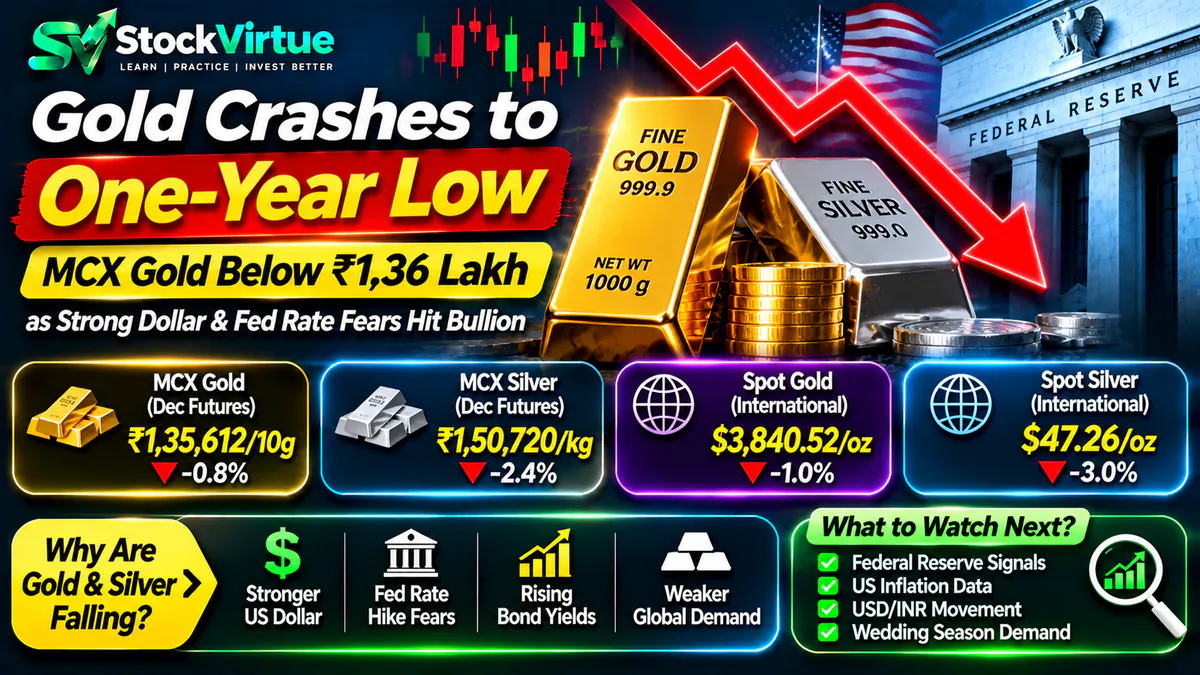
Gold and silver prices came under renewed pressure on Monday as international bullion markets extended their recent correction. Gold touched its lowest level in more than a year, while domestic MCX gold futures slipped below ₹1.36 lakh per 10 grams during the morning session.
The decline reflects a combination of a stronger US dollar, elevated US Treasury yields and growing expectations that the Federal Reserve could raise interest rates again in December. These developments have reduced the near-term appeal of precious metals, which do not offer regular interest income.
Silver has faced even heavier selling pressure, falling below $48 per ounce internationally and touching a one-year low, according to market reports.
For Indian investors, the correction is particularly important because gold plays a major role in household savings, jewellery purchases and portfolio diversification. The fall also creates a volatile trading environment for participants in the Multi Commodity Exchange (MCX).
The key question now is whether this is a temporary correction after a strong rally or the beginning of a deeper adjustment in precious-metal prices.
1. Gold prices fall to their lowest level in more than a year
International gold prices extended their decline on Monday, November 16, as investors reassessed the outlook for US monetary policy.
Spot gold fell approximately 1% to $3,840.52 per ounce during the Asian trading session, after touching its lowest level since October 2025.
US gold futures also moved lower, reflecting the pressure across international bullion markets.
The decline follows a difficult week for precious metals, with gold recording its steepest weekly fall in more than a year.
Gold price snapshot
Market indicator | Reported price | Movement |
|---|---|---|
International spot gold | $3,840.52/oz | Around -1% |
MCX Gold December futures | ₹1,35,612/10g | -0.8% |
Previous MCX settlement | ₹1,36,705/10g | — |
MCX figures are reported morning-session observations from November 16, 2026. Prices vary with contract, exchange snapshot and trading time.
The decline indicates that investors are currently giving greater importance to interest-rate expectations and currency movements than to gold's traditional safe-haven appeal.
2. Why is gold falling? Three major factors behind the correction
Gold prices are influenced by several factors, but the latest decline is primarily linked to developments in the US financial market.
A. Stronger US dollar puts pressure on gold
Gold is internationally priced in US dollars.
When the dollar strengthens against other currencies, gold becomes more expensive for buyers using those currencies. This can reduce international demand and put downward pressure on bullion prices.
The US dollar has been trading near its highest level since April 2025, creating an unfavourable environment for gold.
A sustained dollar rally could continue to challenge precious-metal prices in the short term.
B. Federal Reserve rate-hike expectations increase
Another important factor is the changing outlook for US interest rates.
Recent comments from Federal Reserve officials have indicated continued concern about inflation.
Markets have increasingly considered the possibility of another interest-rate increase in December. According to Reuters reporting on Monday, market pricing indicated approximately a 92% probability of a 25-basis-point increase.
Higher interest rates generally reduce the relative attractiveness of gold because the metal does not pay interest or dividends.
When investors can earn higher returns from interest-bearing assets, some may reduce their exposure to non-yielding precious metals.
C. Rising US Treasury yields reduce bullion demand
Gold prices are also sensitive to movements in US government bond yields.
When Treasury yields increase, investors may find bonds and other interest-bearing instruments more attractive compared with gold.
This can encourage portfolio reallocation away from precious metals.
The combination of a strong dollar and higher bond yields has therefore created multiple challenges for gold.
3. Silver faces even stronger selling pressure
Silver has experienced a sharper correction than gold.
International spot silver declined approximately 3% to $47.26 per ounce in Monday's reported trading, touching its lowest level in around one year.
Domestic MCX silver futures also remained under significant pressure.
The metal has been affected by the same macroeconomic developments weighing on gold, but its industrial-demand exposure creates additional uncertainty.
Silver is used in several industries, including:
Solar panel manufacturing.
Electronics and electrical equipment.
Automotive components.
Industrial applications.
Jewellery and investment products.
Research cited in recent market coverage has also projected a decline in global silver demand during 2026, partly because elevated prices have encouraged substitution in certain applications.
This makes silver different from gold: its price is influenced not only by investment demand and monetary policy but also by industrial consumption.
4. What is happening to gold prices in India?
Indian gold prices are influenced by international bullion prices, the rupee-dollar exchange rate, import duties, taxes, transportation costs and domestic demand.
Consequently, a fall in international gold prices does not always translate into an identical percentage decline in Indian retail prices.
During Monday's morning session, MCX gold December futures were reported around ₹1,35,612 per 10 grams, down approximately ₹667 from the previous close in one market snapshot.
Retail gold prices also vary across cities and jewellery sellers.
For consumers, it is important to distinguish between:
24-karat gold: Generally used for investment bars and coins because of its higher purity.
22-karat gold: Commonly used for jewellery manufacturing.
MCX gold futures: Exchange-traded contracts that represent standardised quantities and delivery specifications. Their prices are not identical to local jewellery-shop prices.
Buyers should also consider GST, making charges and applicable retailer premiums when comparing jewellery prices.
5. Will falling gold prices benefit Indian jewellery buyers?
The correction could offer some relief to Indian households planning gold purchases during the wedding season.
India is one of the world's major gold-consuming markets, and jewellery demand often increases around weddings and festivals.
Lower bullion prices may improve affordability and encourage consumers who had postponed purchases during the earlier rally.
However, retail jewellery prices do not necessarily fall by the same amount as international gold prices.
The final purchase cost depends on:
Gold purity.
Local bullion rates.
Jewellery making charges.
GST and applicable taxes.
Retailer premiums.
Currency movements.
For long-term buyers, a correction may create an opportunity to compare prices and purchase gradually, rather than attempting to predict the exact market bottom.
6. What should MCX gold and silver traders watch?
The latest correction has increased volatility across precious-metal futures.
Traders should pay particular attention to the following developments.
Gold: ₹1.35 lakh becomes an important level to monitor
Market commentary published on November 16 identified ₹1,35,000 per 10 grams as an immediate support reference for MCX December gold.
If the price remains above this area, some recovery attempts may emerge. However, a sustained decline below support could increase selling pressure.
Internationally, analysts have discussed a broad near-term range of $3,850–$4,000 per ounce.
These are market observations and analyst reference levels, not guaranteed support, resistance or price targets.
Silver: volatility remains elevated
Silver is showing greater downside pressure than gold.
Its price direction will depend on the US dollar, interest-rate expectations and industrial-demand developments.
Traders should avoid assuming that silver must recover simply because it has fallen sharply.
Important factors for MCX traders
US dollar index movements.
US Treasury yields.
Federal Reserve commentary.
International gold and silver prices.
USD/INR exchange-rate movements.
Geopolitical developments in West Asia.
Domestic physical demand.
MCX futures also involve leverage and mark-to-market settlement. Traders should understand contract specifications, margin requirements and expiry dates before entering positions.
7. Important events that could influence gold this week
The precious-metals market is entering an event-heavy week.
Event | Why it matters |
|---|---|
Federal Reserve Chair commentary | May influence expectations for future US interest rates |
October FOMC meeting minutes | Provides insight into policymakers' views on inflation |
US inflation indicators | Can influence dollar and bond-yield movements |
Indian inflation data | Important for domestic monetary-policy expectations |
Chinese industrial production | Relevant to silver and industrial-metal demand |
West Asia developments | May influence safe-haven demand and crude oil prices |
USD/INR movements | Affect domestic bullion prices |
The Federal Reserve's next signals could be especially important.
A more hawkish message may keep pressure on gold, while signs that policymakers are becoming cautious about further tightening could offer some relief.
8. Is this a buying opportunity or a warning sign?
The latest correction has created two different perspectives in the gold market.
Short-term traders are facing a difficult environment because the stronger dollar, higher yields and rate-hike expectations are weighing on prices.
Long-term investors may view the correction differently. Gold continues to have a role in portfolio diversification, central-bank reserves and protection against certain economic and geopolitical risks.
Recent market commentary has highlighted continued central-bank buying and the possibility that Indian wedding-season demand could help limit further downside.
However, neither central-bank demand nor seasonal jewellery demand guarantees an immediate price recovery.
Investors should distinguish between short-term price movements and the long-term reasons for holding gold.
StockVirtue Commodity Market Takeaway
Gold and silver are experiencing a significant correction as financial markets reassess the outlook for US interest rates.
The stronger dollar, elevated Treasury yields and growing expectations of a December Federal Reserve rate hike have weakened the appeal of precious metals.
Gold's fall to a more-than-one-year international low and the pressure on MCX futures show that bullion is currently facing strong macroeconomic headwinds.
For Indian buyers, lower prices may provide some relief ahead of the wedding season. For MCX traders, however, the current environment demands careful risk management because both gold and silver remain volatile.
The next major direction for bullion will depend on Federal Reserve signals, inflation readings, currency movements and global demand.
StockVirtue — Learn | Practice | Invest Better