
Indian Stock Market
GIFT Nifty Today: Indian Stock Market Signals Positive Opening on November 23; Nifty, Sensex Levels and Key Triggers
GIFT Nifty signals a positive opening for November 23, 2026. Check Nifty and Sensex levels, FII flows, crude oil, global cues and today's market triggers.
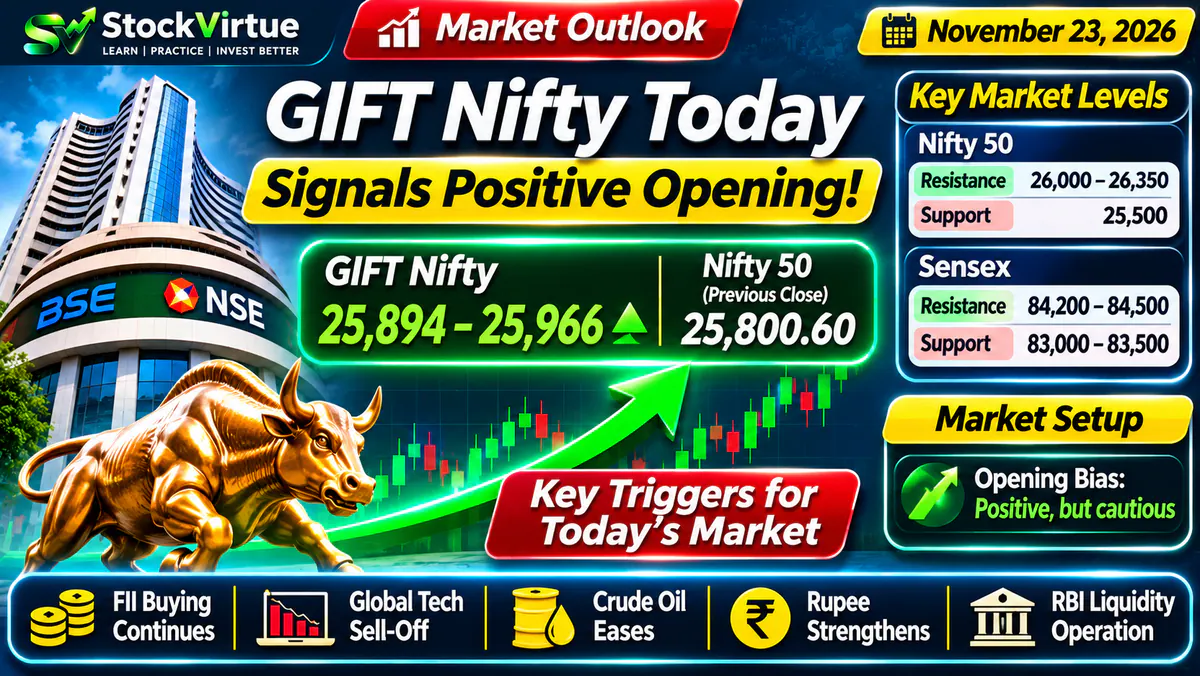
GIFT Nifty indicates a potentially higher opening for Indian equities as foreign investor buying and easing crude prices support sentiment. However, global technology-stock weakness and falling Asian markets could limit the upside.
The Indian stock market is preparing for a potentially positive start on Monday, November 23, 2026, with GIFT Nifty indicating an upward opening for the Nifty 50 and Sensex.
Early morning market reports showed GIFT Nifty trading at different levels between approximately 25,894 and 25,966. These readings represented a premium over the previous Nifty 50 closing level of 25,800.60, suggesting positive opening sentiment.
However, the outlook remains mixed. Foreign institutional investor (FII) buying, a stronger rupee and easing crude oil prices are providing support to Indian equities. On the other hand, Asian markets are under pressure following Friday's sharp sell-off on Wall Street, driven by concerns about technology valuations and artificial intelligence-related investments.
Investors will also monitor institutional flows, the RBI's liquidity operation, commodity prices and upcoming economic data during this holiday-shortened trading week.
1. GIFT Nifty Today: What Does It Indicate for the Indian Market?
GIFT Nifty is an important early indicator watched by traders before the Indian equity market opens.
On November 23, early reports showed the futures contract trading higher:
Market indicator | Reported level |
|---|---|
GIFT Nifty – early snapshots | 25,894–25,966 |
Previous Nifty 50 close | 25,800.60 |
Implied market sentiment | Positive |
Expected opening direction | Potential gap-up |
The different GIFT Nifty readings were recorded at different times during the morning. They should not be interpreted as one simultaneous market quote.
A positive GIFT Nifty reading generally indicates that traders expect a higher opening for Indian benchmark indices. However, it does not guarantee that the Nifty will sustain gains throughout the trading session.
The actual opening will also depend on pre-open orders, overnight developments, institutional activity and changes in global market sentiment.
2. How Did Sensex and Nifty Perform on Friday?
Indian benchmark indices finished Friday's session, November 20, with strong gains, extending their winning streak to four consecutive weeks.
Index | Friday closing level | Daily gain |
|---|---|---|
Nifty 50 | 25,800.60 | 1.12% |
Sensex | 83,919.71 | 1.08% |
The Nifty gained 286.30 points, while the Sensex advanced 897.96 points.
Banking, information technology and realty shares contributed to the domestic market's recovery.
The Nifty's return above 25,800 was particularly important because the index had experienced consolidation before its latest upward move.
The positive weekly performance suggests that domestic buying interest remained strong despite weakness in international technology shares.
3. Five Major Factors That Could Influence the Market Today
A. Foreign institutional investors continue buying
Foreign institutional investors extended their buying streak to the ninth consecutive trading session on November 20.
According to provisional exchange data, FIIs purchased equities worth approximately ₹10,308 crore on Friday.
Domestic institutional investors, meanwhile, were net sellers of approximately ₹4,860 crore.
This difference between foreign and domestic institutional activity is important because institutional flows can influence market liquidity and short-term sentiment.
Reuters also reported substantial foreign investment into Indian equities during November, with overseas investors redirecting some capital towards India amid the global technology-stock sell-off.
However, investors should remember that institutional flows can change quickly and should not be treated as a guaranteed indicator of future market direction.
B. Global technology-stock sell-off creates uncertainty
US equity markets experienced a sharp decline on Friday, November 20.
US index | Friday closing level | Daily change |
|---|---|---|
Dow Jones | 48,147.33 | -1.93% |
S&P 500 | 6,910.42 | -3.70% |
Nasdaq Composite | 22,617.73 | -5.28% |
Technology shares experienced particularly strong selling pressure.
Concerns surrounding artificial intelligence valuations, technology investment spending and the sustainability of earnings expectations contributed to the decline.
The weakness may affect Indian IT stocks because many domestic technology companies depend on spending by international clients.
However, a fall in US technology stocks does not automatically mean every Indian IT company will decline. Company-specific earnings, valuations and business outlook remain important.
C. Asian markets open under pressure
Asian equities started Monday's session on a weak note following the Wall Street sell-off.
South Korea's Kospi declined approximately 2.34%–3.17% in early reports, while the Kosdaq also recorded losses. Japan's equity market remained closed for a public holiday.
Weak Asian market performance could create volatility during India's opening session.
Traders should watch whether Asian markets recover or extend their losses as the Indian market begins trading.
D. Crude oil prices remain an important factor
Crude oil prices have moderated from recent levels, offering potential support to India's macroeconomic outlook.
Early November 23 reports placed Brent crude around $91.80–$91.83 per barrel and WTI crude near $82.93 per barrel.
India is a major crude oil importer. Lower international oil prices can potentially reduce import costs and ease inflationary pressure.
However, geopolitical developments, supply disruptions and currency movements can quickly change the direction of crude oil prices.
E. Indian rupee and US bond yields
The Indian rupee closed at approximately ₹92.67 against the US dollar on Friday, November 20.
Reuters reported that the rupee had strengthened by around 1.7% during the previous week, supported by foreign investment inflows and dollar selling.
A stronger rupee can support foreign investor returns when investments are converted back into other currencies. It may also help reduce some imported inflation pressures.
Investors will continue monitoring the dollar index, US Treasury yields and movements in the rupee during the week.
4. Nifty 50 Technical Analysis: Support and Resistance Levels
The Nifty 50 closed at 25,800.60 on Friday after breaking above the important 25,500 area.
Technical market commentary published ahead of Monday's session indicates that the broader short-term trend remains positive.
The following levels can help traders organise their market observations:
Technical level | Nifty 50 |
|---|---|
Immediate support | 25,500 |
Important lower reference | 25,000 |
Immediate upside objective | 26,000 |
Next resistance zone | 26,300–26,350 |
Bullish scenario
If the Nifty sustains above 25,800 and buying continues, traders may watch the 26,000 psychological level.
A decisive move above 26,000 could bring the 26,300–26,350 area into focus.
Strong participation from banking and other heavyweight stocks could support this scenario.
Bearish scenario
If global weakness creates selling pressure, the Nifty may struggle to sustain gains after a positive opening.
A move back below 25,800 could indicate that opening momentum is weakening.
The 25,500 area remains an important support reference. A sustained move below it would require traders to reassess the positive technical outlook.
These are reference levels from pre-market technical commentary, not guaranteed trading signals.
5. Sensex Technical Levels for November 23
The Sensex closed Friday at 83,919.71, gaining 897.96 points.
Market technical commentary identified the following important areas:
Level | Sensex |
|---|---|
Immediate support zone | 83,000–83,500 |
Immediate resistance zone | 84,200–84,500 |
A sustained move above 84,200 could strengthen the near-term bullish structure.
On the downside, the 83,000–83,500 zone will be important if selling pressure increases.
6. Banking Stocks: Will Nifty Bank Continue Its Rally?
Banking shares have played an important role in the recent Indian market recovery.
The Nifty Bank index gained approximately 5.90% during the previous trading week, making it one of the stronger sectoral performers.
Investors may monitor:
Large private-sector banks.
Public-sector banking stocks.
Credit growth and deposit mobilisation.
Net interest margins.
Asset quality and provisioning.
Institutional buying activity.
Banking stocks may continue to influence the broader market because of their significant weight in benchmark indices.
However, traders should avoid assuming that the previous week's sectoral rally will automatically continue.
7. Important Economic Events and Market Calendar
The current trading week is shorter because Indian equity markets will remain closed on Tuesday, November 24, for Prakash Gurpurb Sri Guru Nanak Dev.
Important developments to monitor include:
Date | Event |
|---|---|
November 23 | HSBC Flash India PMI |
November 23 | RBI Variable Rate Repo auction |
November 24 | Indian equity market holiday |
November 25 | Trading resumes |
November 27 | End of the trading week |
The Reserve Bank of India has scheduled a four-day Variable Rate Repo auction with a notified amount of ₹50,000 crore on November 23.
The auction is a liquidity-management operation. It should not be confused with a change in the RBI policy interest rate.
Investors will also monitor upcoming inflation and economic growth data, along with expectations surrounding the RBI's December monetary policy decision.
8. Stocks and Sectors to Watch Today
The following stocks and sectors may attract attention because of recent developments and broader market conditions.
Stock or sector | Reason to monitor |
|---|---|
Banking stocks | Strong weekly sector performance |
Indian IT companies | Global technology-stock weakness |
Oil and gas | Changes in international crude prices |
Tata Steel | Proposed business transactions with APL Apollo |
APL Apollo Tubes | Proposed acquisition of Tata Steel businesses |
IndusInd Bank | Latest corporate governance announcement |
These are news-based watchlist candidates, not recommendations to buy or sell.
9. How Should Traders Approach Today's Market?
A positive GIFT Nifty indication can create expectations of a gap-up opening, but traders should avoid making decisions solely on pre-market futures prices.
A disciplined approach may include:
Observe the actual Nifty and Sensex opening.
Compare the opening level with Friday's closing prices.
Monitor whether the Nifty sustains above 25,800.
Watch the 25,500 support area and 26,000 psychological resistance.
Monitor banking stocks and heavyweight index constituents.
Check whether trading volume supports the market move.
Keep global technology sentiment and crude oil movements in view.
Define risk before placing any trade.
A gap-up opening followed by strong buying participation may indicate positive momentum. However, a gap-up followed by heavy selling can produce a gap-fill or reversal.
Traders should therefore wait for price confirmation instead of chasing the first move.
Conclusion: Will Nifty Continue Its Rally Today?
GIFT Nifty is signalling a potentially positive start for Indian equities on November 23, supported by foreign investor buying, a stronger rupee and relatively softer crude oil prices.
However, global technology-stock weakness and pressure in Asian markets introduce uncertainty.
For the Nifty 50, 25,800 remains an important reference level, while 25,500 is a key support area. On the upside, traders will monitor 26,000 and the 26,300–26,350 zone.
The banking sector's performance, institutional flows and global market recovery will be important factors in determining whether the domestic rally can continue.
The key message for traders today: A positive GIFT Nifty reading indicates opening sentiment, not a guaranteed market direction. Watch the actual market opening, volume and price confirmation before making trading decisions.