Gold & Silver
Gold and Silver Under Pressure: Strong US Dollar and Fed Rate Hike Bets Trigger Bullion Sell-Off
Gold and silver extend losses as a stronger US dollar and Fed rate hike expectations pressure bullion. Check MCX prices and the outlook for Indian investors.
Gold and silver prices have come under significant pressure in international and domestic commodity markets, with a stronger US dollar, rising Treasury yields and expectations of further interest-rate tightening by the US Federal Reserve weighing on precious metals.
Gold recorded its third consecutive daily decline on Thursday, November 12, touching its lowest level in more than a year. Silver also witnessed substantial selling, extending its recent losses.
However, Friday's trading brought some relief as investors started buying gold after the sharp correction. The recovery has not yet erased the week's losses, leaving traders cautious about the near-term direction of bullion.
For Indian investors, the decline is particularly important because international gold and silver prices influence domestic bullion rates and MCX futures.
1. Why are gold and silver prices falling?
The recent correction in precious metals is being driven by a combination of US economic data, currency movements and changing expectations about Federal Reserve policy.
Three major factors are influencing the market.
Stronger US dollar
The US dollar has strengthened considerably, approaching its highest level in approximately 19 months.
Gold and silver are internationally priced in US dollars. When the dollar becomes stronger, precious metals become relatively more expensive for buyers using other currencies.
This can reduce international demand and put pressure on bullion prices.
Higher US Treasury yields
Gold and silver do not generate regular interest payments.
When government bond yields increase, investors may find interest-bearing assets more attractive compared with holding precious metals.
This can reduce investment demand for bullion, particularly when expectations of higher interest rates increase.
Expectations of another Federal Reserve rate hike
Higher-than-expected US inflation data and hawkish comments from Federal Reserve officials have increased expectations of further monetary tightening.
Markets have been pricing in a possible December rate increase, creating additional uncertainty for gold and silver investors.
The next important signals are expected from US producer-price data and further comments from Federal Reserve policymakers.
2. International gold and silver prices: Latest developments
On Thursday, November 12, international bullion prices experienced a sharp decline.
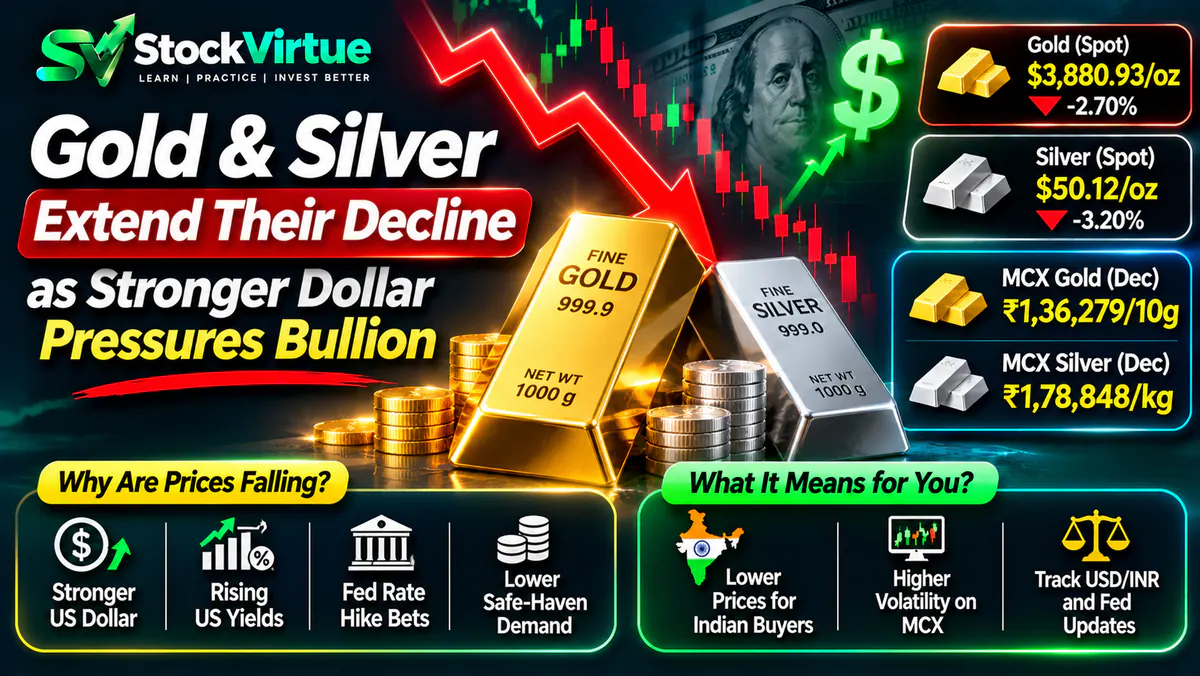
According to Reuters, spot gold fell approximately 2.7% to $3,880.93 per ounce during Thursday's trading, after touching its lowest level since October 2025.
US gold futures for December delivery settled approximately 2.9% lower at $3,885.30 per ounce.
Silver also witnessed significant selling pressure.
International bullion market
Commodity | Thursday's reported movement |
|---|---|
Spot gold | Around $3,880.93/oz |
US gold futures | $3,885.30/oz |
Spot silver | Around $50.12/oz |
Spot platinum | Around $1,518.49/oz |
On Friday, November 13, gold recovered approximately 1% as investors bought after the sharp decline. Reuters reported spot gold around $3,915.31 per ounce during Friday's trading.
Despite this recovery, gold remained down approximately 3.5% for the week.
Silver also recovered from its intraday lows but remained under pressure on a weekly basis.
The rebound suggests that some investors are attempting to take advantage of lower prices, although it is too early to conclude that the broader correction has ended.
3. MCX gold and silver prices: What happened in India?
The domestic commodity market also witnessed selling pressure, particularly in silver futures.
On Thursday, November 12, MCX December gold futures closed at approximately ₹1,36,279 per 10 grams.
MCX December silver futures settled at approximately ₹1,78,848 per kilogram.
A separate commodity-market closing report recorded gold at ₹1,36,225 and silver at ₹1,78,724. Small differences can arise from contract selection and reporting snapshots.
MCX bullion prices
Commodity | November 12 reported close |
|---|---|
Gold futures | Around ₹1,36,279 per 10 grams |
Silver futures | Around ₹1,78,848 per kilogram |
Silver experienced a particularly sharp decline, reflecting its sensitivity to both investment demand and industrial-market expectations.
Domestic prices can differ from international movements because of the USD/INR exchange rate, import duties, local premiums, taxes and contract specifications.
These figures represent reported previous-session prices, not live MCX quotations.
4. Why is gold falling even when inflation is high?
Gold is traditionally considered a store of value and a potential hedge against inflation.
However, its relationship with inflation is not always straightforward.
When inflation rises, central banks may respond by maintaining higher interest rates or increasing borrowing costs.
If investors expect interest rates to remain elevated, the opportunity cost of holding gold increases because the metal does not provide interest income.
This is what makes the current situation important.
Higher energy prices have increased concerns about future inflation, while stronger US inflation data has encouraged expectations of tighter monetary policy.
Consequently, the same inflation concerns that might normally support gold as a hedge are currently contributing to pressure on bullion through interest-rate expectations and dollar strength.
5. What does the correction mean for Indian gold buyers?
The decline in international gold prices can create opportunities for Indian jewellery buyers and investors, but domestic prices do not always fall at the same rate.
Several factors influence the final price in India:
International gold prices.
The USD/INR exchange rate.
Import duties and applicable taxes.
Domestic premiums and supply conditions.
Jewellery making charges and retailer margins.
A weaker rupee can partially offset a decline in international gold prices.
For example, if international gold becomes cheaper but the rupee weakens against the dollar, the reduction in domestic gold prices may be smaller.
Buyers should therefore compare local retail prices rather than relying only on international gold quotations.
6. What should MCX gold and silver traders watch?
The recent volatility makes the precious-metals market important for commodity traders.
However, traders should monitor several indicators instead of reacting only to daily price movements.
US dollar index: A stronger dollar can continue to put pressure on international bullion prices.
US Treasury yields: Rising yields may reduce the appeal of non-interest-bearing precious metals.
Federal Reserve commentary: Any change in expectations about December interest rates could trigger sharp price movements.
US producer-price data: The latest inflation-related data could influence expectations about future monetary policy.
USD/INR exchange rate: Currency movements can affect domestic MCX gold and silver prices.
International gold and silver demand: Investment flows, central-bank purchases and industrial demand can influence the longer-term direction.
Important risk for futures traders
Gold and silver futures are leveraged instruments. Even a small price movement can create a substantial profit or loss depending on contract size and margin.
Traders should also check the applicable MCX contract expiry, lot size, margin requirements and exchange specifications before entering a position.
7. Is this a buying opportunity or the beginning of a bigger correction?
The latest recovery in gold suggests that some investors are willing to buy after the sharp decline.
However, a short-term rebound does not necessarily indicate that the market has established a bottom.
The direction of bullion prices will depend on whether the US dollar remains strong, Treasury yields continue rising and the Federal Reserve maintains a hawkish policy outlook.
If interest-rate expectations moderate and the dollar weakens, gold and silver could receive support.
On the other hand, stronger inflation data or further expectations of monetary tightening could extend the correction.
Investors should distinguish between short-term price movements and the long-term role of precious metals in a diversified portfolio.
8. Key events to watch next
The following developments could influence precious metals during the coming sessions:
US producer-price inflation data.
Federal Reserve officials' comments on future interest rates.
Movements in the US dollar index.
Changes in US Treasury yields.
International crude oil prices and geopolitical developments.
Domestic rupee movements.
Gold and silver investment demand.
These factors will help determine whether the latest recovery develops into a more sustained rebound or remains a temporary reaction after heavy selling.
StockVirtue Commodity Market Takeaway
Gold and silver are experiencing a significant correction as a stronger US dollar, higher Treasury yields and expectations of further Federal Reserve tightening reduce the appeal of precious metals.
Gold's recovery on Friday indicates that bargain hunting has emerged after the sharp decline. However, both metals remain under pressure on a weekly basis.
For Indian investors, the impact will depend not only on international bullion prices but also on the rupee, domestic premiums and applicable taxes.
For MCX traders, the current environment calls for careful monitoring of currency movements, US economic data and Federal Reserve expectations.
The key question for the coming sessions is whether the Friday recovery can develop into a sustained rebound or whether bullion will face another round of selling pressure.
StockVirtue — Learn | Practice | Invest Better