Commodity Market
Crude Oil Climbs Above $95: What It Means for India's Economy and MCX Traders
Brent crude climbs above $95. Understand the impact on India's economy, inflation, rupee, oil stocks and MCX crude oil traders.

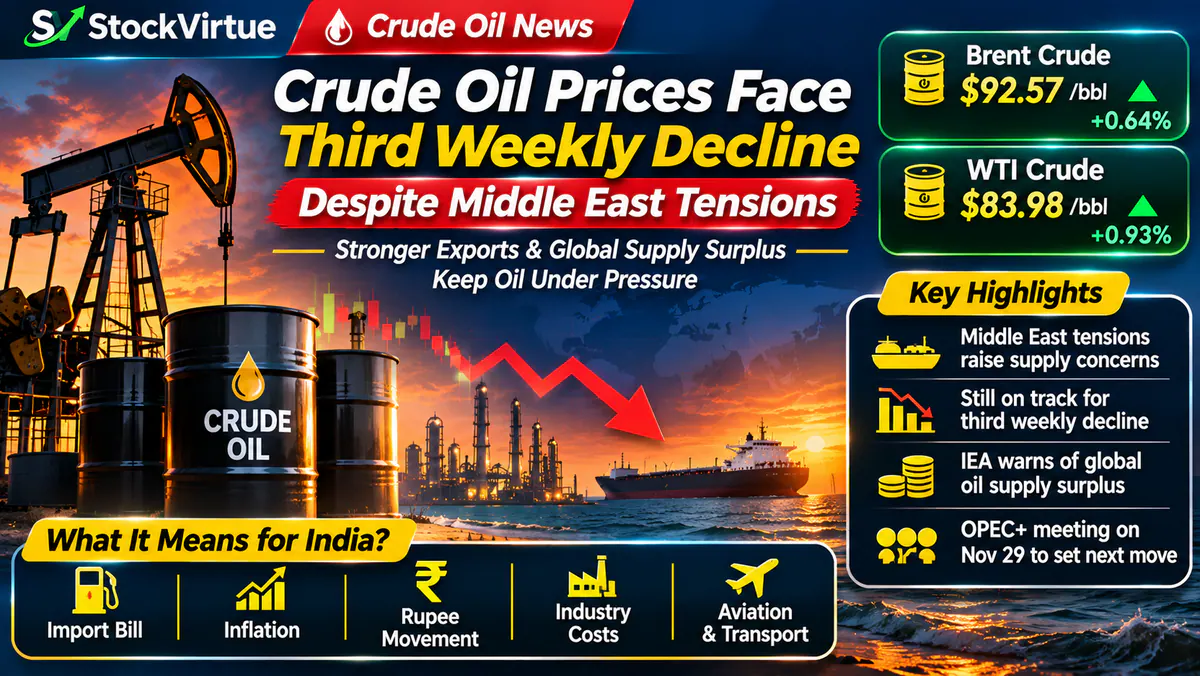
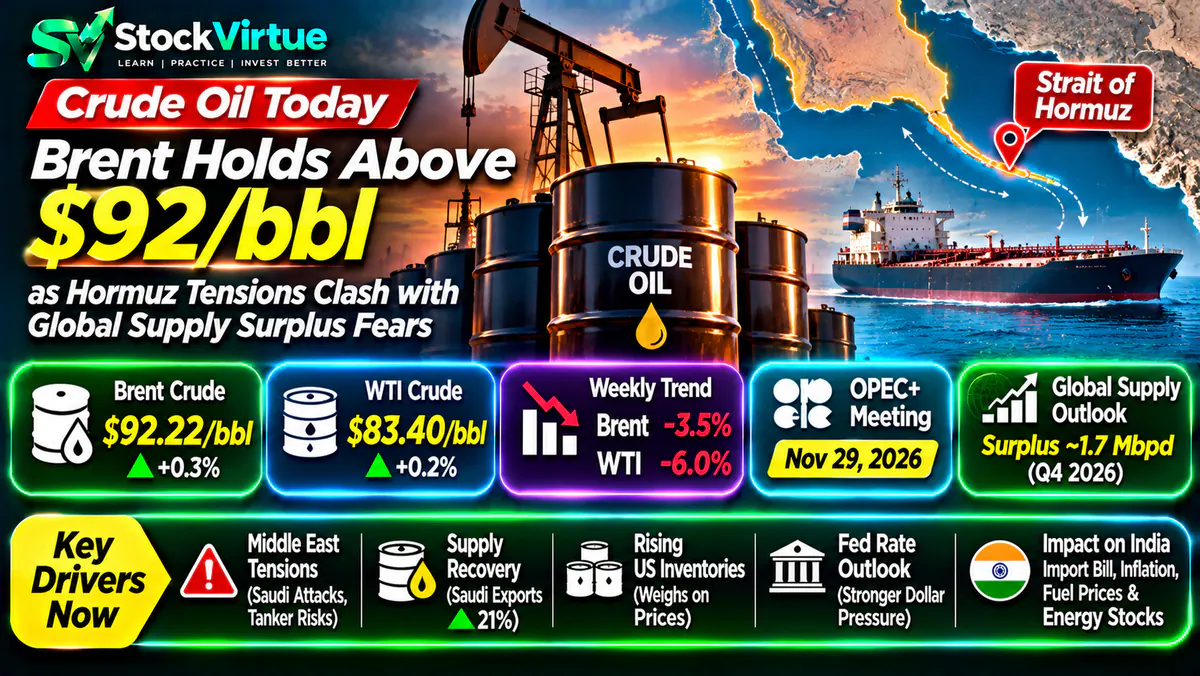
International crude oil prices have moved back above $95 per barrel, bringing India's energy costs and commodity markets into focus. Fresh geopolitical tensions in the Middle East, concerns about disruptions to oil shipments and uncertainty surrounding the US-Iran conflict have contributed to renewed volatility in global energy prices.
Brent crude futures settled at $95.82 per barrel on Thursday, November 12, gaining 3.3% during the session. US West Texas Intermediate (WTI) crude settled at $88.74, up approximately 2.6%.
On Friday morning, Brent was trading around $95.40–$95.70, while WTI was near $88.40–$88.50.
For India, which relies heavily on imported crude oil, sustained price increases could affect the import bill, inflation, the rupee and the operating costs of several industries.
The movement is also important for traders on the Multi Commodity Exchange (MCX), where domestic crude oil futures respond to international prices, currency movements and changes in market expectations.
1. Why has crude oil moved above $95?
The latest increase in crude oil prices is linked primarily to renewed supply concerns in the Middle East.
Reports of attacks involving Saudi energy infrastructure and vessels in the Strait of Hormuz have raised concerns about the security of oil production and transportation routes.
The situation has become more complicated amid the continuing US-Iran conflict.
The Strait of Hormuz is one of the world's most important energy shipping routes. A prolonged disruption could affect the movement of crude oil and petroleum products from major Gulf producers to international markets.
Three developments are particularly important:
Middle East tensions: Reports of attacks on energy infrastructure and shipping have increased concerns about potential supply disruptions.
Strait of Hormuz risks: Any interruption to tanker movements through this strategic waterway could affect international oil availability.
Uncertain diplomatic outlook: Conflicting signals about negotiations and the future of the conflict have made it difficult for traders to assess how quickly supply conditions could normalise.
However, the latest rebound should be viewed in context. Reuters reported that Brent was still heading for a second consecutive weekly decline, indicating that the broader market remains volatile rather than moving in a clear upward trend.
2. Latest crude oil prices: Brent, WTI and MCX
International crude prices and domestic MCX futures are connected, but they are not identical.
The international benchmarks are quoted in US dollars per barrel, while MCX crude oil futures are quoted in Indian rupees per barrel.
International crude oil prices
Benchmark | November 12 settlement |
|---|---|
Brent crude | $95.82/barrel |
WTI crude | $88.74/barrel |
MCX crude oil market
The November 19, 2026 MCX crude oil futures contract was trading around ₹8,302 per barrel at approximately 8:51 AM IST on November 13.
MCX indicator | Reported value |
|---|---|
Contract expiry | November 19, 2026 |
Price | ₹8,302/barrel |
Previous close | ₹8,184 |
Change | +₹118 |
Percentage change | +1.44% |
Trading volume | 51,494 contracts |
These are time-specific market observations, not closing prices for November 13. Prices can change throughout the trading session.
3. Why does rising crude oil matter so much for India?
India is one of the world's major crude oil importers. Consequently, international oil prices have a direct connection with the country's economic conditions.
When crude prices rise, Indian oil-importing companies may have to spend more on purchasing energy from overseas suppliers.
The impact can extend across several areas of the economy.
Higher import bill
More expensive crude oil increases the cost of India's energy imports, particularly if higher prices continue over an extended period.
This can put pressure on the country's trade balance and current account.
Pressure on the Indian rupee
Higher oil import expenses can increase demand for foreign currency to pay international suppliers.
If this contributes to sustained external-sector pressure, it may weigh on the rupee, although currency movements also depend on capital flows, global dollar strength and other factors.
Inflation concerns
Crude oil is an important input for transportation, manufacturing, aviation, logistics and several industrial activities.
Higher energy costs can gradually increase the prices of goods and services, depending on how much of the additional cost businesses pass on to consumers.
Impact on economic growth
If energy costs remain elevated, businesses may face higher operating expenses, while households may have less money available for discretionary spending.
The overall economic impact depends on the duration of the price increase, government policy and the extent to which companies absorb or pass on higher costs.
4. Which Indian sectors could be affected by rising crude oil?
Crude oil price movements do not affect every industry in the same way. Some companies may benefit from higher prices, while others could face pressure on their operating margins.
Sector | Possible impact |
|---|---|
Oil marketing companies | Higher crude procurement costs can affect marketing margins if selling prices do not adjust sufficiently |
Aviation | Higher aviation turbine fuel costs can increase operating expenses |
Paint companies | Petroleum-linked raw materials can influence production costs |
Tyre manufacturers | Synthetic rubber and other petroleum-linked inputs may become more expensive |
Chemicals | Higher feedstock and energy costs can affect margins |
Logistics | Higher diesel and transportation expenses can increase operating costs |
Upstream oil producers | Higher realised crude prices can support revenue, subject to production and other factors |
Investors should examine individual company results rather than assuming that every company in a sector will respond identically.
5. MCX crude oil trading: How does international oil affect Indian futures?
MCX crude oil futures provide Indian market participants with a way to trade price movements in crude oil without purchasing physical barrels.
The domestic contract is influenced by several factors:
International crude prices: Brent and WTI movements provide important global price signals.
USD/INR exchange rate: Since international crude is priced in US dollars, currency movements influence its rupee equivalent.
Global supply and demand: Production decisions, inventories, refinery demand and consumption trends influence prices.
Geopolitical developments: Conflict, sanctions and shipping disruptions can create sudden price movements.
Market positioning: Futures trading activity, open interest and changes in trader expectations can contribute to volatility.
Understanding the MCX crude oil contract
The standard MCX Crude Oil futures contract has a lot size of 100 barrels, while the Crude Oil Mini contract has a smaller lot size of 10 barrels.
For illustration, if the standard contract is priced at ₹8,300 per barrel:
100 barrels × ₹8,300 = ₹8,30,000 contract value.
This is the approximate notional value of one standard contract, not the amount a trader necessarily pays upfront. Futures trading generally requires margin, and the margin requirement can change.
The smaller Mini contract has an approximate notional value of ₹83,000 at the same illustrative price.
Always verify the current exchange contract specifications, expiry, margin and applicable charges before trading.
6. What should MCX crude oil traders watch?
The current market environment requires attention to both international developments and domestic trading conditions.
Here are some important factors to monitor:
Brent crude near $95: A sustained move above this area could keep international energy markets sensitive to supply-related headlines. It is not, by itself, a confirmed breakout signal.
MCX crude around ₹8,300: The November contract was trading near this level in early Friday observations. Traders should use updated exchange prices rather than treating the early quote as a current live price.
USD/INR movement: A weaker rupee can increase domestic crude prices even when international prices remain relatively stable.
US crude inventories: Changes in weekly inventory data can influence expectations about supply and demand.
Middle East developments: Any confirmed disruption or restoration of shipping and production could lead to sharp price adjustments.
Contract expiry: The November 19, 2026 MCX crude contract is approaching expiry. Traders should monitor rollover activity and avoid confusing prices from different contract months.
7. Could crude oil reach $100 again?
The possibility of crude oil moving towards $100 cannot be ruled out, particularly if supply disruptions intensify.
However, the market also faces factors that could limit further gains.
A reduction in geopolitical tensions, improved shipping conditions, stronger supply availability or weaker global demand could put downward pressure on prices.
Goldman Sachs has reportedly highlighted a significant upside risk under a severe supply-disruption scenario, including a potential Brent price of $140 per barrel in 2027 if Gulf oil production remains substantially below its 2025 average.
This is a conditional scenario, not a central forecast or a guaranteed price target.
For traders and investors, the important distinction is between a temporary geopolitical price spike and a sustained change in the global supply-demand balance.
8. What investors should watch next
Over the coming sessions, the following developments may influence crude oil and the broader Indian market:
Whether Brent crude can sustain levels above $95.
Whether tensions in the Strait of Hormuz affect actual oil shipments.
Whether international crude inventories continue to rise or fall.
Whether the Indian rupee faces additional pressure.
Whether domestic fuel prices change.
Whether MCX crude futures experience increased volume and open interest.
Whether the global demand outlook changes.
These indicators can help investors understand whether the current price movement is driven mainly by geopolitical risk, physical supply conditions or broader commodity-market positioning.
StockVirtue Commodity Market Takeaway
Crude oil moving above $95 per barrel is an important development for India because energy prices influence inflation, imports, currency movements and corporate operating costs.
For MCX traders, the recent volatility creates opportunities as well as risks. International benchmark prices, the rupee, inventory data and geopolitical developments can all influence domestic crude futures.
However, traders should remember that commodity futures are leveraged instruments. A relatively small price movement can create a significant profit or loss depending on position size and margin.
Rather than reacting to every headline, market participants should understand the underlying supply-demand situation, follow exchange contract specifications and manage risk carefully.
StockVirtue — Learn | Practice | Invest Better