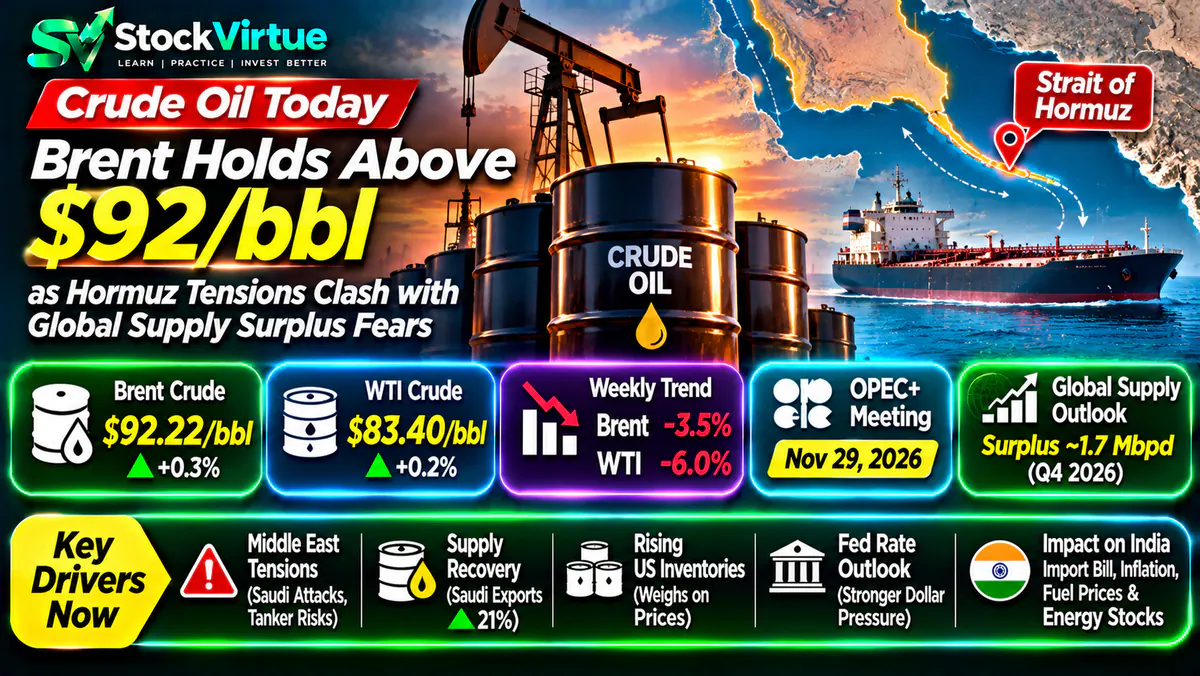
Crude Oil & Energy
Crude Oil Prices Face Third Weekly Decline Despite Middle East Tensions: Brent Near $93, WTI Around $84
Crude oil prices recover but head for a third weekly decline as Middle East tensions, stronger exports and global supply surplus expectations shape the market.
The global crude oil market is facing two opposing forces: geopolitical uncertainty in the Middle East and growing expectations of stronger oil supplies.
On Friday, November 20, crude oil prices recovered modestly as renewed concerns about shipping disruptions and regional security supported buying. However, the recovery was not sufficient to prevent Brent and US West Texas Intermediate (WTI) futures from heading towards their third consecutive weekly decline.
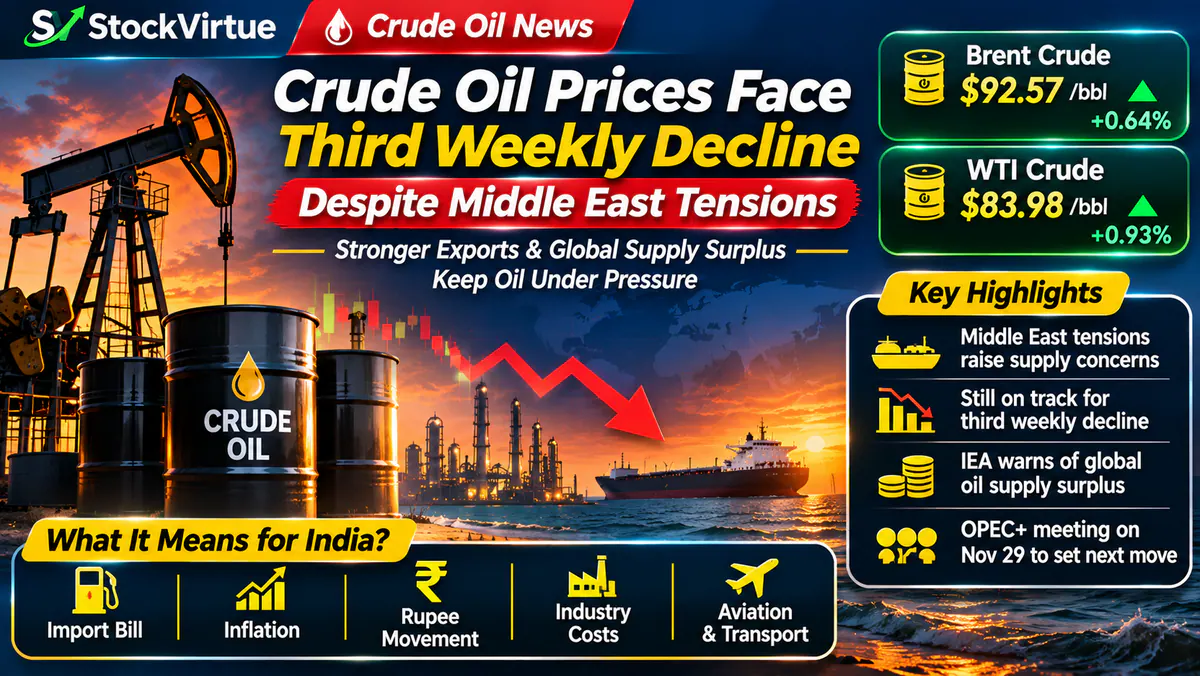
Brent crude settled at approximately $92.57 per barrel, while US WTI finished at $83.98 per barrel. Despite the Friday recovery, both benchmarks remained under pressure as investors assessed improving Middle Eastern export flows and forecasts of a potential global supply surplus.
For India, which imports a substantial portion of its crude oil requirements, these developments matter beyond commodity trading. Changes in international oil prices can influence the import bill, inflation, the rupee, fuel costs and the profitability of several industries.
Here is a closer look at what is driving crude oil prices and what traders and investors should monitor next.
1. Crude Oil Prices Recover on Friday, but Weekly Trend Remains Weak
Oil prices moved higher during Friday's trading session as traders reacted to fresh geopolitical concerns and adjusted their positions ahead of the US Thanksgiving holiday.
The latest reported settlement prices were:
Crude oil benchmark | November 20 settlement | Daily change |
|---|---|---|
Brent crude | $92.57/barrel | +0.64% |
US WTI crude | $83.98/barrel | +0.93% |
Source: Reuters, November 20, 2026. Prices are Friday settlement figures, not live quotations.
The daily recovery followed a period of selling pressure that had pushed both benchmarks lower.
According to Reuters, Brent was heading for a weekly decline of approximately 4%, while the December WTI contract was on course to lose around 5%.
The two benchmarks were facing a third consecutive weekly decline.
This difference between daily and weekly performance is important. A positive trading session does not necessarily indicate that the broader market trend has reversed.
Oil traders are therefore watching whether the recovery can continue or whether the market returns to its recent downward direction.
2. Middle East Tensions Create Fresh Supply Concerns
Geopolitical developments remain one of the biggest sources of uncertainty for crude oil.
On November 20, Reuters reported renewed concerns following Houthi attacks on Saudi Arabia's capital, Riyadh, along with reports of tanker disruptions in the Strait of Hormuz.
Iran also reported that two tankers had struck naval mines in the Strait. These claims were reported by Iranian state media, but Reuters said it could not independently verify the report.
These developments attracted attention because the Middle East is one of the world's most important oil-producing and exporting regions.
Any disruption to major shipping routes could affect the movement of crude oil to international buyers.
Why is the Strait of Hormuz so important?
The Strait of Hormuz is a narrow maritime passage connecting the Persian Gulf with the Gulf of Oman and the Arabian Sea.
Major oil-producing countries use this route to transport crude oil and petroleum products to international markets.
A prolonged interruption could create:
Delays in crude oil deliveries.
Higher tanker insurance costs.
Increased shipping expenses.
Greater uncertainty for refineries.
Additional upward pressure on oil prices.
However, geopolitical tensions do not automatically produce a sustained price increase.
The actual effect depends on whether shipments are disrupted, how long the disruption lasts and whether other producers can compensate for missing supplies.
3. Stronger Middle Eastern Oil Exports Are Limiting Price Gains
While geopolitical developments are creating supply concerns, actual export flows are providing an important counterweight.
Reuters reported that crude shipments through the Strait of Hormuz had recovered to approximately pre-war levels, helping increase expectations of sufficient global supplies.
This is one of the main reasons oil prices remained weak despite renewed security concerns.
When more crude reaches international markets, buyers have greater access to supply. If production and exports increase faster than consumption, prices may face downward pressure.
The market is therefore evaluating two different developments:
Geopolitical risk: Potential shipping disruptions could reduce available supply and support higher prices.
Stronger export flows: Increased deliveries could ease supply tightness and limit price gains.
The balance between these forces will be important in determining the next major move in crude oil.
4. IEA Warns of a Potential Global Oil Supply Surplus
The International Energy Agency's November 2026 Oil Market Report provides another important part of the current market picture.
The IEA reported a significant increase in global oil supply during October.
According to the report:
Global oil supply rose by 2.3 million barrels per day to 105.4 million barrels per day in October.
Global supply had increased by 5.3 million barrels per day since August.
Oil demand was forecast to decline by 2.7 million barrels per day in 2026 to 102.3 million barrels per day.
The IEA expected global supply to reach an average of 108.1 million barrels per day in 2027.
The agency also indicated that the global oil market could return to a surplus in the fourth quarter of 2026, with a larger surplus expected in 2027 under its November forecast.
What does an oil supply surplus mean?
A supply surplus occurs when the quantity of oil available exceeds the amount being consumed over a given period.
For example, imagine:
Daily oil supply: 105 million barrels.
Daily oil demand: 103 million barrels.
The market would have an indicative surplus of 2 million barrels per day.
When surplus conditions persist, additional crude may accumulate in storage or remain available for future delivery.
This can reduce buying pressure and place downward pressure on benchmark prices.
However, supply-demand forecasts are estimates. Actual market conditions can change because of geopolitical events, production decisions, economic activity and unexpected disruptions.
5. Why Are Oil Prices Falling Despite Geopolitical Risks?
This is one of the most important questions facing crude oil traders.
Normally, serious supply-disruption concerns can push crude oil higher because buyers become worried about future availability.
But the market is not driven by geopolitical news alone.
Several factors are currently influencing prices:
A. Rising global supply
The IEA's November report showed that global oil supply increased substantially during October.
Higher production and exports can reduce concerns about shortages.
B. Improving Middle Eastern exports
The recovery in crude shipments through the Strait of Hormuz has reduced some of the immediate supply concerns.
C. Weak demand expectations
The IEA's forecast of falling global oil demand in 2026 has added to concerns about the balance between production and consumption.
D. Inventory expectations
Higher availability of crude can support inventory rebuilding. Rising inventories often indicate that supply is exceeding immediate consumption requirements.
E. Financial-market positioning
Traders also respond to expectations, existing positions and changes in risk appetite.
When many market participants expect prices to decline, selling pressure can continue even when short-term geopolitical developments create temporary buying opportunities.
The combination of these factors explains why oil can experience a short-term recovery while remaining in a broader weekly downtrend.
6. Russian Oil Refining Disruptions Add Another Supply Risk
Russia remains an important participant in the international energy market.
Reuters reported on November 20 that Ukrainian attacks had reduced Russian refinery crude-processing volumes by approximately 45% since late October.
Disruptions to refinery operations can influence the availability of refined petroleum products such as diesel and gasoline.
However, a reduction in refining activity does not necessarily translate into an equal reduction in crude oil production.
The effect depends on whether crude that is not processed is stored, exported, redirected to other facilities or remains unproduced.
This distinction matters because crude oil and refined petroleum products are different markets.
A disruption in refining can tighten diesel or gasoline supplies even when crude oil remains relatively well supplied.
For traders, monitoring both crude production and refinery activity provides a more complete understanding of the energy market.
7. What Could OPEC+ Decide at Its November 29 Meeting?
The next important event for oil traders is the upcoming OPEC+ ministerial meeting scheduled for November 29, 2026.
OPEC+ decisions can influence the global oil market because participating producers collectively account for a significant portion of international crude supply.
The group will need to consider several competing factors:
Current global supply levels.
Demand growth expectations.
Inventory movements.
Geopolitical disruptions.
Production capacity.
The outlook for 2027.
If producers decide to limit output, the market could receive additional price support.
If production policy allows more supply to enter the market while demand remains weak, prices could face additional pressure.
However, traders should wait for official decisions rather than assuming that a particular production adjustment will be announced.
The November 29 meeting is therefore an important event to monitor, particularly because the market is already debating the possibility of a supply surplus.
8. What Does the Crude Oil Outlook Mean for India?
India is highly sensitive to international crude oil prices because it imports a large share of its petroleum requirements.
When international crude prices rise, the cost of importing energy can increase.
When prices decline, some of that pressure may ease.
However, the effect on Indian consumers and companies is not always immediate because domestic fuel pricing depends on several other factors.
A. India's import bill
A sustained increase in crude oil prices can raise India's expenditure on imported energy.
This may affect the country's trade balance and current account.
B. Inflation
Crude oil is an important input for transportation, manufacturing and several other industries.
Higher energy costs can increase expenses across the economy.
C. Rupee movement
India's oil import requirements create demand for foreign currency.
Higher oil prices can increase the amount of foreign exchange required to purchase the same quantity of crude, although the actual exchange-rate movement depends on many factors.
D. Government finances
Changes in crude prices can affect fuel-related tax collections, subsidies and other government financial considerations.
The final impact depends on domestic pricing decisions and fiscal policy.
E. Corporate profitability
Companies across different industries may experience different effects.
Potential beneficiaries of lower crude prices can include:
Aviation companies.
Paint manufacturers.
Tyre producers.
Certain chemical companies.
Logistics and transportation businesses.
Oil exploration and production companies may face different revenue pressures when international crude prices decline.
These are general industry relationships, not guaranteed changes in individual company earnings.
9. How MCX Crude Oil Traders Should Read the Current Market
For Indian commodity traders, international Brent and WTI prices are important reference points, but MCX crude oil futures do not move in exactly the same way as either benchmark.
MCX crude oil contracts are influenced by:
International crude oil prices.
USD/INR exchange-rate movements.
Domestic trading conditions.
Contract specifications.
Expiry and settlement rules.
Market liquidity and trader positioning.
For example, international crude prices may decline while the rupee weakens against the US dollar.
The currency movement can partially offset the impact of lower dollar-denominated crude prices on the domestic commodity market.
Three things MCX crude oil traders should monitor
1. International benchmark prices
Follow Brent and WTI to understand the broader global direction.
2. Dollar-rupee exchange rate
Currency movements can influence the rupee value of internationally traded crude.
3. Supply and geopolitical developments
Watch OPEC+ announcements, Middle East shipping conditions, US inventory data and refinery activity.
Beginners should also understand contract lot sizes, tick values, margin requirements and expiry conditions before trading commodity futures.
Do not assume that an international price movement will translate into an identical percentage change in an MCX contract.
10. Three Possible Scenarios for Crude Oil Prices
The next phase of the crude oil market will depend on whether supply concerns or surplus expectations become more influential.
Scenario 1: Prices recover further
If Middle East tensions escalate and actual oil shipments are disrupted, traders may begin pricing in a greater risk of supply shortages.
This could support Brent and WTI prices.
Scenario 2: Prices remain under pressure
If exports continue recovering and global production remains strong, supply surplus concerns may dominate.
In that situation, crude oil could remain under selling pressure.
Scenario 3: Prices move within a volatile range
If geopolitical risks remain elevated but physical supply remains available, crude oil may experience sharp movements in both directions without establishing a clear trend.
This could create challenging trading conditions for participants who rely only on short-term price movements.
These are analytical scenarios, not price predictions or trading recommendations.
11. Key Crude Oil Events to Watch This Week
Event | Why it matters |
|---|---|
OPEC+ meeting – November 29 | May influence production policy and 2027 supply expectations |
Middle East shipping developments | Could affect crude export availability |
US crude inventory data | Provides information about changes in domestic oil stocks |
Global refinery activity | Influences demand for crude and availability of petroleum products |
US dollar movement | Can affect dollar-denominated commodity prices |
Global economic indicators | Help assess future oil consumption |
For investors and traders, the most important task is to distinguish between temporary market reactions and developments that actually change the physical supply-demand balance.
Conclusion: Crude Oil Faces a Battle Between Geopolitical Risk and Supply Surplus
The global crude oil market is entering an important period.
Brent and WTI recovered on November 20, but both benchmarks were heading towards a third consecutive weekly decline.
Geopolitical tensions around Saudi Arabia and the Strait of Hormuz continue to create uncertainty. At the same time, stronger Middle Eastern exports and the IEA's supply outlook are limiting the market's ability to sustain a recovery.
The upcoming OPEC+ meeting on November 29 could provide additional direction for the market.
For India, international crude oil prices remain important because of their connection with imports, inflation, currency movements and corporate costs.
StockVirtue Takeaway: Do not evaluate crude oil only through geopolitical headlines. Track actual export flows, global production, demand forecasts, inventory movements and OPEC+ decisions. The balance between physical supply and consumption is essential to understanding the direction of the oil market.