Crude Oil & Energy
Crude Oil Today: Brent Holds Above $92 as Strait of Hormuz Tensions Clash with Global Supply Surplus Fears
Brent crude trades near $92 as Middle East tensions and Strait of Hormuz risks clash with global supply surplus fears. Explore the impact on India, energy stocks and MCX traders.
Global crude oil markets are navigating an unusual combination of geopolitical uncertainty and growing concerns about excess supply. Oil prices edged higher on Friday after fresh security concerns emerged in the Middle East, but both major international benchmarks remained on course for a third consecutive weekly decline.
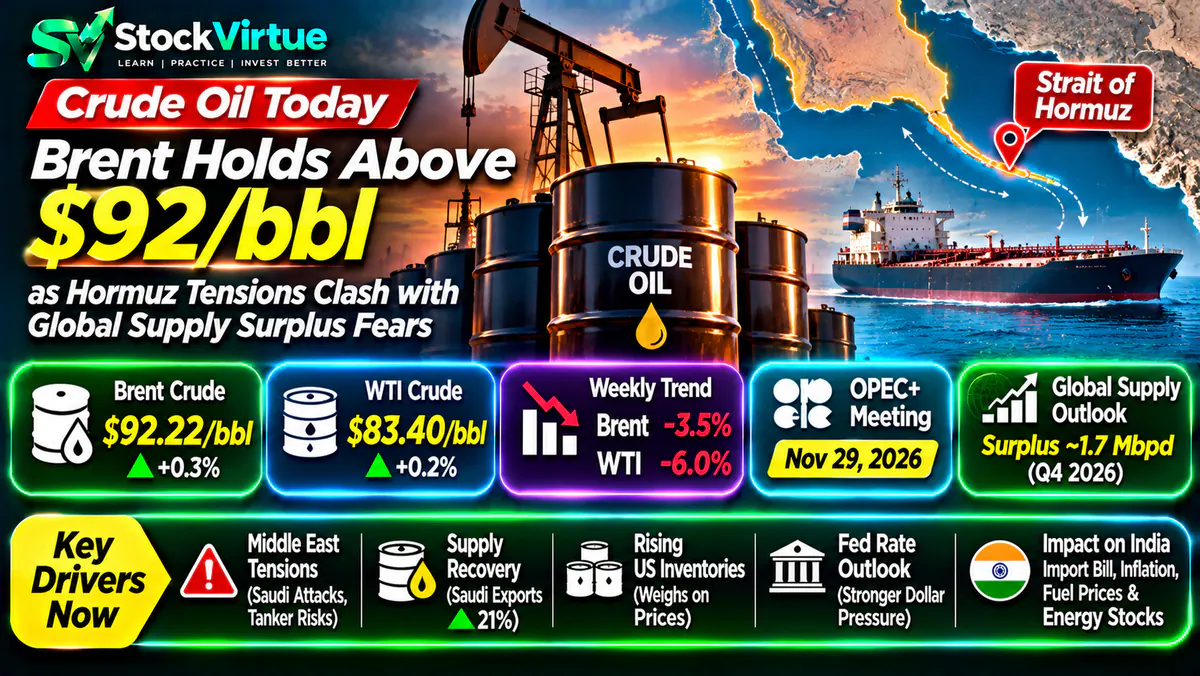
Brent crude futures rose 0.3% to approximately $92.22 per barrel, while US West Texas Intermediate (WTI) gained 0.2% to around $83.40 per barrel during early trading.
The latest movement comes amid reports of renewed attacks involving Saudi Arabia and disruptions to oil tankers in the strategically important Strait of Hormuz. At the same time, recovering Middle Eastern exports, rising US crude inventories and expectations of a global supply surplus are limiting the upside in prices.
For India, which depends heavily on imported crude oil, this situation has implications extending beyond the commodity market. Changes in international oil prices can influence the rupee, inflation, fuel costs, government finances and the profitability of energy companies.
1. Crude oil prices today: Brent and WTI move higher
International crude oil prices recorded a modest recovery during Friday's early trading session.
The increase followed renewed concerns about the security of oil shipments through the Middle East.
Global crude oil price snapshot – November 20, 2026
Benchmark | Reported price | Daily movement |
|---|---|---|
Brent crude | $92.22/barrel | +0.3% |
US WTI crude | $83.40/barrel | +0.2% |
Brent weekly performance | — | Around -3.5% |
December WTI weekly performance | — | Around -6% |
Prices represent reported early-session observations and are not final closing prices.
Despite Friday's recovery, both benchmarks were heading towards their third consecutive weekly decline.
The difference between the two benchmarks also remains important. Brent is the international reference price for a large share of globally traded crude, while WTI is the primary US benchmark.
For Indian energy companies and traders, international crude prices are important reference points, although actual domestic procurement costs can differ because of crude quality, freight, currency and other factors.
2. Strait of Hormuz: Why the world is watching this shipping route
One of the biggest sources of uncertainty for the oil market is the Strait of Hormuz.
This narrow waterway connects the Persian Gulf with the Gulf of Oman and the Arabian Sea. It is a critical route for crude oil and liquefied natural gas exports from major Middle Eastern producers.
Before the current conflict, approximately 20 million barrels of oil per day moved through the Strait of Hormuz.
Recent security developments have raised concerns about the reliability of this route.
On Thursday, Iran's navy claimed that two oil tankers had struck naval mines and caught fire in the strait. The claim was carried by Iranian state media, but Reuters reported that it could not independently verify the incident.
Separately, the Iran-aligned Houthi movement launched missiles towards Riyadh, Saudi Arabia, adding to concerns about regional security.
These developments have increased the risk premium in crude oil prices.
A risk premium is the additional amount traders may be willing to pay because of uncertainty about future supply.
However, the market is not reacting only to geopolitical developments. Expectations of recovering oil flows and growing global inventories are creating an opposing force.
3. The biggest contradiction: Oil supply is recovering despite geopolitical tensions
While security concerns remain elevated, international oil supply has started recovering from earlier disruptions.
Saudi Arabia's crude exports increased nearly 21% in September compared with August, reaching approximately 5.38 million barrels per day, according to data from the Joint Organisations Data Initiative.
This was the country's highest monthly export level since February.
The recovery in exports is important because additional supply can reduce pressure on international prices, particularly when demand growth remains limited.
The United States is also considering increasing oil and diesel exports to Europe, according to recent market reporting.
These developments suggest that the global market is gradually adjusting to supply disruptions through alternative routes, recovering production and changes in trade flows.
For traders, the key question is whether recovering supply can outweigh the continuing geopolitical risks.
4. IEA warns of a major global oil supply surplus
Another important factor influencing crude oil prices is the International Energy Agency's outlook for global supply and demand.
The IEA has indicated that global oil supply has returned to surplus after the earlier disruption caused by the Middle East conflict.
Its recent assessment points to an average global oil supply surplus of approximately 1.7 million barrels per day in the fourth quarter of 2026.
Other market forecasts also point towards a potentially larger surplus during 2027 as Middle Eastern production recovers.
The US Energy Information Administration's November outlook similarly expects global inventories to begin building in the fourth quarter of 2026, with a more substantial accumulation during the first half of 2027.
This is an important development because crude oil prices are influenced not only by current production but also by expectations about future availability.
When supply consistently exceeds consumption, inventories tend to increase. Higher inventories can place downward pressure on prices unless geopolitical disruptions or unexpected demand changes alter the balance.
What could a global oil surplus mean?
Greater availability of crude oil for international buyers.
Potential pressure on Brent and WTI prices.
Reduced urgency among refiners to secure additional supplies.
More competition among exporting countries.
Increased sensitivity to production decisions by OPEC+.
However, a projected surplus does not guarantee lower prices. Shipping disruptions, sanctions, production cuts and unexpected demand changes can quickly alter the outlook.
5. OPEC+ meeting on November 29: The next major market trigger
Oil traders are also preparing for the next important OPEC+ policy meeting scheduled for November 29, 2026.
OPEC+ includes members of the Organization of the Petroleum Exporting Countries and other oil-producing countries, including Russia.
The group plays a significant role in global crude oil supply through production targets and voluntary adjustments.
The upcoming meeting will focus on the group's output policy for 2027.
If producers maintain or increase supply restrictions, prices could receive support.
On the other hand, a decision to restore more production could add to concerns about excess supply.
The market will closely examine:
Whether existing production adjustments will continue.
Whether additional supply will be restored.
How quickly Middle Eastern production returns to previous levels.
Whether members comply with their production commitments.
How the group responds to weaker demand expectations.
The outcome could become one of the most important short-term triggers for crude oil prices.
6. What does the crude oil situation mean for India?
India is particularly sensitive to changes in international crude oil prices because it imports a large proportion of its petroleum requirements.
A sustained rise in crude oil prices can increase the country's import expenditure and put pressure on the current account.
It can also influence inflation, transport costs and the financial performance of companies across multiple industries.
Impact on major Indian sectors
A. Oil marketing companies
Companies such as Indian Oil Corporation, BPCL and HPCL purchase crude oil and process it into petroleum products.
Higher crude prices can increase working-capital requirements and create pressure on refining and marketing economics.
The actual impact depends on refining margins, inventory movements, product prices and the extent to which higher costs can be passed on.
B. Aviation sector
Airlines are sensitive to aviation turbine fuel costs.
A sustained increase in crude oil and refined fuel prices can increase operating expenses and affect profitability.
C. Paint and chemical companies
Many paint, polymer and chemical manufacturers use petroleum-derived raw materials.
Higher crude prices can increase input costs, although the impact varies by product, supply contracts and pricing power.
D. Automobile and logistics companies
Fuel costs influence transportation expenses and consumer spending.
A prolonged increase in petrol and diesel prices could affect vehicle operating costs and demand for fuel-intensive products.
E. Government finances and inflation
Higher imported oil costs can increase pressure on India's trade balance and inflation.
The effect on government finances depends on taxation, fuel-price policy, subsidies and other fiscal decisions.
7. Which Indian energy stocks should investors watch?
The changing global oil environment could create different opportunities and risks across India's energy sector.
Company | Business area | Key factor to monitor |
|---|---|---|
Reliance Industries | Refining and petrochemicals | Refining margins and crude sourcing |
Indian Oil Corporation | Refining and fuel marketing | Marketing margins and inventory gains or losses |
BPCL | Oil refining and marketing | Fuel margins and crude costs |
HPCL | Refining and marketing | Refining performance and marketing economics |
ONGC | Oil and gas exploration | Realisations and production |
Oil India | Oil and gas production | Crude and gas prices, output growth |
GAIL | Natural gas transportation and marketing | Gas sourcing costs and transmission volumes |
Petronet LNG | LNG infrastructure | LNG imports and terminal utilisation |
It is important to remember that crude oil does not affect every energy company in the same way.
Upstream producers may benefit from stronger realised crude prices, while fuel retailers and certain downstream businesses can face pressure if input costs rise faster than selling prices.
Refining companies are influenced by the difference between crude procurement costs and refined-product prices, commonly measured through refining margins.
Therefore, investors should examine individual company results rather than assuming that rising oil prices are automatically positive or negative for the entire energy sector.
8. MCX crude oil traders: What should be watched?
For Indian commodity traders, international crude oil movements are an important input into MCX crude oil contracts.
However, MCX prices are not simply a direct conversion of Brent or WTI into Indian rupees.
Domestic futures prices are influenced by several factors:
International crude oil benchmarks.
Rupee-dollar exchange-rate movements.
Domestic contract specifications.
Import and transportation costs.
Global inventory data.
Market liquidity and futures positioning.
Geopolitical developments.
Important events for MCX crude oil traders
Event | Why it matters |
|---|---|
OPEC+ meeting – November 29 | May influence future production levels |
US crude inventory data | Indicates changes in supply and demand |
Strait of Hormuz developments | Could affect global shipping and supply |
US Federal Reserve policy | May influence the dollar and commodity sentiment |
China demand indicators | Help assess future oil consumption |
Russian energy developments | May influence exports and refining capacity |
Traders should also pay attention to contract expiry dates and the difference between near-month and later-month futures.
Crude oil is a volatile commodity. Using leverage without appropriate risk management can result in substantial losses.
9. The long-term energy story: The world is reconsidering energy security
The current crisis is also changing the global conversation about energy security.
The International Energy Agency has warned that prolonged disruption to the Strait of Hormuz could encourage countries to diversify their supply routes and reduce dependence on vulnerable shipping corridors.
Its World Energy Outlook highlights the potential for oil flows through the strait to decline substantially over the coming decade under a scenario of persistent disruption and accelerated investment in alternative routes.
The agency has also highlighted how energy security concerns can accelerate investment in electrification, renewable energy, energy efficiency and alternative fuels.
For India, this creates an important long-term opportunity.
The country continues to require reliable oil and gas supplies, but greater investment in solar power, wind energy, battery storage, electric mobility and domestic energy infrastructure could help diversify its energy mix.
The transition will not eliminate crude oil demand overnight. Instead, traditional energy and renewable energy are likely to remain interconnected parts of the global energy system for years.
10. What could happen next in the crude oil market?
The direction of crude oil prices will depend on which of two competing forces becomes stronger.
Factors that could push prices higher:
Escalation of conflict in the Middle East.
Further disruptions to tanker movements through the Strait of Hormuz.
Reduced Russian oil exports.
Continued OPEC+ production restrictions.
Unexpected increases in global fuel demand.
Factors that could push prices lower:
Recovery in Middle Eastern oil exports.
Higher US crude inventories.
A sustained global supply surplus.
Weaker economic activity and oil demand.
Additional production from major oil exporters.
The November 29 OPEC+ meeting and developments around Middle Eastern shipping routes are likely to remain central to market sentiment.
The key takeaway: Crude oil is no longer moving on geopolitical headlines alone. Traders must balance supply disruptions against inventories, production decisions and the longer-term shift in global energy demand.
StockVirtue — Learn | Practice | Invest Better
Disclaimer: This article is for educational and informational purposes only and does not constitute investment advice or a recommendation to buy or sell crude oil futures, energy stocks or any other financial instrument. Prices are reported observations from November 20, 2026, and may change during trading. Forecasts and production expectations are not guaranteed outcomes. Commodity futures involve substantial risk, particularly when traded with leverage. Readers should verify live prices and official disclosures before making financial decisions.