Commodity Market
What Is MCX? How India’s Commodity Exchange Works, Trading Hours, Products and Risks
What is MCX and how does it work? Learn about MCX commodities, futures, options, lot sizes, margins, trading hours and risks in India.
When investors discuss the Indian stock market, they usually think about the NSE and BSE. But India also has an important exchange dedicated to another major asset class: commodities.
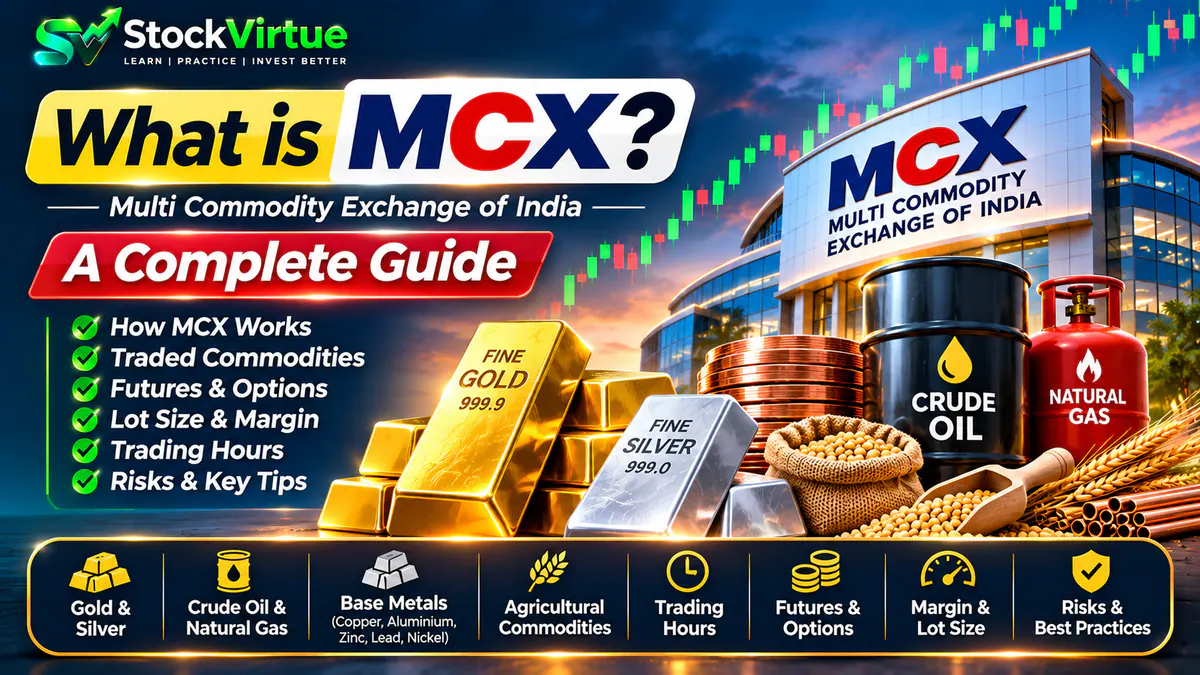
From gold and silver to crude oil, natural gas and industrial metals, the Multi Commodity Exchange of India (MCX) provides an organised electronic marketplace where participants can trade commodity derivatives.
MCX plays an important role in price discovery and risk management. It is used by traders seeking exposure to commodity prices, as well as businesses that want to manage the risk of changing raw-material costs.
But how exactly does MCX work? Can an individual trade gold or crude oil without purchasing the physical commodity? What are futures, options, lot sizes and margins?
What is MCX?
MCX stands for Multi Commodity Exchange of India Limited. It is an electronic commodity derivatives exchange that began operations in November 2003 and operates under the regulatory framework of the Securities and Exchange Board of India (SEBI).
Unlike the NSE and BSE, which are primarily associated with equity and other financial securities, MCX specialises in commodity derivatives.
Its platform facilitates trading in contracts linked to commodities such as:
Gold and silver
Crude oil and natural gas
Copper, aluminium, zinc, lead and nickel
Selected agricultural commodities
Commodity indices and related derivative products
MCX provides a platform for transparent trading, price discovery and risk management. It is India's largest commodity derivatives exchange, according to its official overview. Source: MCX – About Us.
Which commodities are traded on MCX?
MCX offers commodity contracts across different segments. Each commodity has its own contract specifications, trading unit, price quotation, expiry date and applicable margin.
Segment | Examples | What influences prices? |
|---|---|---|
Bullion | Gold, Silver | Global prices, US dollar, interest rates, inflation and demand |
Energy | Crude Oil, Natural Gas | Global supply, demand, inventories, geopolitics and weather |
Base metals | Copper, Aluminium, Zinc, Lead, Nickel | Industrial demand, mining output, manufacturing and global inventories |
Agriculture | Selected agricultural commodities | Crop production, weather, domestic supply and demand |
The exact contracts available for trading can change. Traders should always check the exchange's current product list and contract specifications before placing an order.
How does MCX trading work?
MCX trading is primarily conducted through standardised derivative contracts. This means a trader generally buys or sells a contract linked to a commodity's price instead of purchasing the physical commodity directly.
For example, imagine gold is trading at ₹1,50,000 per 10 grams.
A trader who expects gold prices to rise may buy a gold futures contract. If the price increases, the contract may generate a profit. If the price falls, the trader may incur a loss.
The actual financial result depends on the contract's trading unit, entry price, exit price, charges and applicable settlement rules.
The basic trading process is:
Open a commodity trading account with a SEBI-registered broker that offers MCX access.
Complete the required KYC and account activation.
Add sufficient funds to meet the required margin.
Select a commodity and its contract expiry.
Review the lot size, price quotation, tick size and margin.
Place a buy or sell order.
Monitor the position, margin requirements and expiry.
Close or settle the contract according to its specifications.
Importantly, commodity contracts may have delivery-related obligations. Traders must understand the expiry and delivery rules before entering a position.
What are futures contracts on MCX?
A futures contract is an agreement to buy or sell a specified quantity of an underlying commodity at a predetermined price for a future settlement date.
For example:
Suppose a trader expects gold prices to increase.
Gold futures entry price: ₹1,50,000 per 10 grams
Illustrative contract quantity: 100 grams
Entry contract value: ₹15,00,000
Exit price: ₹1,51,000 per 10 grams
Price movement: ₹1,000 per 10 grams
The hypothetical gross profit would be:
₹1,000 × 10 = ₹10,000
If the price instead falls to ₹1,49,000 per 10 grams, the hypothetical gross loss would be ₹10,000.
This example is only for understanding how contract value and price movement work. The 100-gram quantity is illustrative, not a representation of a currently available MCX contract. Actual contract sizes, quotations and expiry rules must be checked on the exchange.
What are options in MCX?
MCX also offers options on commodity futures. These contracts give traders another way to participate in commodity price movements.
There are two basic types:
Call option: Gives the buyer the right, but not the obligation, to take a specified position in the underlying futures contract at the strike price, subject to the contract's terms.
Put option: Gives the buyer the right, but not the obligation, to take the corresponding opposite position at the strike price, subject to the contract's terms.
An options buyer pays a premium to purchase the contract. The buyer's loss is generally limited to the premium paid, excluding applicable charges and subject to the contract's settlement rules.
An options seller receives the premium but takes on an obligation. The potential loss can be substantial.
MCX options are based on commodity futures, rather than being direct purchases of physical commodities. Source: MCX – Market Operations FAQs.
What is lot size in MCX?
Lot size is the standard quantity represented by one exchange-traded contract. It is one of the most important details a trader should understand before entering a commodity position.
For example, if a contract represents 100 units and the commodity's quoted price changes by ₹10 per unit, the contract's value changes by ₹1,000, before charges.
The calculation is:
Profit or loss = Price movement × Contract quantity
A small movement in the commodity's price can therefore create a much larger rupee impact depending on the contract quantity.
MCX also specifies the tick size, which is the minimum permitted price movement for a contract.
There is no single lot size for all MCX commodities. Every contract has its own specifications.
What is margin in MCX trading?
One important difference between buying physical commodities and trading futures is the margin requirement.
In futures trading, a trader does not generally pay the entire contract value upfront. Instead, the broker collects the required margin according to exchange and regulatory requirements.
For example, assume:
Total contract value: ₹10,00,000
Illustrative margin requirement: 10%
Margin deposited: ₹1,00,000
The trader gets exposure to a contract worth ₹10 lakh by depositing ₹1 lakh as margin.
However, this does not mean the trader can lose only ₹1 lakh. Losses can reduce the available funds, additional margin may be required, and a position may be squared off if margin requirements are not met.
Actual margin requirements vary by commodity, contract, volatility and applicable rules. They can change during the life of a position.
MCX trading timings in India
MCX operates from Monday to Friday, excluding Saturdays, Sundays and exchange-declared holidays.
According to the current exchange schedule applicable after the November 2026 daylight-saving time change, the general trading timings are:
Commodity category | Trading hours (IST) |
|---|---|
Internationally referenceable non-agricultural commodities, including bullion, metals and energy | 9:00 AM – 11:55 PM |
Internationally referenceable agricultural commodities | 9:00 AM – 9:00 PM |
Other agricultural commodities | 9:00 AM – 5:00 PM |
The exchange also provides a pre-market special session from 8:45 AM to 8:59 AM.
Trading hours can change with international daylight-saving adjustments, exchange circulars and holidays. Always check the current MCX schedule before trading. Source: MCX – Trading and Surveillance.
What factors affect MCX prices?
Commodity prices are influenced by both domestic and international developments. Some important factors include:
1. International market prices
Gold, silver, crude oil and many industrial metals are influenced by global commodity benchmarks. International price movements can affect domestic futures prices.
2. US dollar and interest rates
Changes in the US dollar and interest-rate expectations can influence precious metals and other internationally traded commodities.
3. Geopolitical developments
Wars, trade restrictions, sanctions and supply disruptions can cause sharp movements in energy and metal prices.
4. Supply and demand
Mining output, oil production, industrial consumption, crop production and inventories all influence commodity prices.
5. Currency movements
Since several commodities are internationally priced in US dollars, changes in the rupee-dollar exchange rate can affect their domestic prices.
6. Government policies
Import duties, taxes, export restrictions and other policy decisions can influence domestic commodity prices and trading activity.
MCX vs NSE: What is the difference?
Both exchanges operate within India's regulated market infrastructure, but their primary trading products are different.
Feature | MCX | NSE |
|---|---|---|
Full name | Multi Commodity Exchange of India | National Stock Exchange of India |
Primary focus | Commodity derivatives | Equity and financial markets, along with derivatives |
Main products | Gold, silver, crude oil, metals and selected agricultural commodities | Shares, equity derivatives, ETFs, debt and other products |
Typical market participants | Commodity traders, producers, manufacturers, hedgers and investors | Retail investors, institutions, traders and companies |
Main purpose | Commodity price discovery and risk management | Securities trading, capital formation and financial-market activity |
The key difference is the underlying asset. MCX contracts are linked to commodities, while NSE's major cash-equity products represent ownership in listed companies.
Is MCX trading suitable for beginners?
MCX can provide opportunities to understand and trade commodity price movements, but commodity derivatives are not risk-free investments.
Beginners should pay particular attention to:
Leverage: A relatively small margin can control a much larger contract value.
Volatility: Commodity prices can move sharply following international events and economic data.
Expiry and delivery: Some contracts have delivery-related requirements. Ignoring them can create unexpected obligations.
Margin calls: Adverse price movements can require additional funds.
Liquidity: Not every commodity or expiry has the same trading volume.
Overnight risk: International markets can move while Indian markets are closed.
A beginner should first understand contract specifications, practise position sizing and learn how losses are calculated before committing real money.
How StockVirtue users can learn MCX trading
Understanding commodity derivatives becomes easier when traders can practise with a simulated portfolio before risking real capital.
A commodity-trading simulator can help users learn:
How gold, silver, crude oil and metal prices move.
How futures contract quantities affect profit and loss.
How margin and leverage change exposure.
How call and put options behave.
How expiry dates and settlement rules work.
How to manage risk and maintain a trading journal.
For example, a simulator can allow a user to practise with virtual funds and a smaller virtual position size, rather than requiring the full notional value of a large commodity contract.
However, virtual trading should be clearly distinguished from real MCX trading. A simulator's prices, contract multipliers, margin calculations and settlement behaviour should be based on documented contract specifications if it aims to replicate exchange trading.
StockVirtue Takeaway
MCX is an important part of India's financial-market ecosystem. It connects commodity producers, manufacturers, hedgers and traders through a regulated derivatives marketplace.
For individual traders, MCX offers exposure to gold, silver, crude oil and other commodities without necessarily purchasing the physical products. But futures and options also introduce leverage, volatility, margin requirements and expiry-related risks.
The right way to approach commodity trading is to understand the contract first, calculate the potential loss and practise disciplined risk management.