Commodity Market
Commodity Market in India: How Gold, Silver, Crude Oil and Other Commodities Are Traded
Learn how the commodity market works in India. Understand MCX, NCDEX, gold, silver, crude oil, futures, options, lot sizes, margins and trading risks.
Stocks in this story
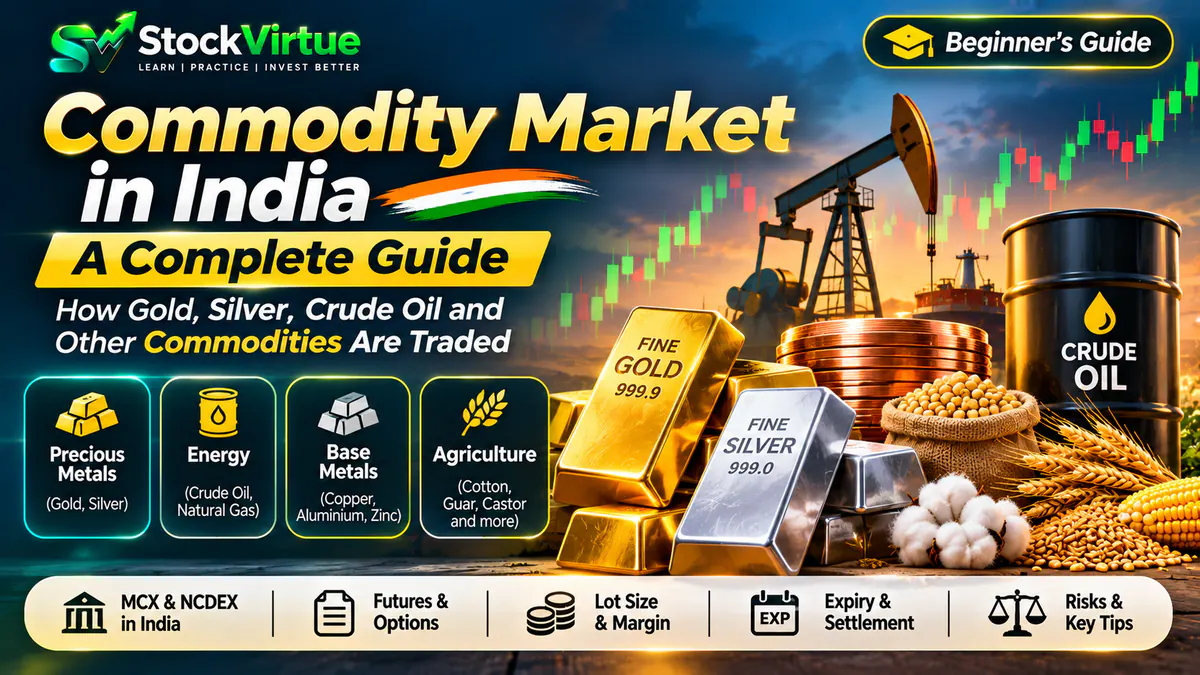
When people hear about the stock market, they usually think about companies, shares, Nifty and Sensex. But there is another important part of the financial market where people trade gold, silver, crude oil, natural gas, copper and agricultural products. This is known as the commodity market.
Commodity prices influence many parts of our everyday lives. Gold affects jewellery prices, crude oil influences fuel costs, natural gas is important for energy production, and metals such as copper and aluminium are essential for manufacturing and infrastructure.
In India, commodity trading has developed into an organised exchange-based market where participants can trade contracts linked to these physical products.
For beginners, understanding this market is important because commodity prices do not move in exactly the same way as company share prices. They are influenced by global demand and supply, currency movements, weather conditions, geopolitical developments and economic policies.
Let's understand how the Indian commodity market works, what people trade, how prices move and what a beginner should know before entering this market.
1. What Is the Commodity Market?
A commodity is a basic physical product that can be bought, sold, produced or used by businesses and consumers.
Examples include:
Gold and silver used in jewellery, investment and manufacturing.
Crude oil used to produce petrol, diesel and other petroleum products.
Natural gas used for electricity, industries and household energy.
Copper and aluminium used in electrical equipment, construction and manufacturing.
Agricultural products such as cotton, guar seed and other permitted commodities.
The commodity market is where buyers and sellers participate in transactions involving these products.
Unlike the equity market, where investors buy ownership in a company, commodity traders generally trade contracts whose value is linked to the price of a physical product.
For example, if a trader expects gold prices to increase, they may buy a gold futures contract. If gold prices rise, the contract may gain value. If prices fall, the position may incur a loss.
2. How Does the Commodity Market Work in India?
India has organised commodity exchanges that allow market participants to trade standardised commodity contracts.
Two important exchanges are:
MCX – Multi Commodity Exchange of India
MCX is a major platform for non-agricultural commodity derivatives, including gold, silver, crude oil, natural gas and industrial metals.
NCDEX – National Commodity and Derivatives Exchange
NCDEX focuses predominantly on agricultural commodity derivatives, providing a platform for contracts linked to agricultural products.
Commodity derivatives trading in India is regulated by the Securities and Exchange Board of India (SEBI).
The exchanges establish standard contract specifications, including trading quantity, price quotation, expiry date, quality requirements and settlement conditions.
This standardisation allows different market participants to trade under common rules.
3. Different Categories of Commodities
The commodity market can be divided into four major categories.
A. Precious Metals
Gold and silver are among the most widely followed commodities in India.
Examples:
Gold
Gold Mini
Gold Guinea
Gold Petal
Silver
Silver Mini
Gold is commonly associated with jewellery demand, investment demand and safe-haven buying. Silver has both investment and industrial uses.
Gold prices are influenced by international bullion prices, the US dollar, interest-rate expectations, inflation and geopolitical uncertainty.
Silver prices can also react strongly to industrial demand, particularly from electronics, solar energy and manufacturing.
B. Energy Commodities
Energy commodities are closely connected to global economic activity.
Examples:
Crude Oil
Natural Gas
WTI Crude Oil
Crude oil is one of the most important commodities because it affects transportation, manufacturing, aviation, chemicals and fuel prices.
Natural gas is used for power generation, industrial processes and other energy requirements.
Prices in this category can react sharply to geopolitical conflicts, production decisions, weather conditions, inventory reports and global consumption.
C. Base Metals
Base metals are essential raw materials for industrial and infrastructure development.
Examples:
Copper
Aluminium
Zinc
Lead
Nickel
Copper is widely used in electrical wiring, renewable energy infrastructure and electronics. Aluminium is important for automobiles, construction and packaging.
Demand from major manufacturing economies, especially China, can have a significant impact on these prices.
D. Agricultural Commodities
Agricultural commodities are connected to farming, food production and seasonal supply.
Examples include:
Cotton
Guar Seed
Guar Gum
Castor Seed
Other exchange-approved agricultural products
Prices can change because of monsoon conditions, crop production, inventory levels, export policies, international demand and government regulations.
Not every agricultural product is available for derivatives trading at all times. Traders should check the current exchange contract list.
4. What Is the Difference Between Spot and Futures Markets?
This is one of the most important concepts for anyone learning commodity trading.
Spot Market
In a spot transaction, the buyer and seller exchange the commodity for payment with immediate or near-term delivery, according to the applicable market arrangements.
For example, when a person purchases physical gold from a jeweller, they are participating in a physical commodity transaction.
Futures Market
A futures contract is an agreement to buy or sell a specified quantity of an underlying commodity at a predetermined price for a future expiry date.
For example, imagine gold futures are trading at ₹1,50,000 per 10 grams.
A trader expects gold prices to increase and buys a futures position.
If the futures price rises to ₹1,52,000, the position may generate a profit, subject to the contract's quotation, quantity, costs and other adjustments.
If the price falls to ₹1,48,000, the position may generate a loss.
The trader is dealing with a derivative contract rather than necessarily purchasing physical gold immediately.
Important: Futures contracts can have physical-delivery obligations. Traders must understand the contract's expiry, tender period and settlement rules. They should not assume every commodity position is automatically cash-settled.
5. What Is a Commodity Lot Size?
Every exchange-traded commodity contract has a specified trading quantity, known as its lot size or contract size.
This is different from buying a small quantity of a commodity in a retail shop.
For example, MCX offers different gold contract variants, including:
Contract | Indicative underlying quantity |
|---|---|
Gold | 1 kg |
Gold Mini | 100 grams |
Gold Ten | 10 grams |
Gold Guinea | 8 grams |
Gold Petal | 1 gram |
These are different contracts, not interchangeable names for the same lot.
Actual availability, contract specifications and expiry months should always be verified on the exchange.
For example, if a Gold contract represents 1 kg and the quoted price is ₹1,50,000 per 10 grams, its notional contract value would be:
₹1,50,000 × 100 = ₹1,50,00,000
That means the underlying contract value is ₹1.5 crore.
A trader may be required to deposit only a fraction of this value as margin, depending on exchange and broker requirements. This is why understanding lot size and leverage is essential.
6. What Is Margin in Commodity Trading?
Commodity futures trading generally does not require traders to pay the entire contract value upfront.
Instead, they deposit an amount known as margin.
Margin acts as a financial safeguard against potential losses on an open position.
Consider a hypothetical example:
Particular | Amount |
|---|---|
Commodity contract value | ₹10,00,000 |
Illustrative margin requirement | 10% |
Initial margin deposit | ₹1,00,000 |
The trader controls a contract worth ₹10 lakh by depositing ₹1 lakh.
However, this does not mean the trader's maximum possible loss is limited to ₹1 lakh.
If the commodity price moves against the position, losses can accumulate quickly. Additional margin may be required, and the broker may close the position if margin requirements are not met.
Actual margin percentages vary by commodity, contract, volatility, exchange requirements and broker policies.
7. How Do Commodity Prices Move?
Commodity prices are influenced by several factors. Understanding these drivers is often more important than simply watching a price chart.
1. Demand and Supply
When demand increases while supply remains limited, prices may rise. When supply increases or demand weakens, prices may decline.
2. US Dollar and Currency Movements
Many international commodities are quoted in US dollars. A stronger dollar can put pressure on internationally traded commodity prices, although the relationship is not always consistent.
For Indian traders, the rupee-dollar exchange rate also matters because it affects the domestic cost of imported commodities.
3. Interest Rates and Inflation
Gold often receives attention when investors are concerned about inflation, currency depreciation or uncertainty around interest rates.
4. Geopolitical Events
Wars, sanctions, shipping disruptions and production restrictions can affect the availability and transportation of commodities.
5. Weather and Seasonal Conditions
Agricultural products are especially sensitive to monsoons, droughts, floods and crop production estimates.
6. Global Economic Growth
Industrial metals and energy commodities can respond to changes in manufacturing, infrastructure spending and global economic activity.
8. What Is the Difference Between Commodity Futures and Options?
Commodity markets also offer derivative contracts beyond futures.
Commodity Futures
A futures contract creates an obligation for the buyer and seller under the contract's settlement rules.
Both rising and falling prices can create trading opportunities, but incorrect market direction can result in losses.
Commodity Options
An option gives its buyer the right, but not the obligation, to buy or sell an underlying futures contract under specified terms.
A Call option gives the buyer the right to buy.
A Put option gives the buyer the right to sell.
An option buyer pays a premium. Option sellers have different obligations and can face substantial risk.
Options are affected by several factors, including the underlying futures price, volatility, time to expiry and strike price.
Beginners should understand these concepts before trading commodity options.
9. What Is Mark-to-Market (MTM)?
Mark-to-Market, commonly called MTM, is the process of adjusting the value of an open futures position based on changes in market prices.
Suppose a trader buys a futures contract and its price increases during the trading session. The position may generate a positive MTM adjustment.
If the price decreases, the trader may face a negative adjustment.
Commodity futures positions are subject to exchange settlement and margin rules. Traders need sufficient funds to handle adverse price movements.
10. What Should Beginners Know Before Trading Commodities?
Commodity trading can be more complicated than it initially appears.
A beginner should understand the following points:
Learn the contract: Know the lot size, price quotation, expiry and settlement method.
Understand leverage: A relatively small price movement can create a large gain or loss compared with the margin deposited.
Track global news: International economic announcements can move commodity prices sharply.
Use risk management: Decide in advance how much risk you are willing to take.
Watch liquidity: Some contracts have better trading volume and tighter bid-ask spreads than others.
Understand delivery obligations: Do not hold a contract close to expiry without understanding its delivery and tender requirements.
Avoid overtrading: Do not increase position sizes simply because a previous trade was profitable.
Commodity trading is not a guaranteed way to make money. It requires market knowledge, discipline and an understanding of the underlying product.
11. Commodity Trading vs Stock Trading
Although both markets operate through exchanges and derivatives, their underlying assets are different.
Feature | Stock Market | Commodity Market |
|---|---|---|
Underlying asset | Company shares | Physical commodities |
Examples | Reliance, TCS, SBI | Gold, Silver, Crude Oil |
Major price drivers | Earnings, business growth, valuation | Demand, supply, global prices |
Trading instruments | Equity, futures and options | Commodity futures and options |
Global influence | Varies by company and sector | Often significant |
Expiry | Cash shares have no expiry | Derivative contracts have expiry |
Delivery | Shares credited to demat account | Commodity-specific settlement and delivery rules |
Both markets offer opportunities and risks. Understanding the underlying asset is essential before participating.
12. Why Is the Commodity Market Important for India?
India is a major consumer of several commodities, particularly gold, crude oil and industrial metals.
Changes in commodity prices can influence the wider economy.
For example:
Higher crude oil prices can increase India's import expenditure and put pressure on fuel costs.
Higher gold prices can affect jewellery demand and household purchasing decisions.
Higher copper prices can influence electrical and manufacturing costs.
Agricultural price movements can affect farmers, food processors and consumers.
The commodity market also provides businesses with tools to manage price uncertainty.
For example, an industrial company that needs copper regularly may use futures contracts to reduce the risk of a sudden increase in procurement costs. This practice is known as hedging.
Conclusion: Understand Commodities Before Entering the Market
The commodity market is much more than buying and selling gold or silver. It connects global energy, manufacturing, agriculture, international trade and financial markets.
From precious metals and crude oil to copper and agricultural products, every commodity has its own price drivers, contract specifications and risks.
For beginners, the best starting point is to understand how the market works, how futures contracts are structured, what margin means and how expiry and settlement operate.
At StockVirtue, our goal is to make financial markets easier to understand. Learning how commodities work is another step towards becoming a more informed and disciplined market participant.