
F&O Trading
Nifty F&O Market Outlook: PCR at 1.65, 26,000 Call OI Dominates as Traders Watch Next Expiry
Nifty F&O update: PCR stands at 1.65, with major put OI at 24,000 and call OI at 26,000. Check FII futures positioning and derivatives market trends.
By Aditya Kumar
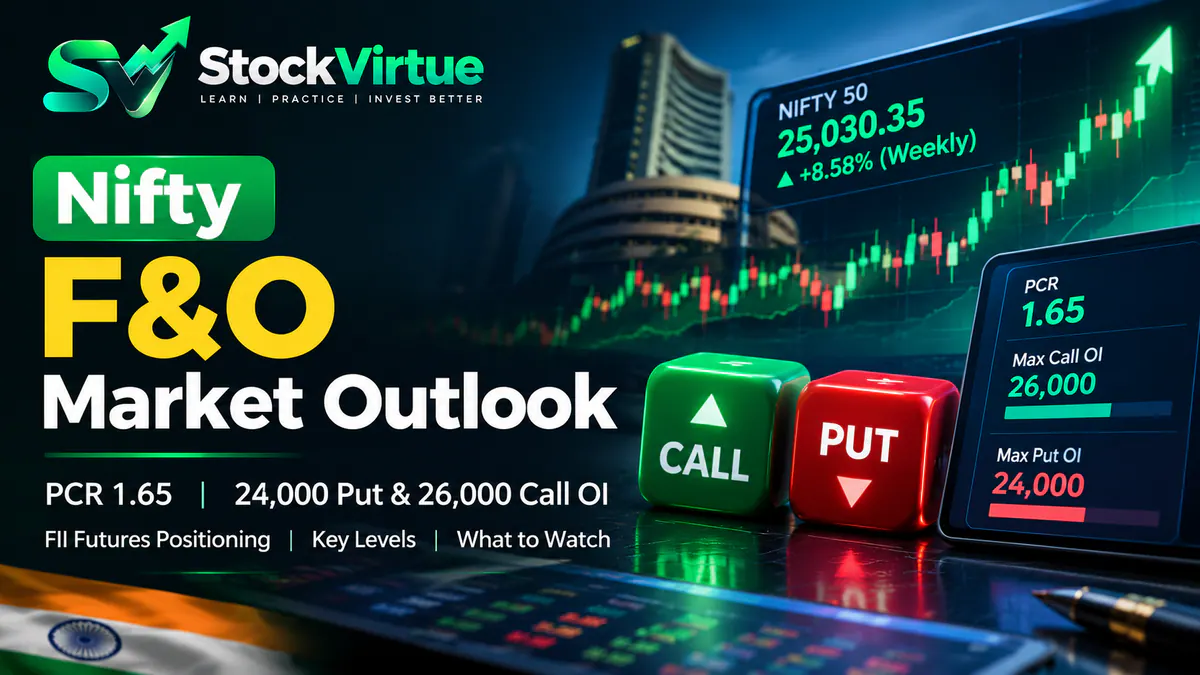
India's derivatives market is entering the new trading week after one of the strongest equity rallies in recent years. The Nifty 50 closed above 25,000 on November 6, while options positioning showed significant open interest at the 24,000 put and 26,000 call strikes.
The latest available derivatives data also indicates that foreign institutional investors (FIIs) remained net short in index futures, although their net short position reduced compared with the previous session.
This creates an interesting situation for derivatives traders: the cash market has delivered a strong rally, but futures positioning still reflects considerable caution.
Here is a breakdown of the latest Nifty F&O data and the important indicators traders should understand.
Nifty options data: Key levels to monitor
According to the available November 6 derivatives positioning report, the Nifty options contract expiring November 9 showed the following figures:
Indicator | Reported value |
|---|---|
Nifty closing level | 25,030 |
Put-Call Ratio (PCR) | 1.65 |
Highest call open interest | 26,000 |
Highest put open interest | 24,000 |
Call OI at 26,000 | Approximately 1.14 crore contracts |
Put OI at 24,000 | Approximately 1.43 crore contracts |
These figures provide an overview of where market participants had accumulated options positions before the next regular trading session.
High call open interest at a strike can indicate an area where traders have built substantial call positions. Similarly, high put open interest can identify a strike with significant put positioning.
However, open interest alone cannot establish whether a level will act as support or resistance. Traders should also examine changes in OI, option premiums, volumes and the direction of the underlying index.
What does a PCR of 1.65 indicate?
PCR stands for Put-Call Ratio.
It compares the open interest or trading activity in put options with call options, depending on the calculation method.
In this report, the Nifty options PCR was 1.65.
A PCR above 1 means put open interest is higher than call open interest under the relevant calculation.
Traders often use PCR as a sentiment indicator, but it should not be interpreted independently.
A higher PCR may reflect put writing, put buying or a combination of positions. These have different market implications.
Therefore, traders should examine the underlying option positions and changes in open interest before drawing conclusions.
FII index futures positioning: Net short positions reduce
One of the important observations from the November 6 derivatives report was the reduction in foreign investor net short positions.
FII index futures positioning | Contracts |
|---|---|
Net short on November 5 | 1,37,438 |
Net short on November 6 | 1,00,416 |
Reduction in net short position | 37,022 |
The data suggests that foreign investors reduced their net short index futures exposure during Friday's session.
However, they remained net short overall.
This is an important distinction: a reduction in bearish positioning is not the same as a complete shift to bullish positioning.
Traders should monitor whether this trend continues during the next trading sessions.
What happened in individual stock futures?
The November 6 report also classified changes in futures positions across 218 F&O stocks.
Position category | Number of stocks |
|---|---|
Long build-up | 46 |
Short covering | 50 |
Short build-up | 39 |
Long unwinding | 27 |
Little change | 56 |
The data shows that short covering and fresh long positions were both visible across individual stocks.
Some notable examples from the report included:
HDFC Bank: Price up 3.57%, OI down 4.59%.
ICICI Bank: Price up 4.42%, OI down 1.88%.
Mahindra & Mahindra: Price up 4.58%, OI down 2.18%.
Hindalco: Price up 1.49%, OI up 11.80%.
Astral: Price down 9.89%, OI up 16.24%.
A price increase combined with falling open interest can indicate short covering, while a price increase with rising OI may indicate long build-up.
These classifications are useful for understanding market positioning, but should not be treated as independent buy or sell signals.
Understanding the difference between long build-up and short covering
Open interest analysis is an important part of futures trading.
Here are four common combinations:
Price movement | Open interest movement | Common interpretation |
|---|---|---|
Price rises | OI rises | Long build-up |
Price falls | OI rises | Short build-up |
Price rises | OI falls | Short covering |
Price falls | OI falls | Long unwinding |
These interpretations describe common market-positioning patterns. They do not reveal every trader's intention or guarantee the next price movement.
Important Nifty levels: 24,000 and 26,000
The latest options positioning highlighted two notable strikes:
24,000 — Highest put open interest
This strike had the largest reported put open interest for the referenced Nifty expiry. Traders may monitor whether put positions remain concentrated there or shift to other strikes.
26,000 — Highest call open interest
This strike had the largest reported call open interest. A significant change in call positions could alter the market's perceived resistance zone.
These are options-positioning reference levels, not guaranteed support and resistance levels.
The Nifty's actual price behaviour, fresh positions and changes in option premiums will determine how relevant these strikes remain.
F&O ban: Why traders should monitor the list
The November 6 derivatives report identified Kaynes Technology as being in the F&O ban list.
A stock enters the ban period when its market-wide position limit crosses the prescribed threshold.
During the ban period, traders generally cannot increase existing positions in that stock's futures and options contracts. They may still reduce or close positions, subject to exchange rules.
The ban list is dynamic and should be checked on the official NSE website before trading.
What should F&O traders watch in the next session?
After the strong weekly rally, traders should avoid assuming that the market will continue moving in the same direction.
Important factors to monitor include:
Whether Nifty sustains above 25,000.
Whether put open interest shifts higher from the 24,000 strike.
Whether call open interest builds further near 26,000.
Whether FII net short positions continue to reduce.
Whether Bank Nifty and heavyweight banking stocks maintain momentum.
Whether market breadth supports the benchmark indices.
Whether volatility increases following the special Muhurat Trading session.
The first regular session after Muhurat Trading may provide a clearer picture of institutional positioning and derivatives activity.
Risk management: Important for F&O beginners
Futures and options trading involves leverage and can result in substantial financial losses.
Beginners should understand the following before entering a position:
Know the lot size and contract value.
Calculate the maximum potential loss before placing an order.
Understand the difference between option buying and option writing.
Avoid trading solely on PCR or open interest.
Monitor expiry and settlement obligations.
Avoid excessive leverage.
Use stop-loss and position-sizing rules.
Do not risk money needed for essential expenses.
Buying an option can result in losing the entire premium paid. Selling options can expose traders to much larger losses, potentially substantial or theoretically unlimited depending on the position.
StockVirtue Takeaway
The latest Nifty derivatives data presents a mixed picture. The market has delivered a strong weekly rally, while foreign investors remain net short in index futures despite reducing their bearish exposure.
A PCR of 1.65 and significant open interest at 24,000 puts and 26,000 calls provide useful information about positioning, but they are not reliable standalone predictions.
Successful F&O analysis requires combining price action, open interest, volume, volatility, market breadth and risk management.
StockVirtue — Learn | Practice | Invest Better