
IPO
IPO Explained: What Is an Initial Public Offering and How to Invest in IPOs in India?
Learn what an IPO is and how it works in India. Understand IPO applications, ASBA, UPI, lot size, allotment, listing gains and investment risks.
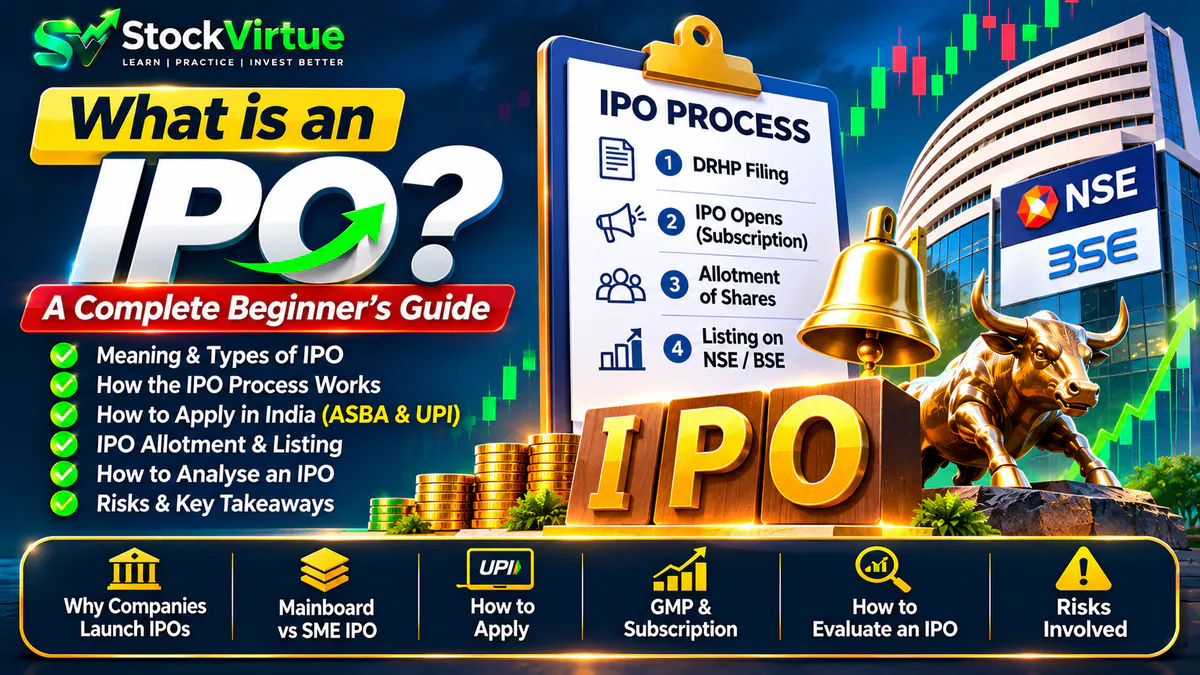
Have you ever wondered how a private company becomes listed on the stock market? Or how ordinary investors get an opportunity to buy shares of a company before its stock starts trading on NSE or BSE?
The process is known as an Initial Public Offering (IPO).
An IPO is an important milestone for a company because it allows the business to raise capital from public investors and become a publicly listed company. For investors, it creates an opportunity to become shareholders in a business at the time it enters the stock market.
However, applying for an IPO does not automatically mean making a profit. The company may list above its issue price, below it or close to it. Understanding the process, valuation and risks is essential before investing.
In this guide, StockVirtue explains how IPOs work in India, how to apply, how shares are allotted and what investors should examine before making a decision.
1. What is an IPO?
IPO stands for Initial Public Offering.
It is the process through which a company offers its shares to the public for the first time and seeks admission to a recognised stock exchange.
Before an IPO, a company may be privately owned by its founders, promoters, employees and private investors. After completing the IPO and listing process, its shares can be traded by eligible investors on the stock exchange.
For example:
Imagine a technology company called ABC Technologies that wants to expand its operations, build new facilities and reduce its existing debt.
Instead of raising all the required money through loans, the company decides to offer shares to public investors.
It launches an IPO at an illustrative price of ₹100 per share. Investors apply for shares during the subscription period. After the allotment process, the company gets listed on the stock exchange.
Once listed, investors can buy and sell its shares through their trading accounts.
This is how a privately held company can become a publicly traded company.
2. Why do companies launch IPOs?
Companies launch IPOs for different business and financial reasons. Raising capital is one of the most common objectives, but it is not the only one.
1. Business expansion
A company may need funds to open new factories, enter new markets, increase production capacity or develop new products.
2. Debt repayment
Some companies use IPO proceeds to repay outstanding loans and improve their balance sheets.
3. Working capital
Businesses need money for everyday operations, including inventory, salaries, suppliers and operating expenses.
4. Brand visibility
Becoming a listed company can increase public visibility and provide greater recognition among customers, business partners and investors.
5. Offer for Sale by existing shareholders
An IPO may also allow existing shareholders, such as promoters or early investors, to sell some of their shares to the public.
The important distinction is that money raised through a fresh issue goes to the company, while money raised through an Offer for Sale (OFS) goes to the selling shareholders.
3. What are the different types of IPOs?
Indian IPOs generally use two pricing approaches: fixed-price issues and book-built issues.
A. Fixed-price IPO
In a fixed-price IPO, the company announces a specific price at which investors can apply for shares.
For example:
Issue price: ₹150 per share
Minimum application: 100 shares
Application amount: ₹15,000
Investors know the price before submitting their applications.
B. Book-built IPO
In a book-built IPO, the company announces a price band rather than one final issue price.
For example:
Lower price: ₹100
Upper price: ₹120
Final issue price: Determined after the bidding process
Investors submit bids within the announced price band. Based on demand at different prices, the final issue price is determined.
Retail investors may generally choose the cut-off option when applying through the applicable process. This means they agree to receive shares at the final discovered issue price, subject to allotment.
Book building is widely used in Indian IPOs.
4. What is the difference between Mainboard IPO and SME IPO?
Companies can enter the public market through the mainboard or the SME platform, subject to the applicable eligibility and regulatory requirements.
Feature | Mainboard IPO | SME IPO |
|---|---|---|
Company profile | Generally larger businesses | Small and medium-sized businesses |
Listing platform | NSE or BSE mainboard | NSE Emerge or BSE SME |
Business scale | Typically larger | Typically smaller |
Liquidity | Often higher, but varies | Can be relatively limited |
Price movements | Can be volatile | Can be particularly volatile |
Investor research | Often broader analyst coverage | May have more limited coverage |
SME IPOs can provide access to smaller growing businesses, but they may also involve higher liquidity, valuation and information risks.
Investors should check the relevant exchange's eligibility, trading and lot-size requirements before applying.
5. How does the IPO process work in India?
An IPO involves several stages before shares become available for public trading.
Step 1: Company prepares for the IPO
The company appoints investment bankers, legal advisers, auditors and other intermediaries to manage the public issue.
The company evaluates its financial position, business plans, capital requirements and public offering structure.
Step 2: DRHP is filed
The company prepares and files a Draft Red Herring Prospectus (DRHP) with SEBI and the relevant stock exchanges, as applicable.
The DRHP contains important information, including:
Company history and business model
Financial statements
Promoter and management information
Risk factors
Industry overview
Proposed use of IPO proceeds
Outstanding legal proceedings
Investors should read this document to understand the business and the risks involved.
Step 3: RHP is published
The Red Herring Prospectus (RHP) is issued before the IPO opens. It contains the offer details and updated disclosures required for the issue.
The final issue price in a book-built offering is determined through the price-discovery process.
Step 4: IPO subscription opens
The company announces the issue dates, price band, lot size and investor categories.
Investors can submit applications during the subscription period.
Step 5: Bidding and price discovery
In a book-built issue, bids are collected at different prices within the announced price band.
The company and its book-running lead managers determine the final offer price after reviewing the demand.
Step 6: Allotment of shares
After the issue closes, the basis of allotment is finalised.
Investors may receive the full quantity, a partial allotment or no shares, depending on the demand and applicable allotment rules.
Step 7: Listing on the stock exchange
Once the allotment and other required procedures are completed, the shares are admitted to trading on the exchange.
Investors can then trade the listed shares through their broker, subject to market conditions.
6. How can retail investors apply for an IPO?
Applying for an IPO in India has become easier through online broker platforms, bank applications and supported UPI payment methods.
Generally, an individual investor needs:
A valid PAN
An active Demat account
A bank account
A supported UPI ID, where applying through UPI
Sufficient funds for the application
Step-by-step IPO application process
Step 1: Select an IPO
Choose the IPO you want to apply for after reviewing its offer document, price band and issue details.
Step 2: Open your broker's IPO section
Log in to your broker's application or website and select the IPO.
Step 3: Enter the application details
Choose the investor category, bid quantity and bid price. If the cut-off option is available and suitable, retail investors can select it.
Step 4: Enter your UPI ID
If you are applying through UPI, provide the eligible UPI ID linked to your own bank account.
Step 5: Approve the UPI mandate
You will receive a request to block the application amount. Check the details and approve it using your UPI PIN.
Step 6: Check application status
After submitting the application, verify that the bid and fund-blocking mandate have been successfully processed.
An application is not necessarily complete merely because the investor has entered the details in a broker application.
7. What is ASBA in an IPO?
ASBA stands for Application Supported by Blocked Amount.
It is a payment mechanism used in public issues in which the application amount is blocked in the investor's bank account rather than immediately transferred to the company.
For example:
Suppose you apply for an IPO worth ₹15,000.
Application amount: ₹15,000
Amount blocked: ₹15,000
Shares allotted: Amount corresponding to the allotted shares is debited.
No allotment: The blocked amount is released.
This means investors do not need to wait for a conventional refund when they receive no allotment.
The blocked amount remains in the bank account until the allotment process is completed, subject to the applicable banking terms.
UPI can also be used as a payment mechanism within the ASBA process for eligible applications.
8. What is IPO lot size?
Lot size is the minimum number of shares an investor can apply for in an IPO, as specified in the offer documents.
For example, assume:
IPO price: ₹100 per share
Lot size: 150 shares
Minimum application: 1 lot
The minimum application amount would be:
₹100 × 150 = ₹15,000
If an investor applies for two lots:
₹100 × 300 = ₹30,000
These are hypothetical figures for understanding the calculation. Actual IPO lot sizes and minimum application amounts vary from issue to issue.
9. What is IPO subscription?
IPO subscription indicates how many times the shares offered in a particular investor category have been bid for.
For example, suppose a company offers 10 lakh shares in a category.
If investors apply for 30 lakh shares, the category is subscribed 3 times.
Shares offered | Shares bid for | Subscription |
|---|---|---|
10 lakh | 10 lakh | 1x |
10 lakh | 20 lakh | 2x |
10 lakh | 50 lakh | 5x |
10 lakh | 100 lakh | 10x |
IPO subscription is generally reported separately for categories such as Qualified Institutional Buyers (QIB), Non-Institutional Investors (NII) and Retail Individual Investors (RII), according to the issue structure.
High subscription can indicate strong demand, but it does not guarantee that the company is fundamentally strong or that its shares will list at a premium.
10. What is IPO allotment?
IPO allotment is the process through which shares are distributed among investors who submitted valid applications.
The allotment process depends on the issue structure, investor category, subscription levels and applicable regulatory rules.
For example, imagine an IPO receives applications for significantly more shares than are available in the retail category.
Not every applicant can receive the quantity requested. The allotment is made according to the applicable basis of allotment, which may involve a lottery-based process for minimum retail lots in an oversubscribed issue.
An investor may therefore receive:
Full allotment
Partial allotment, where permitted
No allotment
Investors can check allotment information through the registrar's website or the relevant exchange and broker platforms.
11. What happens after IPO listing?
Once the shares are listed on NSE or BSE, they become available for trading in the secondary market.
The listing price is determined by market demand and supply during the exchange's listing process.
There are three broad possibilities:
Listing at a premium
If the listing price is higher than the IPO issue price, the shares list at a premium.
Listing at a discount
If the listing price is lower than the issue price, the shares list at a discount.
Listing near the issue price
The shares begin trading at or close to the IPO price.
For example:
Detail | Example |
|---|---|
IPO issue price | ₹100 |
Listing price | ₹125 |
Listing gain | ₹25 |
Percentage gain | 25% |
If the same shares list at ₹85, the investor faces an initial notional loss of ₹15 per share, or 15%.
These are hypothetical examples. Actual listing prices can move rapidly once trading begins.
12. How should investors analyse an IPO before applying?
An IPO should be evaluated as an investment in a business, not simply as an opportunity to earn listing gains.
Here are some important areas to examine.
A. Understand the business model
What does the company sell? Who are its customers? How does it generate revenue? Does it have a competitive advantage?
A business that investors cannot understand may be difficult to evaluate.
B. Check revenue and profit growth
Review the company's financial statements across multiple years.
Look at:
Revenue growth
Profit after tax
EBITDA and operating margins
Cash flow from operations
Borrowings and interest costs
Return on capital employed
Consistent growth supported by cash generation can be more meaningful than a single strong financial year.
C. Understand the IPO valuation
Compare the company's valuation with listed businesses in the same industry.
Common valuation measures include:
Price-to-Earnings (P/E)
Price-to-Book (P/B)
Enterprise Value to EBITDA (EV/EBITDA)
Return on Equity (ROE)
A company can have strong growth prospects and still be offered at an expensive valuation.
D. Check the use of IPO proceeds
Understand whether the money will be used for expansion, debt repayment, working capital or other corporate purposes.
Also check how much of the offering is a fresh issue and how much is an OFS.
E. Examine promoter and management background
Review promoter shareholding, management experience, related-party transactions and any relevant regulatory or legal disclosures.
F. Read the risk factors
The offer document contains a dedicated risk section. Investors should pay attention to customer concentration, supplier dependence, pending litigation, regulatory exposure and other material risks.
13. What is GMP in an IPO?
GMP stands for Grey Market Premium.
It is an unofficial indication of the premium at which IPO shares are reportedly being traded in the grey market before their official listing.
For example:
IPO issue price: ₹100
Reported GMP: ₹20
Implied grey-market indication: ₹120
However, GMP is not an official exchange price or a guaranteed prediction of the listing price.
It is based on an unofficial market and may change quickly. It should never be treated as the only reason to apply for an IPO.
Investors should focus on company fundamentals, valuation, financial performance and risks rather than relying on GMP predictions.
14. Main risks of investing in IPOs
IPO investments involve risks, just like investments in already-listed companies.
1. Listing risk: A share can list below its issue price.
2. Valuation risk: The company may be offered at a price that leaves limited room for future returns.
3. Business risk: The company's revenue and profits may not grow as expected.
4. Market risk: Broader market corrections can affect newly listed shares.
5. Liquidity risk: Some smaller companies may have limited trading volumes.
6. Information risk: Newly listed companies may have a shorter public-market history and limited analyst coverage.
7. Allocation uncertainty: Even a valid application does not guarantee that shares will be allotted.
Investors should consider their financial position, risk tolerance and investment horizon before applying.
15. IPO vs FPO: What is the difference?
An IPO and an FPO are both ways through which a company can offer shares to public investors, but they happen at different stages.
Feature | IPO | FPO |
|---|---|---|
Full form | Initial Public Offering | Follow-on Public Offering |
When it happens | When a company first offers shares to the public | After the company is already listed |
Listing status | Company is preparing to become publicly listed | Company is already publicly listed |
Main purpose | Raise capital and/or provide an exit opportunity to existing shareholders | Raise additional capital and/or provide an exit opportunity to existing shareholders |
An IPO marks a company's first public share offering, while an FPO is a subsequent public offering by an already-listed company.
16. How can beginners practise IPO investing?
Before investing real money, beginners can learn the IPO process through a stock market simulator.
A useful IPO learning environment can help users understand:
How to read an IPO price band
How to calculate the minimum application amount
How subscription levels change
How allotment works
How listing prices compare with issue prices
How portfolio value changes after listing
Why a high GMP or subscription figure does not guarantee returns
For example, a simulated IPO can let a learner apply with virtual money, receive a simulated allotment and track the stock after listing.
This can help beginners understand the primary market without risking actual capital. However, simulated allotment and price behaviour should be clearly identified as educational simulations, not predictions of real IPO outcomes.
Frequently Asked Questions About IPOs
Q1. Can beginners invest in an IPO?
Yes. Eligible individual investors can apply for IPOs through supported bank or broker platforms, subject to the issue's terms and applicable rules.
Q2. Is a Demat account required for an IPO?
A valid Demat account is generally required to receive shares allotted in an IPO.
Q3. Does applying for an IPO guarantee allotment?
No. If an IPO is oversubscribed, the available shares may be insufficient to satisfy every valid application.
Q4. Is IPO investment risk-free?
No. An IPO can list below its issue price, and the company's share price can fall after listing.
Q5. What happens if I do not receive IPO allotment?
The blocked application amount is released through the applicable ASBA process. No shares are credited to your Demat account.
Q6. Can I sell IPO shares on listing day?
Once the shares are listed and credited to your Demat account, you can generally sell them through your broker, subject to applicable trading and regulatory restrictions.
Q7. What is the difference between DRHP and RHP?
The DRHP is the draft offer document filed during the IPO preparation process. The RHP is the updated offer document issued before the public issue opens, containing the relevant offer details and disclosures.
StockVirtue Takeaway
An IPO gives investors an opportunity to participate in a company's journey from private ownership to public listing. But the excitement around a new issue should never replace proper research.
Before applying, understand the company's business, study its financial performance, evaluate its valuation, check the use of proceeds and read the offer document carefully.
Remember: A popular IPO is not automatically a good investment, and a strong listing gain is not guaranteed.
Learn how the primary market works, practise your analysis and make investment decisions based on facts rather than hype.