Official updates
SEBI Warns Investors Against Fake WhatsApp and Telegram Trading Groups Impersonating Registered Brokers
SEBI warns investors against fake WhatsApp and Telegram trading groups impersonating registered brokers. Learn the warning signs and how to verify brokers, apps and payments.
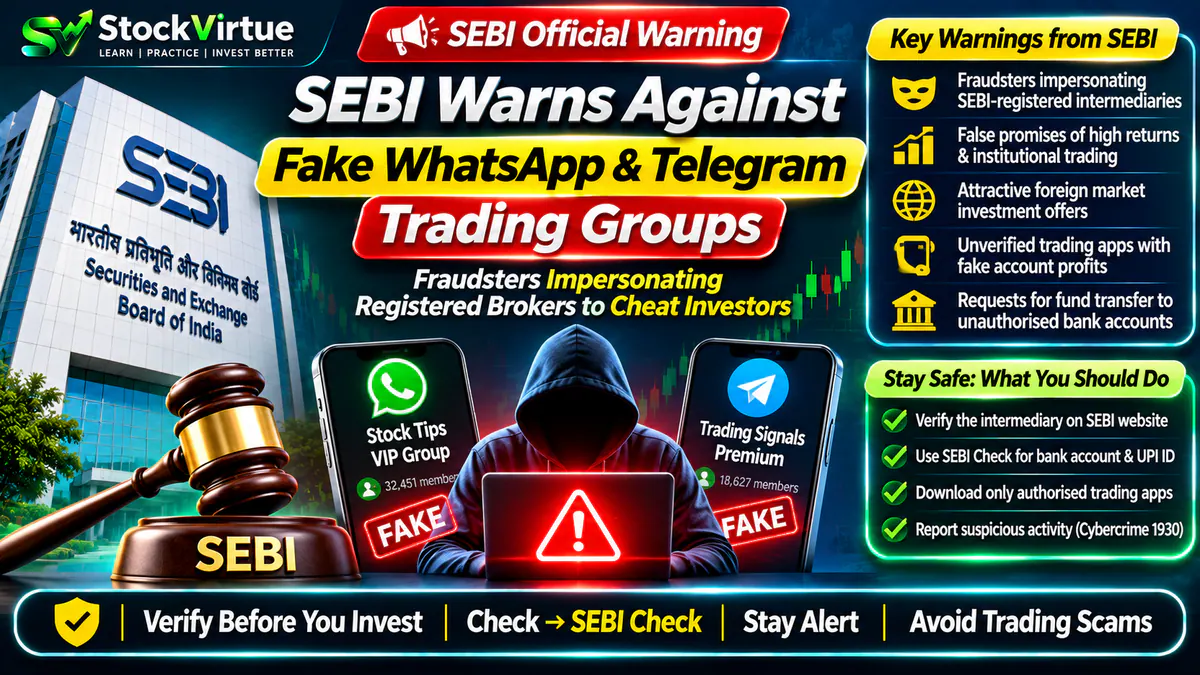
SEBI has cautioned investors against fraudsters impersonating registered stock market intermediaries through private WhatsApp and Telegram groups. Scammers are reportedly using fake institutional trading opportunities, foreign market investment promises and unauthorised trading applications to deceive retail investors.
The Securities and Exchange Board of India (SEBI) has issued a fresh warning to investors about fraudulent investment schemes operating through closed social media groups, particularly WhatsApp and Telegram.
In its Press Release No. 76/2026, dated November 23, 2026, the market regulator highlighted how fraudsters are impersonating SEBI-registered intermediaries to create an impression of legitimacy and persuade investors to open trading accounts on unauthorised platforms.
According to the regulator, these operators are attracting investors with promises of institutional trading opportunities, attractive returns from international markets and opportunities to recover losses suffered in Indian equities.
Investors are subsequently encouraged to download unverified trading applications, follow stock recommendations and transfer money into bank accounts belonging to unregistered entities.
The latest warning highlights the growing importance of verifying financial intermediaries, trading applications and payment details before participating in stock market activities.
1. What Has SEBI Warned Investors About?
SEBI has identified fraudulent operators who use closed social media groups to impersonate legitimate stockbrokers and other registered market intermediaries.
These groups are designed to appear professional and trustworthy. Fraudsters may use the names, registration details, logos, screenshots and other identifying information of genuine financial institutions to convince investors that they are dealing with authorised market participants.
The regulator has observed that investors are being attracted through purported institutional trading opportunities, with international stock markets portrayed as more lucrative than Indian markets.
Fraudsters may provide recommendations on shares, stocks and indices listed on both domestic and international exchanges.
After gaining an investor's confidence, they direct the individual towards unauthorised trading platforms and request money transfers to bank accounts belonging to unregistered entities.
SEBI's warning makes it clear that investors should independently verify the identity and registration status of anyone offering investment advisory or trading-related services.
2. How Do Fake WhatsApp and Telegram Trading Groups Operate?
Fraudulent trading groups often follow a structured approach to gain investor confidence.
Step 1: Sending invitations to private groups
Investors may receive invitations through social media platforms, unknown phone numbers or unsolicited messages.
The invitation may promote a VIP trading community, institutional trading service or exclusive stock market research group.
Step 2: Creating an impression of legitimacy
Fraudsters may impersonate a registered stockbroker, investment adviser or research analyst.
They may misuse genuine company names, registration details, screenshots of SEBI's website and other official-looking material.
Some groups may also contain members who publish fabricated profit screenshots and testimonials to create the impression that other investors are earning money.
Step 3: Offering attractive investment opportunities
The group administrators may promote:
Institutional trading opportunities.
Off-market negotiated block trades.
International stock market opportunities.
Special trading accounts.
Opportunities to recover losses from Indian investments.
Claims of steady investment growth.
These claims can make inexperienced investors believe they are receiving access to opportunities normally available only to large financial institutions.
Step 4: Directing investors to fake trading applications
Once investors become interested, the operators may ask them to download an unauthorised trading application.
These applications may display fabricated account balances, portfolio holdings, profits and transaction histories.
The displayed information can create the false impression that the investor's money has been successfully invested in the market.
Step 5: Collecting money through unauthorised bank accounts
Investors may eventually be instructed to transfer money into bank accounts or payment channels that do not belong to the genuine SEBI-registered intermediary.
This is a critical warning sign because the investor may believe the payment is being made to a legitimate broker when it is actually being directed elsewhere.
3. Seven Warning Signs Investors Should Never Ignore
SEBI has highlighted several suspicious practices associated with these fraudulent groups.
Warning sign | Why it matters |
|---|---|
Invitations from unknown sources | Fraudsters may use unsolicited invitations to attract investors |
Administrators using foreign or Indian mobile numbers | Phone numbers alone do not establish an intermediary's identity |
Promises to recover Indian portfolio losses | These claims may be used to exploit investors who have already suffered losses |
Institutional or off-market trading offers | Fraudsters may use professional-sounding terminology to create false credibility |
Fake institutional trading accounts | Investors may be shown accounts that are not connected to genuine market infrastructure |
Unverified trading applications | Displayed balances and portfolio information may be fabricated |
Forged SEBI documents and employee connections | False official-looking material may be used to gain trust |
Another suspicious practice is the circulation of new invitation links after an earlier group has been suspended or removed.
Investors should be cautious if an administrator asks them to move to another private group without a verifiable explanation.
4. Why Are Fraudsters Promoting Foreign Stock Market Investments?
One of the notable aspects of SEBI's latest warning is the use of international market investment opportunities to attract Indian investors.
Fraudsters reportedly portray foreign stock markets as more lucrative than Indian equities.
They may claim that international trading offers special opportunities to recover losses suffered in domestic portfolios.
Such claims can appeal to investors who are looking for quick recovery after losing money in the Indian stock market.
However, overseas investment opportunities involve their own regulatory, currency, settlement, taxation and operational considerations.
An investment opportunity should never be considered legitimate simply because it is described as an institutional trade or an international market strategy.
Investors should verify the legal entity offering the service and independently understand the platform through which transactions are being conducted.
5. How to Verify Whether a Stockbroker or Investment Adviser Is SEBI Registered
Before opening a trading account or accepting investment-related services, investors should verify the intermediary's registration details.
SEBI provides an official facility through which investors can check the registration status of market intermediaries.
A safer verification process includes:
Visit the official SEBI website.
Find the intermediary registration section.
Search for the entity using its legal name or registration details.
Confirm that the registration information matches the organisation contacting you.
Independently visit the intermediary's official website using a verified address.
Confirm the communication channel before sharing personal or financial information.
Important: A fraudster may copy the registration number or name of a genuine broker. Finding a genuine entity in SEBI's database does not automatically prove that the person contacting you is authorised to represent that entity.
Always verify the contact details and official communication channels independently.
6. Use SEBI Check to Verify Bank Accounts and UPI IDs
SEBI has introduced the SEBI Check facility to help investors verify payment details associated with registered intermediaries.
Before transferring money to a financial intermediary, investors can use the facility to check relevant bank account details and UPI IDs.
The facility is particularly important when someone sends payment instructions through WhatsApp, Telegram or another messaging platform.
Investors should:
Verify the recipient's bank account details.
Check the UPI ID through the official SEBI Check facility.
Confirm that the legal account holder matches the registered intermediary.
Avoid transferring money to unrelated third-party accounts.
Never rely solely on a screenshot of a payment confirmation or registration certificate.
Official verification facility:
https://siportal.sebi.gov.in/intermediary/sebi-check
SEBI also provides UPI verification through its investor portal:
https://investor.sebi.gov.in/upi-verification.html
7. Download Only Authorised Trading Applications
Another important warning concerns fraudulent mobile trading applications.
Some unauthorised applications imitate genuine stockbroking platforms and display fabricated investment balances and portfolio information.
Investors should not download trading applications simply because a group administrator shares an installation link.
Instead, they should:
Visit the official website of the registered broker.
Follow the trading application link provided by that broker.
Check the relevant exchange's authorised mobile application list.
Look for the SEBI-supported verified label on eligible stock trading applications in the Google Play Store.
Check the developer's identity and official application details before installation.
SEBI maintains information about authorised mobile applications and investor verification facilities through its investor support portal.
Official reference:
https://investor.sebi.gov.in/Investor-support.html
8. What Should Investors Do If They Encounter a Suspicious Trading Group?
Investors should avoid engaging with suspicious administrators or transferring money while attempting to verify an investment offer.
If a suspicious group or fraudulent trading platform is encountered:
Do not transfer funds.
Do not share OTPs, passwords, PINs or remote-access permissions.
Do not upload identity documents to an unverified application.
Preserve relevant messages, phone numbers, payment instructions and screenshots.
Verify the intermediary independently through SEBI.
Report suspected cyber financial fraud through the official cybercrime reporting system.
If money has already been transferred, contact your bank immediately and report the incident through India's cybercrime helpline 1930 or the official portal:
For securities-market-related complaints against registered intermediaries, investors can also use SEBI's SCORES grievance-redressal platform:
9. Why This Warning Matters for India's Retail Investors
India's stock market has become increasingly accessible through mobile applications, digital brokerage accounts and online financial education platforms.
While digital access has made investing more convenient, it has also created opportunities for impersonation, fraudulent trading applications and misleading investment promotions.
The problem is particularly serious when fraudsters use the identities of genuine financial institutions.
A person may see a familiar broker's name, official-looking registration certificate or apparently profitable trading account and assume that the opportunity is genuine.
SEBI's latest warning reinforces an important principle: investors must verify the identity of the intermediary, the authenticity of the trading application and the destination of their payments before investing.
Financial education is not just about understanding stocks, technical indicators and portfolio returns. It also includes knowing how to identify fraudulent investment activities.
10. SEBI's Earlier Investor Protection Warnings
The November 23 announcement builds on the regulator's continuing efforts to address financial fraud on social media platforms.
In October 2026, SEBI also issued a caution concerning stock tips offered through invitation-only WhatsApp groups.
That warning highlighted unregistered operators posing as market experts and using false profit claims to encourage investors to follow unauthorised trading calls.
The latest announcement places additional emphasis on impersonation of registered intermediaries, fake institutional accounts, foreign-market investment pitches and unauthorised payment channels.
Together, these warnings underline the need for investors to independently verify financial services instead of relying on social media claims.
Conclusion: Verify Before You Invest
SEBI's latest warning against fake WhatsApp and Telegram trading groups highlights a growing concern for retail investors participating in India's securities market.
Fraudsters are using the identities of registered intermediaries, fabricated trading applications, false institutional opportunities and international investment promises to gain investor confidence.
The safest approach is to verify every intermediary, trading application and payment destination through official channels before transferring money.
Investors should remember that a professional-looking WhatsApp group, a registration certificate screenshot or a displayed trading profit does not prove that an investment platform is genuine.
Check the intermediary. Validate the payment details. Verify the trading application. Invest only after independent verification.
Sources
- Securities and Exchange Board of India (SEBI)