
Official updates
Federal Reserve Survey Reveals How Banks Are Managing Liquidity: Reserve Buffers, Money Markets and Weekend Banking in Focus
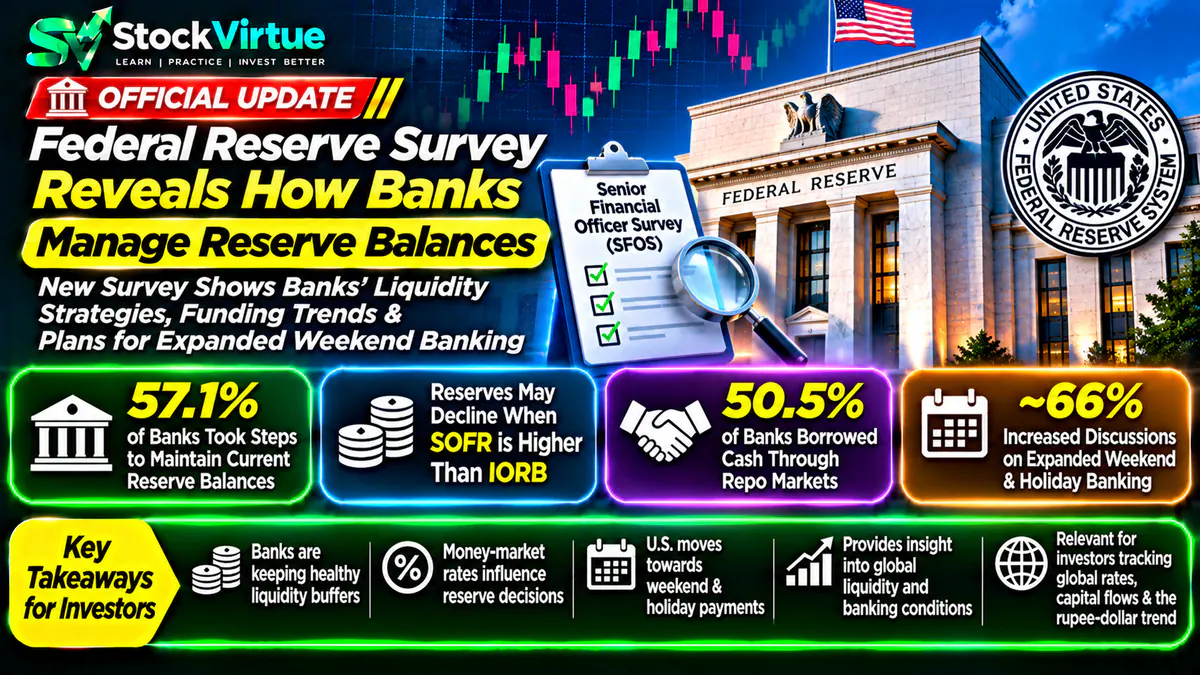
The US Federal Reserve has released new findings on how banks are managing their cash reserves, accessing short-term funding markets and preparing for changes in banking operations over weekends and holidays.
The report, published on November 20, 2026, is based on the Federal Reserve's September 2026 Senior Financial Officer Survey. It provides an inside look at how banks assess their liquidity requirements, manage reserve balances and respond to changing money-market conditions.
The survey collected responses from 91 banks, including 56 domestic US banks and 35 foreign banking organisations. Together, these institutions held approximately three-fourths of total banking-system reserve balances when the survey was conducted.
One of the most important findings is that more than half of the participating banks had taken steps to maintain their existing reserve levels. The survey also found that internal liquidity stress requirements were a major consideration when banks decided how much cash to keep available.
For global financial markets, these findings offer useful insight into the banking system's liquidity preferences and the way financial institutions prepare for potential funding pressure.
Although the report focuses on US banks rather than Indian banks, its findings are relevant to investors following global interest rates, banking liquidity, money markets and central-bank operations.
1. What has the Federal Reserve announced?
The Board of Governors of the Federal Reserve System released the latest results of its Senior Financial Officer Survey (SFOS) on November 20, 2026.
The survey was conducted jointly with the Federal Reserve Bank of New York between September 18 and September 28, 2026.
The research was designed to understand four important areas:
How banks determine the minimum reserve balances they are comfortable holding.
How institutions expect their balance sheets and deposits to change.
How banks participate in short-term funding markets.
How financial institutions are preparing for expanded payment-system operating hours.
The survey was distributed to senior financial officers at 100 banks, and 91 institutions provided responses included in the published report.
Importantly, the Federal Reserve uses the survey to gather information for internal analytical purposes. It is not a stress-test result, a regulatory enforcement announcement or a declaration that the banking system is facing a liquidity crisis.
2. More than half of banks are focused on maintaining reserve balances
One of the key findings concerns the way banks have managed their reserve positions over recent months.
The survey asked institutions whether they had taken steps to increase, decrease or maintain their reserve balances.
Reserve management strategies reported by banks
Reserve management approach | Banks | Share of respondents |
|---|---|---|
Maintaining existing reserve levels | 52 | 57.1% |
Decreasing or limiting reserve growth | 15 | 16.5% |
Increasing or limiting reserve declines | 6 | 6.6% |
Limited or no active reserve-management action | 18 | 19.8% |
Total | 91 | 100% |
The findings show that approximately 57% of respondents had taken actions intended to maintain their current reserve balances.
This is significant because reserves are an important source of liquidity for banks.
Financial institutions need sufficient available funds to manage customer withdrawals, payments, settlements and other obligations.
Maintaining reserve balances can therefore be part of a bank's broader liquidity-management strategy.
However, the result should not be interpreted as evidence that every bank is experiencing funding stress. The survey describes institutions' reported management strategies, not a direct measurement of distress.
3. Why do banks maintain reserve balances?
To understand the survey, it is important to understand what bank reserves actually represent.
Banks hold reserve balances in accounts at the Federal Reserve. These balances help institutions settle payments and meet liquidity requirements.
A bank cannot simply use all its available funds for lending or investment because it must also maintain sufficient liquidity to meet expected and unexpected obligations.
The Federal Reserve survey uses a measure called the Lowest Comfortable Level of Reserves (LCLOR).
This represents the lowest reserve balance a bank would feel comfortable holding before taking active steps to replenish or increase its reserves.
Such steps could include:
Borrowing in the federal funds market.
Raising funds through wholesale funding markets.
Reducing holdings of other liquid assets.
Offering more attractive deposit rates to attract funds.
The concept helps explain why banks may maintain reserve buffers even when they are not facing immediate liquidity problems.
Internal liquidity stress testing is a major factor
The survey asked banks to identify the most important factors influencing their preferred reserve levels.
The most frequently identified leading consideration was meeting internal liquidity stress metrics.
In simple terms, banks want to ensure they can meet projected cash outflows even under difficult financial conditions.
These conditions may include unusually large customer withdrawals, market disruptions or unexpected payment obligations.
For banks, maintaining a comfortable liquidity buffer is not just about day-to-day transactions. It is also about being prepared for situations in which access to funding becomes more difficult.
4. How interest-rate differences could influence bank reserves
Another important part of the report examined how banks might change their reserve balances under different interest-rate conditions.
The Federal Reserve compared two important US money-market rates:
SOFR: The Secured Overnight Financing Rate, a benchmark reflecting the cost of overnight borrowing backed by US Treasury securities.
IORB: The Interest on Reserve Balances rate, which is the rate the Federal Reserve pays eligible institutions on reserve balances held at the central bank.
The difference between these rates can influence the financial attractiveness of holding reserves compared with lending funds in the market.
The survey tested hypothetical situations in which SOFR was higher or lower than IORB.
What happens when SOFR rises above IORB?
When the SOFR rate is higher than the IORB rate, banks may find it more attractive to deploy some of their reserve balances into alternative short-term funding opportunities.
In the survey's scenario where SOFR was 5 basis points above IORB:
Expected reserve response | Banks | Share |
|---|---|---|
Decrease reserve balances | 44 | 48.4% |
Increase reserve balances | 2 | 2.2% |
Keep reserve balances unchanged | 45 | 49.5% |
The response became more pronounced under wider hypothetical spreads.
When SOFR was 10 basis points above IORB, approximately 56% of respondents indicated that they would expect to reduce reserve balances.
At a 20-basis-point positive spread, approximately 69% expected reserves to decline.
This demonstrates that changes in the relative attractiveness of short-term funding rates can influence how banks manage liquidity.
However, these are hypothetical survey responses. They are not forecasts of an actual reduction in the banking system's reserve balances.
5. Banks expect balance sheets and deposits to remain broadly stable
The survey also asked financial officers about their expectations for the next 12 months.
The responses indicate that most participating banks expect their balance sheets and deposit levels to remain relatively stable or grow moderately.
Banks' expectations over the next 12 months
Indicator | Expected outcome | Average probability |
|---|---|---|
Total balance sheet | Remain flat or grow up to 5% | 57.3% |
Total balance sheet | Grow more than 5% | 33.4% |
Total deposits | Remain flat or grow up to 5% | 56.2% |
Total deposits | Grow more than 5% | 36.2% |
Preferred reserve levels | Remain within ±5% | 70.0% |
These figures represent average probabilities assigned by survey respondents to different possible outcomes. They are not actual growth rates or guaranteed forecasts.
The results suggest that participating banks generally expect their balance sheets and deposits to remain stable or expand modestly.
For financial-market observers, deposit trends are particularly important because deposits represent a major source of bank funding.
Changes in deposit levels can influence how banks manage liquidity, funding costs and lending capacity.
6. Federal funds and repo markets remain important funding channels
The Federal Reserve also examined how participating banks use short-term wholesale funding markets.
Two important markets covered in the report were:
Federal funds market: A market in which eligible financial institutions lend and borrow reserve balances, generally on an overnight basis.
Repurchase agreement (repo) market: A funding market in which securities are used as collateral for short-term borrowing.
Bank participation in funding markets
Market activity | Active participants |
|---|---|
Borrowing in the federal funds market | 45.1% |
Borrowing cash through repo markets | 50.5% |
Lending in the federal funds market | 5.5% |
Lending cash through repo markets | 39.6% |
The results show that borrowing is more common than lending among the participating institutions in these particular survey measures.
Price was the most frequently identified leading constraint for banks that actively borrowed in these markets.
For institutions that did not participate as active borrowers, a preference for alternative overnight funding sources was frequently cited.
The findings illustrate how banks choose between different funding options depending on pricing, liquidity requirements and internal risk-management policies.
7. Weekend banking and expanded Federal Reserve payment hours
One of the more interesting sections of the survey concerns the future expansion of payment-system operating hours.
The Federal Reserve previously announced plans to expand the operating days of two major payment services:
Fedwire Funds Service.
National Settlement Service (NSS).
The expansion is intended to include Sundays and weekday holidays.
According to the Federal Reserve's report, implementation is expected no earlier than 2028, allowing financial institutions and payment-system participants time to prepare.
The September survey examined how banks are responding to the planned changes.
What banks reported
Approximately two-thirds of respondents said their institutions had increased internal discussions about expanded operating hours.
Around one-third reported that they were offering or planning to offer additional payment and liquidity-management options to customers on weekends and holidays.
Nearly two-thirds of domestic-bank respondents considered it important to have access to discount-window borrowing during at least some Sunday and weekday-holiday hours.
The discount window is a Federal Reserve facility through which eligible institutions can borrow directly from the central bank, subject to applicable conditions.
The findings suggest that expanded payment-system hours could require changes to bank liquidity planning, staffing, funding arrangements and customer services.
However, the survey does not indicate that all banks will immediately introduce full weekend banking services.
8. What does the Federal Reserve survey mean for global financial markets?
The survey does not announce a change in US monetary policy or provide a direct signal about the next Federal Reserve interest-rate decision.
Its importance lies in the information it provides about bank liquidity behaviour.
There are several areas global investors may find useful.
A. Liquidity management remains a central banking priority
The fact that 57.1% of respondents reported actions to maintain their current reserve levels highlights the importance banks place on managing liquidity buffers.
B. Money-market rates influence reserve decisions
The hypothetical SOFR-IORB scenarios demonstrate that banks' willingness to hold reserves can change when alternative short-term funding returns become more attractive.
C. Funding-market conditions matter
Participation in federal funds and repo markets provides insight into how institutions obtain short-term funding and manage their cash requirements.
D. Payment infrastructure is evolving
The planned expansion of Federal Reserve payment-system operating hours could influence how banks organise their liquidity and operational processes.
These observations can help investors understand the broader financial environment, but they should not be used alone to predict stock-market movements or interest-rate decisions.
9. Why should Indian investors follow this US banking development?
Although the survey covers US banks, its findings are relevant to Indian investors interested in global financial conditions.
The United States remains one of the most important centres of international banking and financial markets.
Changes in US liquidity conditions can influence short-term interest rates, Treasury markets, dollar funding conditions and international capital flows.
For India, several channels deserve attention.
RBI monetary policy: Changes in US interest-rate expectations can influence global monetary conditions, although the Reserve Bank of India makes policy decisions based on India's own economic conditions.
Foreign investment: Global funding conditions and investor risk appetite can influence capital flows into emerging markets, including India.
Rupee-dollar movement: Changes in dollar demand, global interest-rate differences and capital flows can affect the Indian currency.
Banking-sector sentiment: International developments can influence how investors assess funding costs, liquidity and financial-sector risks.
It is important to distinguish between a US banking survey and an RBI assessment. The Federal Reserve's findings do not directly describe Indian banks or establish that India's banking system is facing the same conditions.
10. What should investors monitor next?
Investors following global financial markets can keep an eye on several indicators connected with the survey.
Indicator | Why it matters |
|---|---|
SOFR and IORB spread | Shows the relative attractiveness of market funding and reserve balances |
Federal funds rate | Important benchmark for US overnight funding conditions |
US Treasury yields | Influences global borrowing costs and investment valuations |
Bank deposit trends | Helps assess the funding position of financial institutions |
Repo market conditions | Provides insight into short-term secured funding |
Federal Reserve policy announcements | Influences expectations about liquidity and interest rates |
RBI liquidity operations | Important for assessing domestic Indian banking liquidity |
These indicators provide a broader picture of global financial conditions and should be interpreted alongside economic data, bank earnings and central-bank policy statements.
StockVirtue Market Takeaway
The Federal Reserve's latest Senior Financial Officer Survey provides a detailed look at how banks are managing liquidity and preparing for changes in financial-market operations.
The most notable findings include:
57.1% of respondents reported taking steps to maintain existing reserve balances.
Internal liquidity stress metrics were a major factor influencing preferred reserve levels.
Almost half of participating banks expected reserves to decline under a hypothetical scenario where SOFR was 5 basis points above IORB.
Half of respondents reported active cash borrowing in repo markets.
Around two-thirds reported increased internal discussions about expanded weekend and holiday operations.
The findings highlight the importance of liquidity management in the banking system and demonstrate how short-term interest-rate differences can influence reserve decisions.
For Indian investors, the report is useful background on the US financial system and the global liquidity environment. However, it should not be interpreted as a direct prediction of Indian interest rates, RBI policy or stock-market performance.
StockVirtue — Learn | Practice | Invest Better
Disclaimer: This article is for educational and informational purposes only and does not constitute investment, banking or monetary-policy advice. It is an independent explanation of the Federal Reserve's September 2026 Senior Financial Officer Survey, released on November 20, 2026. Survey responses reflect the views of participating institutions and hypothetical scenarios; they are not guaranteed forecasts or actual market outcomes. Readers should consult the original Federal Reserve report for full details.
Sources
- Board of Governors of the Federal Reserve System · Published 20 Nov 2026, 8:30 pm IST