Official updates
NSE Tightens Rules for Retail Algo Trading: Static IP Access Restricted to Genuine Tech-Savvy Investors
NSE tightens retail algo trading compliance, restricting tech-savvy static IP access to investors who develop their own algorithms. Understand the new rules and penalties.
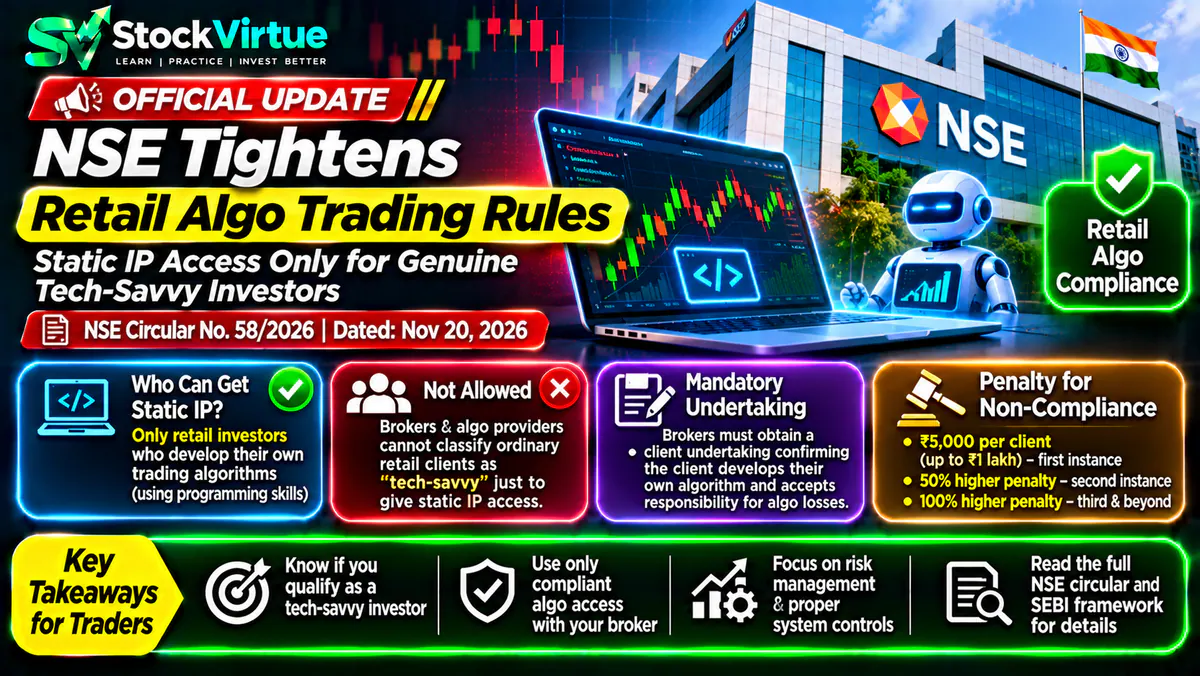
The National Stock Exchange of India (NSE) has issued a fresh circular tightening compliance requirements for retail algorithmic trading, specifically targeting the misuse of static IP facilities by certain algo providers.
In its circular dated November 20, 2026, the exchange clarified that static IP access under the special provision for tech-savvy retail investors is intended only for individuals who develop their own algorithmic trading strategies using programming knowledge.
The exchange has also directed trading members and empanelled algo providers not to classify ordinary retail clients as tech-savvy investors merely to provide them with static IP access.
The clarification is important for retail traders who use broker APIs, automated trading systems and third-party algorithmic strategies. It also reinforces the responsibilities of brokers and technology providers under India's retail algo-trading framework.
For investors, the development highlights an important shift in the regulatory approach: access to automated trading facilities must be supported by appropriate technical capability, broker oversight and compliance documentation.
1. What has NSE announced?
NSE issued Circular No. 58/2026 on November 20, 2026, through its Inspection Department.
The circular refers to the existing regulatory framework for safer participation of retail investors in algorithmic trading, introduced by SEBI and subsequently implemented by the exchanges.
The exchange said it had received complaints about the misuse of static IP facilities after the retail algo framework became operational on April 1, 2026.
It also observed that certain exchange-empanelled algo providers were supplying static IP facilities to retail customers by presenting them as tech-savvy investors, even when they did not meet the prescribed definition.
NSE has now reiterated that this practice is not permitted.
The latest circular is effective immediately:
The central clarification: A retail investor cannot qualify for the special tech-savvy category simply by purchasing an automated strategy or subscribing to an algo provider's service. The investor must actually develop their own algorithm using programming knowledge.
2. What is a static IP address, and why does it matter in algo trading?
A static IP address is an internet address that remains fixed rather than changing periodically.
In algorithmic trading, static IP addresses help brokers identify and control the network locations from which clients or approved systems connect to their trading infrastructure.
For example, imagine a trader develops an automated trading strategy using a computer and programming tools.
The strategy connects to a broker's API and sends orders based on predefined conditions.
A static IP can help the broker identify the authorised connection and apply appropriate access controls.
This is important because automated trading systems can generate orders without the trader manually placing each order.
Without appropriate controls, unauthorised access, poorly configured strategies or misuse of API credentials can create operational and financial risks.
Static IP restrictions are therefore part of the wider framework intended to improve traceability, security and accountability in retail algo trading.
3. Who qualifies as a tech-savvy retail investor?
The NSE circular refers to SEBI's definition of a tech-savvy retail investor.
Under this category, the investor must develop their own algorithmic trading strategies using programming knowledge.
This distinction matters because developing an algorithm is different from simply using an existing automated trading product.
Consider these examples:
Trading activity | Tech-savvy investor classification |
|---|---|
Developing your own trading algorithm using Python | May qualify, subject to applicable requirements |
Writing your own API-based trading logic | May qualify, subject to applicable requirements |
Purchasing an automated strategy from a provider | Does not automatically qualify |
Subscribing to a ready-made algo trading service | Does not automatically qualify |
Using a third-party strategy without developing it yourself | Does not automatically qualify |
Manually placing orders through a broker's trading application | Not the special tech-savvy algo category |
The important distinction is ownership and development of the algorithmic logic, not simply technical familiarity with trading applications.
Meeting this definition does not automatically exempt an investor from other applicable algo registration, broker API, exchange and risk-control requirements.
4. What exactly must brokers and algo providers do?
NSE has made the responsibilities of trading members and empanelled algo providers clearer.
The latest circular sets out the following requirements.
A. Static IP access must be restricted
Static IP facilities under the tech-savvy retail investor provision must only be provided to retail investors who genuinely develop their own algorithms using programming knowledge.
Brokers and algo providers must not extend this classification to ordinary retail customers simply to provide them with access to automated trading.
B. Brokers must obtain a formal undertaking
Trading members registering a client under the tech-savvy category must obtain an undertaking confirming that the client meets SEBI's definition.
The undertaking must also acknowledge that the investor is developing their own algorithms using programming knowledge.
C. The undertaking must address responsibility for algo losses
NSE requires the undertaking to include an acknowledgement that the investor, as a tech-savvy client developing their own algorithm, will have no recourse to the exchange's Investor Grievance mechanism in the event of losses incurred because of the logic of the algorithm used.
This is an important distinction: the specified acknowledgement relates to losses arising from the investor's own algorithm logic. It should not be interpreted as a blanket removal of every investor protection or grievance right for unrelated broker or exchange service issues.
D. Compliance will be monitored
The exchange has stated that it will closely monitor brokers and empanelled algo providers to ensure compliance.
This places greater responsibility on firms that provide automated trading facilities to retail investors.
5. What penalties can brokers and algo providers face?
NSE has specified consequences for non-compliance.
The circular identifies a penalty where a trading member fails to obtain the required undertaking from a tech-savvy retail client.
Penalty structure for trading members
Violation | Regulatory consequence |
|---|---|
First instance of failure to obtain undertaking | ₹5,000 per client, subject to a maximum of ₹1 lakh |
Second instance | 50% escalation in the penalty |
Third instance and subsequent violations | 100% escalation as specified in the circular |
The exchange has also clarified that the empanelment status of an algo provider may be reviewed if violations are identified.
Depending on the circumstances, the provider's empanelment may be suspended or revoked.
These provisions increase the importance of maintaining proper client classification, documentation and compliance records.
6. How does this connect with SEBI's retail algo-trading framework?
The latest NSE circular is not an entirely new retail algo-trading framework.
It is a compliance clarification under the existing framework introduced by SEBI.
SEBI issued its original circular on February 4, 2025, titled Safer participation of retail investors in Algorithmic Trading.
The framework was designed to establish clearer responsibilities for:
Retail investors.
Stock brokers.
Stock exchanges.
Third-party algo providers.
Technology vendors.
The objective was to enable retail participation in algorithmic trading while maintaining appropriate controls over order execution, API access, risk management and accountability.
Following implementation-related extensions and exchange guidance, the retail algo framework became operational from April 1, 2026.
NSE's November 20 circular now addresses a specific compliance concern: the misuse of the special static IP arrangement intended for retail investors who develop their own algorithms.
This shows that the regulatory focus is moving beyond simply introducing rules towards monitoring how brokers and providers actually implement them.
7. What does the circular mean for ordinary retail traders?
For most retail investors, the practical impact will depend on how they access automated trading.
If you manually trade through a broker application
The circular does not introduce a new requirement for ordinary manual trading simply because you use a trading application.
If you use a ready-made algo service
You should not assume that purchasing an automated strategy makes you a tech-savvy retail investor.
Your broker and the algo provider must ensure that your access is structured under the applicable regulatory requirements.
If you develop your own trading algorithms
You may fall within the tech-savvy category if you meet the prescribed definition.
However, you must also follow the applicable broker API, static IP, undertaking, registration and other exchange requirements.
If you provide algo trading services
The circular makes proper classification and documentation particularly important.
Providers must not present ordinary subscribers as self-developing algo traders merely to obtain static IP facilities.
8. Does this affect F&O traders?
The circular is relevant to the wider retail algorithmic-trading ecosystem, including strategies that may trade futures and options.
Automated F&O strategies can involve rapid order generation, multiple positions, leverage and complex risk exposures.
A technical failure or incorrectly configured algorithm can therefore create significant losses.
For example, consider a hypothetical options strategy that automatically sells an option when a particular market condition is detected.
If the strategy has an incorrect stop-loss condition or repeatedly sends orders because of a programming error, the resulting exposure may be very different from what the trader intended.
This is why the regulatory framework places importance on broker oversight, traceability and proper control of algorithmic order execution.
However, the November 20 circular specifically addresses static IP access and the tech-savvy retail investor classification. It should not be presented as a new blanket restriction on all F&O trading or all retail API users.
9. What should investors and brokers do now?
The latest NSE circular is effective immediately, so the relevant participants should review their existing arrangements.
For retail investors:
Understand whether your trading strategy is self-developed or supplied by a third party.
Confirm that your broker has classified your algo access correctly.
Understand the responsibilities described in any undertaking before signing it.
Never share API credentials or static IP access without understanding the security implications.
Use appropriate risk limits and monitor automated positions.
For brokers:
Review clients registered under the tech-savvy category.
Verify that the required undertaking is obtained.
Check that static IP facilities are provided only to eligible clients.
Review arrangements involving third-party algo providers.
Maintain documentation to demonstrate compliance.
For algo providers:
Review existing client onboarding and classification practices.
Avoid offering the tech-savvy classification to customers who do not meet the definition.
Coordinate with brokers to ensure the applicable exchange requirements are followed.
10. Why this development matters for India's retail trading ecosystem
Algorithmic trading is becoming increasingly accessible to individual investors.
Broker APIs, cloud infrastructure, programming tools and third-party trading platforms have lowered the technical barriers to building automated strategies.
However, accessibility also creates new risks. A retail investor may not fully understand the behaviour of an automated system, the risks of leveraged positions or the consequences of a programming error.
The NSE clarification highlights the importance of distinguishing between someone who independently develops a trading algorithm and someone who simply purchases access to an automated product.
For India's growing retail trading ecosystem, the long-term objective is not necessarily to discourage technology-driven participation.
It is to ensure that access, responsibility and risk controls are properly defined.
StockVirtue — Learn | Practice | Invest Better
Disclaimer: This article is for educational and informational purposes only. It is an independent explanation of an official exchange circular and does not constitute legal, investment or trading advice. The regulatory requirements described are based on NSE Circular No. 58/2026 dated November 20, 2026. Readers, brokers and algo providers should consult the complete official circular and applicable SEBI regulations for their specific circumstances.