
Official updates
US Multinational Companies Employ 44.2 Million People Worldwide; India Among Top Overseas Employment Destinations
US multinational companies employed 44.2 million people worldwide in 2024. The BEA report highlights India's role, global investment and R&D spending.
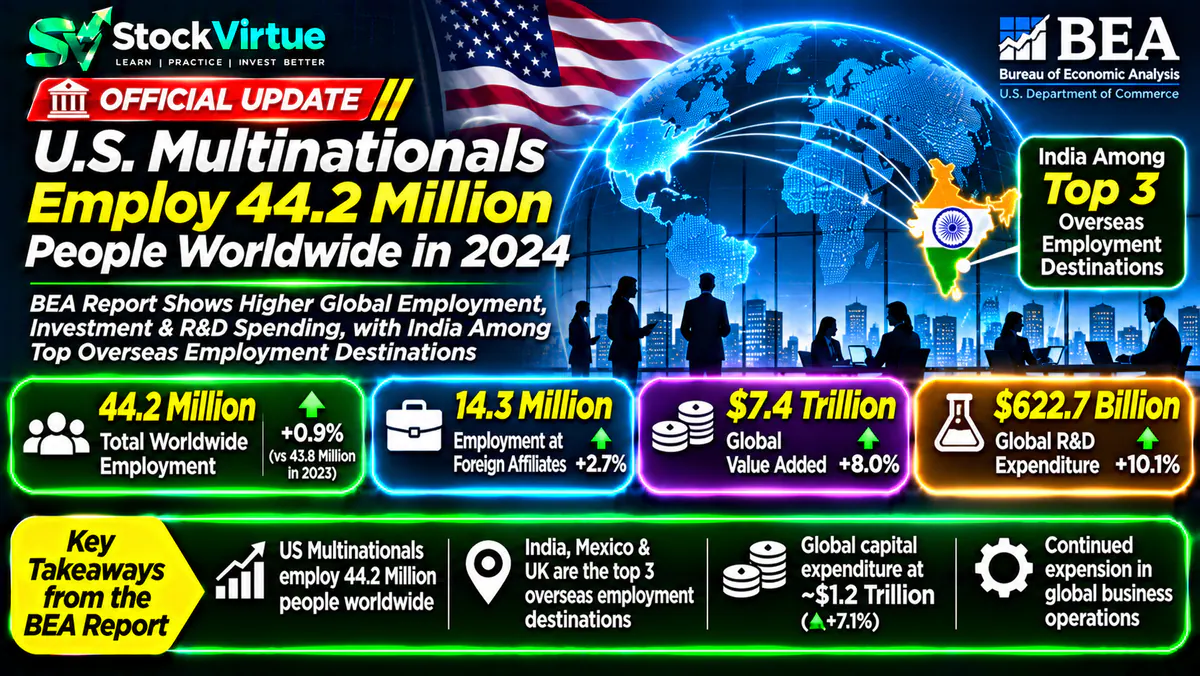
US multinational companies continued expanding their global business footprint in 2024, with worldwide employment reaching 44.2 million workers, according to newly released statistics from the US Bureau of Economic Analysis (BEA).
The latest report, titled Activities of U.S. Multinational Enterprises, 2024, shows that employment across US parent companies and their majority-owned foreign affiliates increased by 0.9% compared with 2023.
One of the most notable findings for international investors is India's position among the three largest overseas employment destinations for foreign affiliates of US multinational enterprises. Mexico and the United Kingdom were the other two leading destinations.
Beyond employment, the report highlights an expansion in global business activity, capital expenditure and research and development spending. Worldwide value added by US multinational enterprises increased to $7.4 trillion, while their global research and development expenditure reached $622.7 billion.
The findings provide an important picture of how American multinational businesses are contributing to economic activity across domestic and international markets.
For India, the report offers useful insight into the country's role in global business operations, although it does not provide a specific India-only employment total in its headline findings.
1. Global employment by US multinational companies rises to 44.2 million
The BEA reported that worldwide employment by US multinational enterprises increased from 43.8 million in 2023 to 44.2 million in 2024.
This represents growth of approximately 0.9%.
The statistics cover employment at US parent companies and their majority-owned foreign affiliates.
Global employment breakdown
Employment category | 2023 revised | 2024 preliminary |
|---|---|---|
US parent companies | 29.8 million | 29.9 million |
Foreign affiliates | 14.0 million | 14.3 million |
Worldwide total | 43.8 million | 44.2 million |
The domestic workforce of US parent companies increased by just 0.1%, while employment at their overseas affiliates grew by 2.7%.
This indicates that overseas operations recorded a faster employment growth rate than the US-based parent companies during the reporting year.
Foreign affiliates accounted for 32.4% of worldwide employment by US multinational enterprises in 2024, compared with 31.9% in 2023.
The figures suggest that international operations remain an important part of the workforce structure of large American businesses.
2. India ranks among the leading overseas employment destinations
One of the most relevant findings for Indian readers is the country's position among the largest employment destinations for foreign affiliates of US multinational enterprises.
According to the BEA, employment at these overseas affiliates was largest in:
India
Mexico
United Kingdom
This is an important indicator of India's participation in international business operations.
American multinational companies operate across several industries, including manufacturing, technology, business services, retail and other commercial activities.
Their overseas operations can contribute to employment, supplier relationships, investment activity and participation in international supply chains.
However, the BEA's headline announcement does not disclose a separate employment total for India. Therefore, India's exact share of the 14.3 million overseas jobs should not be inferred from the overall figures.
Why India's position matters
India's presence among the leading overseas employment destinations highlights its importance in the international operating networks of US multinational companies.
For the Indian economy, this is relevant in several ways:
Employment opportunities: International business operations can support direct and indirect employment.
Technology and services: Multinational companies can create demand for skilled professionals and specialised services.
Supply-chain participation: Indian businesses may become suppliers and service partners to international companies.
Investment activity: Expansion of overseas operations can involve spending on facilities, equipment and business infrastructure.
International trade: Cross-border business operations can contribute to trade in goods and services.
These are potential economic channels, not proof that every multinational investment automatically creates the same level of benefit for the domestic economy.
3. Global business value added increases to $7.4 trillion
The employment figures are only one part of the report.
The BEA also found that worldwide current-dollar value added by US multinational enterprises increased by 8.0% in 2024, reaching approximately $7.4 trillion.
Value added measures the contribution made by a business to economic output. It is different from revenue or total sales.
Value added by US multinational enterprises
Business category | 2024 value added | Annual growth |
|---|---|---|
US parent companies | $5.7 trillion | +8.5% |
Foreign affiliates | $1.8 trillion | +6.5% |
Worldwide total | $7.4 trillion | +8.0% |
US parent companies accounted for 21.8% of total US private-industry value added in 2024, compared with 21.2% in 2023.
This shows the substantial contribution of US multinational parent companies to domestic economic activity.
For foreign affiliates, value added was largest in the United Kingdom, Ireland and Canada.
The data suggests that the economic contribution of American multinational companies extends well beyond their domestic operations.
4. Capital expenditure rises as companies invest in business infrastructure
Another important finding concerns spending on property, plant and equipment.
Worldwide capital expenditure by US multinational enterprises increased by 7.1% to approximately $1.2 trillion in 2024.
This spending includes investment in physical business assets such as buildings, machinery, equipment and other infrastructure.
Capital expenditure breakdown
Category | 2024 expenditure |
|---|---|
US parent companies | $968.7 billion |
Foreign affiliates | $216.2 billion |
Worldwide total | Approximately $1.2 trillion |
The BEA also reported that spending by US parent companies represented 36.5% of all US private-business capital expenditure.
Capital investment is important because it can support production capacity, business expansion, operational efficiency and long-term economic activity.
For multinational companies, investment decisions across different countries can also reflect access to skilled labour, infrastructure, consumer markets and supply-chain opportunities.
However, the report does not establish that the increase in global capital spending was directed towards any particular country or industry.
5. Research and development expenditure crosses $622 billion
Research and development was another area of significant growth.
Worldwide R&D spending by US multinational enterprises increased by 10.1% to $622.7 billion in 2024.
This was faster than the reported growth in employment and capital expenditure.
R&D spending breakdown
Category | 2024 R&D expenditure |
|---|---|
US parent companies | $536.5 billion |
Foreign affiliates | $86.2 billion |
Worldwide total | $622.7 billion |
US parent companies accounted for 69.6% of all business R&D performed in the United States.
The increase in research spending highlights the importance of innovation and technology development in the operations of large multinational businesses.
R&D investment can support the development of new products, production processes, software, medicines and other technologies.
For countries seeking to attract multinational investment, research capabilities and skilled workforces can become important competitive advantages.
India's presence among the largest overseas employment destinations is relevant to this wider discussion, although the BEA's headline R&D figures do not establish India's individual share of foreign-affiliate research spending.
6. What does this report tell us about the US global business model?
The BEA statistics highlight three important features of US multinational operations.
First, domestic operations remain significant.
US parent companies accounted for approximately 67.6% of worldwide employment by these multinational enterprises.
This shows that the United States continues to host the majority of their combined workforce.
Second, international operations are expanding.
Employment at foreign affiliates increased by 2.7%, faster than employment at US parent companies.
The overseas workforce accounted for nearly one-third of total employment.
Third, investment in business assets and research remains substantial.
Capital expenditure reached approximately $1.2 trillion, while R&D spending increased to $622.7 billion.
Together, these findings show that multinational companies are important participants in employment, production, investment and innovation across multiple economies.
7. What could the findings mean for India?
India's position among the leading overseas employment destinations provides a useful starting point for understanding its relationship with US multinational businesses.
The data is relevant to several areas of the Indian economy.
Technology and business services
International companies operating in India can contribute to demand for software development, consulting, research, engineering and other specialised services.
Manufacturing and industrial supply chains
Multinational business operations can create opportunities for domestic suppliers, logistics providers, equipment manufacturers and industrial service companies.
Employment and skills
International operations may create demand for specialised skills and workforce training.
Foreign investment and economic activity
Business expansion by international companies can contribute to investment, commercial activity and connections with global markets.
However, readers should distinguish between the presence of US multinational affiliates in India and direct foreign investment inflows recorded by the Reserve Bank of India.
The BEA report measures the operations and finances of US parent companies and their majority-owned foreign affiliates. It is not an India-specific foreign direct investment release.
8. What should investors monitor after this report?
Although the BEA announcement is not a direct stock-market trigger, it provides useful background for investors following global economic and business trends.
The following areas deserve attention:
Indicator | Why it matters |
|---|---|
US corporate investment | Helps assess business expansion and capital spending |
Global employment trends | Provides insight into multinational workforce activity |
R&D expenditure | Indicates investment in innovation and technology |
Foreign affiliate activity | Shows the international operating footprint of US companies |
US economic growth | Influences multinational earnings and investment decisions |
India-US business activity | Relevant to India's participation in global supply chains |
Investors should combine these indicators with company earnings, sector-specific information and official Indian economic data before evaluating individual stocks or investment opportunities.
9. Understanding the data: Preliminary estimates and revisions
An important detail in the release is that the 2024 figures are preliminary.
The BEA has also revised its 2023 statistics using newly available and updated source information.
This means that the reported year-on-year changes compare preliminary 2024 estimates with revised 2023 estimates.
The agency provides additional data tables covering employment, capital expenditure, value added, research and development, sales, compensation, financial statements and international trade.
More detailed information is available by industry and country.
The next scheduled release, covering the activities of US multinational enterprises in 2025, is August 20, 2027.
StockVirtue Market Takeaway
The latest BEA report highlights the growing scale of international operations by US multinational companies.
Worldwide employment increased to 44.2 million in 2024, with overseas employment growing faster than employment at US parent companies.
India's position among the three largest foreign-affiliate employment destinations is particularly relevant for Indian readers, reflecting its participation in the international business networks of American companies.
The report also highlights substantial global investment, with value added reaching $7.4 trillion, capital expenditure rising to approximately $1.2 trillion and research spending reaching $622.7 billion.
For investors, the broader message is that multinational business activity should be evaluated through employment, investment, productivity and innovation—not just headline revenue figures.
StockVirtue — Learn | Practice | Invest Better
Disclaimer: This article is for educational and informational purposes only and does not constitute investment advice or a recommendation to buy or sell any security. The statistics are based on the US Bureau of Economic Analysis release dated November 20, 2026. Figures for 2024 are preliminary, while 2023 figures are revised. The report covers US parent companies and their majority-owned foreign affiliates and should not be interpreted as a direct measurement of India's total foreign investment, employment or economic growth.
Sources
- U.S. Bureau of Economic Analysis · Published 20 Nov 2026, 7:00 pm IST