Official updates
Result of the 4-day Variable Rate Repo (VRR) auction held on November 23, 2026
RBI allots ₹50,005 crore in its November 23 VRR auction against bids of ₹1,51,982 crore. Check the cutoff rate, weighted average rate and liquidity implications.
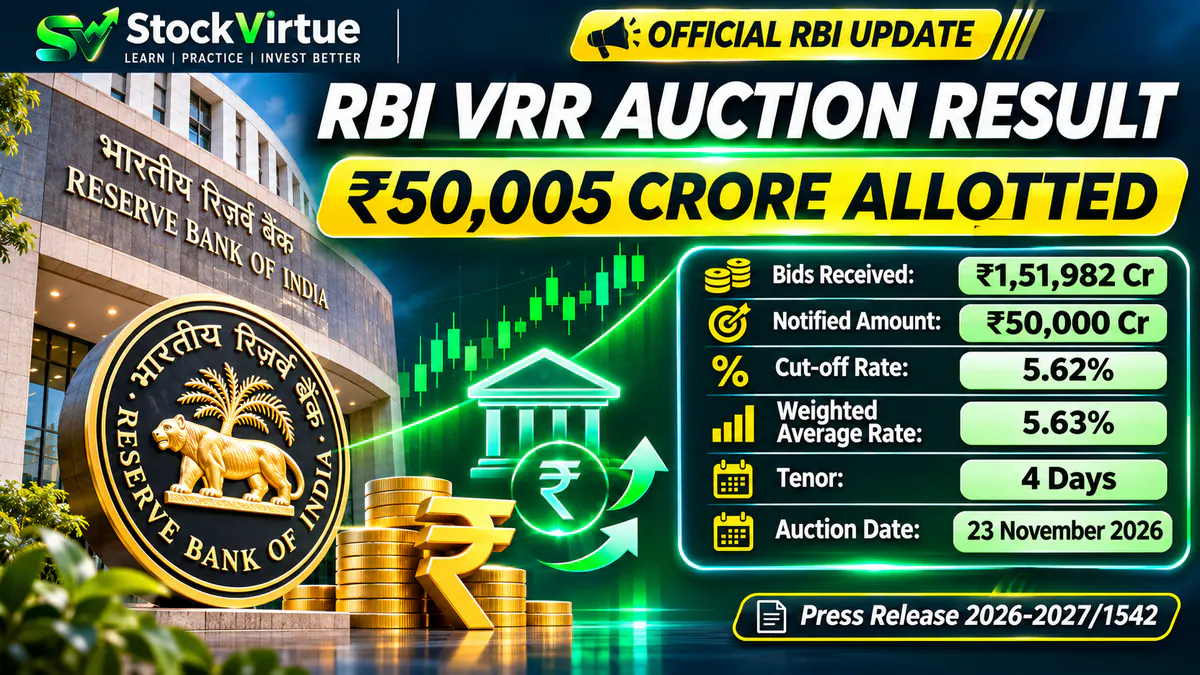
The Reserve Bank of India received bids worth ₹1,51,982 crore against a notified amount of ₹50,000 crore in its four-day Variable Rate Repo auction. The cutoff rate was fixed at 5.62%, while the weighted average rate stood at 5.63%.
The Reserve Bank of India (RBI) has announced the results of its four-day Variable Rate Repo (VRR) auction conducted on November 23, 2026, under the Liquidity Adjustment Facility (LAF).
According to the central bank's official press release, participating banks submitted total bids worth ₹1,51,982 crore against the notified auction amount of ₹50,000 crore.
The RBI allotted ₹50,005 crore through the auction, with a cutoff rate of 5.62% and a weighted average rate of 5.63%.
The auction was conducted to address near-term liquidity requirements in the banking system. The result provides an indication of banks' demand for short-term funds through the RBI's liquidity-management facility.
1. RBI VRR Auction Result: Key Figures
The RBI released the auction outcome on November 23, 2026, under Press Release No. 2026-2027/1542.
The important figures are:
Auction parameter | Official result |
|---|---|
Auction type | Variable Rate Repo (VRR) |
Tenor | 4 days |
Notified amount | ₹50,000 crore |
Total bids received | ₹1,51,982 crore |
Amount allotted | ₹50,005 crore |
Cutoff rate | 5.62% |
Weighted average rate | 5.63% |
Partial allotment at cutoff rate | 86.98% |
Announcement date | November 23, 2026 |
The total bids received were approximately 3.04 times the notified auction amount.
This indicates that the banking system submitted substantially more bids than the amount notified by the RBI for this particular operation.
2. What Does the ₹1.52 Lakh Crore Bid Amount Indicate?
One of the most notable figures in the announcement is the total bid amount of ₹1,51,982 crore.
The RBI had notified ₹50,000 crore for the four-day operation, but participating banks submitted bids worth more than three times that amount.
This reflects strong demand for funds through the auction.
However, the total bid amount should not be confused with the actual amount borrowed by banks.
The RBI allotted ₹50,005 crore, meaning the amount of liquidity provided through this operation was close to the notified amount.
The difference between bids received and funds allotted reflects the auction's allocation process and the demand expressed by participating banks.
It does not, by itself, establish that the entire banking system is facing a liquidity shortage of ₹1.52 lakh crore.
3. Understanding the Cutoff Rate of 5.62%
The RBI announced a cutoff rate of 5.62% for the four-day VRR auction.
The weighted average rate was slightly higher at 5.63%.
A cutoff rate represents the marginal rate at which bids were accepted in the auction. The weighted average rate represents the average rate across the allotted bids, weighted by the amount allocated.
The difference between the two figures was 0.01 percentage point, or one basis point.
These rates help market participants understand the cost at which liquidity was allocated through this particular operation.
They should not be interpreted as a change in the RBI's policy repo rate.
4. What Is a Variable Rate Repo Auction?
A Variable Rate Repo (VRR) auction is a liquidity-management instrument used by the RBI under the Liquidity Adjustment Facility.
Through a repo operation, the RBI provides short-term funds to eligible banks against eligible collateral, subject to the applicable operational rules.
In a variable-rate auction, participating banks submit bids at the interest rates at which they are willing to borrow funds.
The RBI evaluates the bids and allocates liquidity according to the auction's rules and the amount available.
Unlike a fixed-rate operation, the borrowing rate is determined through the auction process.
Why does the RBI conduct VRR auctions?
VRR auctions help the central bank manage short-term liquidity conditions.
They can be used to:
Address temporary funding requirements in the banking system.
Manage fluctuations in overnight and short-term money-market liquidity.
Support orderly functioning of money markets.
Improve the transmission of monetary policy.
Manage short-term liquidity conditions without changing the policy repo rate.
The latest auction was a four-day operation, making it a short-term liquidity arrangement rather than a permanent injection of funds.
5. When Will the Four-Day VRR Funds Be Reversed?
The RBI's earlier announcement dated November 20, 2026, specified that the four-day VRR auction would be conducted on November 23, with a notified amount of ₹50,000 crore.
The announced date of reversal was November 27, 2026.
This means the liquidity provided through the operation is intended to be reversed at the end of the specified tenor, subject to the applicable settlement arrangements.
The operation therefore represents temporary liquidity support rather than a permanent addition to the banking system's funds.
6. What Could the Auction Mean for Banks and Financial Markets?
The auction result is relevant for banks, money-market participants and investors who monitor India's short-term liquidity conditions.
Several aspects deserve attention.
Banking liquidity
The high volume of bids indicates substantial demand for funds through the VRR operation.
Banks may use short-term RBI liquidity facilities to manage funding requirements and liquidity positions.
Short-term interest rates
The cutoff and weighted average rates provide useful information about borrowing costs in the auction.
Money-market participants may monitor subsequent liquidity operations and short-term interest-rate movements to understand changes in funding conditions.
RBI liquidity management
The operation highlights the RBI's use of variable-rate instruments to manage near-term liquidity.
The central bank can use different liquidity-management tools depending on evolving market conditions.
Monetary policy transmission
Stable and orderly money-market conditions help monetary policy changes transmit through the financial system.
However, a single VRR auction result does not indicate that the RBI has changed its monetary policy stance.
7. Does This Mean the RBI Is Changing Interest Rates?
No.
The November 23 VRR auction result is a liquidity-management announcement, not a monetary policy rate decision.
The cutoff rate of 5.62% and weighted average rate of 5.63% relate specifically to this auction.
The RBI's policy repo rate is determined through the Monetary Policy Committee's policy process.
Investors should distinguish between:
Policy repo rate: The policy rate announced by the RBI's Monetary Policy Committee.
VRR auction rate: The variable rate determined through a particular liquidity auction.
Money-market rates: Short-term borrowing and lending rates influenced by liquidity conditions and market demand.
These rates are related to the broader monetary framework but serve different purposes.
8. What Should Investors Monitor Next?
Investors and banking-sector observers may follow several developments after the latest auction.
The reversal of the four-day VRR funds on November 27.
Subsequent RBI liquidity-management announcements.
Overnight money-market rates.
Interbank funding conditions.
Bank deposit and credit growth.
The RBI's upcoming monetary policy communication.
These indicators can help market participants understand how liquidity conditions are evolving.
However, the auction result alone should not be treated as a direct buy or sell signal for banking stocks.
9. RBI VRR Auction: Important Details at a Glance
Particular | Details |
|---|---|
Institution | Reserve Bank of India |
Auction | Four-day Variable Rate Repo |
Auction date | November 23, 2026 |
Notified amount | ₹50,000 crore |
Bids received | ₹1,51,982 crore |
Amount allotted | ₹50,005 crore |
Cutoff rate | 5.62% |
Weighted average rate | 5.63% |
Partial allotment percentage | 86.98% |
Date of reversal | November 27, 2026 |
RBI press release | 2026-2027/1542 |
Conclusion
The RBI's four-day VRR auction conducted on November 23, 2026, attracted bids worth ₹1,51,982 crore against the notified amount of ₹50,000 crore.
The central bank allotted ₹50,005 crore at a cutoff rate of 5.62%, while the weighted average rate stood at 5.63%.
The auction highlights demand for short-term funds through the RBI's liquidity-management framework and provides useful information about funding conditions in the banking system.
The next important date is November 27, 2026, when the four-day liquidity operation is scheduled for reversal.
For investors and market participants, the key takeaway is that VRR auctions are important tools for managing short-term banking liquidity, but their results should not be confused with changes in the RBI's monetary policy rate.
Sources
- Reserve Bank of India · Published 23 Nov 2026, 10:40 am IST