
Official updates
RBI Data: India's Forex Reserves Fall to $705.34 Billion as Bank Credit Growth Reaches 19.5%
RBI data shows India's forex reserves fell to $705.34 billion, while bank credit grew 19.5% and deposits rose 16.9%. Explore the latest banking and liquidity figures.
Stocks in this story
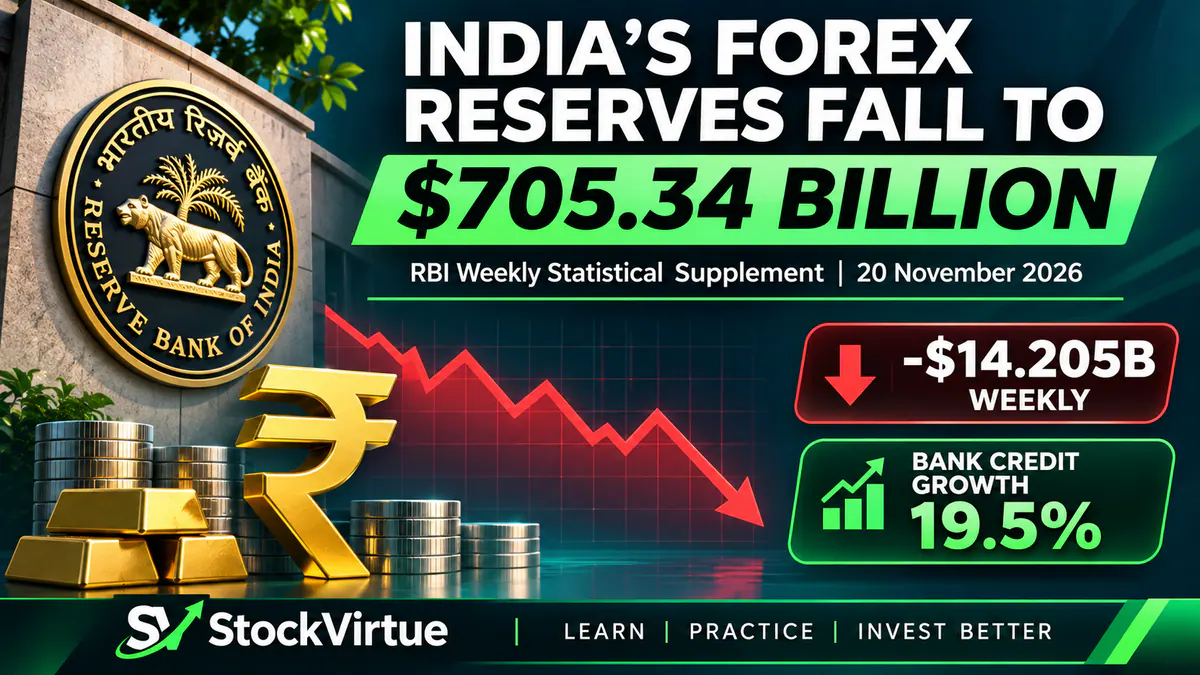
The Reserve Bank of India (RBI) has released its latest Weekly Statistical Supplement, providing an updated picture of India's foreign exchange reserves, banking activity, money supply and liquidity conditions.
The data, published on November 20, 2026, shows that India's foreign exchange reserves declined by $14.21 billion during the week ended November 13, taking the total to approximately $705.34 billion.
At the same time, banking-sector figures point to continued expansion in credit and deposits. Scheduled commercial banks reported year-on-year deposit growth of 16.9%, while bank credit increased by 19.5% based on the reporting comparisons in the supplement.
The RBI data also shows that the broad money supply measure, M3, reached approximately ₹337.68 lakh crore as of October 31, 2026.
These figures provide an important snapshot of the country's financial system. They help investors, economists and market participants understand developments in external reserves, domestic lending, banking liquidity and monetary conditions.
However, the figures cover different reporting dates. Foreign exchange reserves are reported as of November 13, while the banking and money-supply figures are based on October 31. They should not be treated as measurements from the same day.
1. India's forex reserves decline to $705.34 billion
The most notable development in the latest RBI supplement is the decline in India's foreign exchange reserves.
As of November 13, 2026, the country's total foreign exchange reserves stood at $705.342 billion, compared with $719.547 billion a week earlier.
This represents a weekly decline of approximately $14.205 billion.
India's foreign exchange reserves
Component | November 13, 2026 |
|---|---|
Total foreign exchange reserves | $705.342 billion |
Foreign currency assets | $583.452 billion |
Gold reserves | $98.613 billion |
Special Drawing Rights (SDRs) | $18.517 billion |
Reserve position in IMF | $4.758 billion |
The weekly decline was spread across several components.
Foreign currency assets decreased by approximately $7.897 billion, while gold reserves declined by around $6.183 billion in dollar terms.
SDRs and the reserve position in the International Monetary Fund also recorded smaller declines.
The figures show that the movement was not limited to one reserve component.
Why do forex reserves matter?
Foreign exchange reserves are an important part of India's external financial position.
The RBI maintains reserves to support confidence in the country's ability to meet external payment requirements and manage periods of pressure in foreign exchange markets.
Reserves can also help the central bank manage excessive volatility in the rupee, although exchange-rate intervention is not intended to guarantee a particular currency level.
A decline in reserves does not automatically indicate an economic crisis.
Reserve movements can be influenced by several factors, including:
Foreign exchange market intervention.
Changes in the value of currencies held in reserves.
International gold-price movements.
Maturing foreign exchange transactions.
External payment flows.
The latest figures therefore need to be interpreted alongside currency movements, capital flows and the RBI's foreign exchange operations.
2. Foreign currency assets account for the largest reserve component
Foreign currency assets remain the largest component of India's forex reserves.
The RBI reported foreign currency assets of approximately $583.45 billion as of November 13.
These assets declined by $7.897 billion over the week.
Foreign currency assets include eligible investments and balances held in foreign currencies. Their reported dollar value can change because of exchange-rate movements involving the currencies in which the assets are held.
The RBI's published definition also excludes certain items, including SDR holdings, which are reported separately.
This distinction matters because the movement in foreign currency assets should not automatically be interpreted as the amount of dollars sold by the central bank.
Investors should examine the complete reserve data and other available information before drawing conclusions about the reasons for a weekly change.
3. Gold reserves decline by $6.18 billion during the week
Gold reserves stood at approximately $98.61 billion as of November 13, compared with $104.80 billion a week earlier.
This represents a decline of approximately $6.18 billion in dollar terms.
The reported value of gold reserves can change because of movements in international gold prices and the valuation of the gold holdings.
Therefore, a fall in the reported dollar value does not necessarily mean that the RBI sold an equivalent quantity of physical gold.
Gold continues to form an important part of India's reserve portfolio, providing diversification alongside foreign currency assets and other reserve components.
For commodity-market participants, the data also highlights why gold-price movements can influence the valuation of central-bank reserve portfolios.
4. Bank deposits rise as credit expansion continues
The latest banking statistics provide another important picture of India's financial system.
According to the RBI supplement, aggregate deposits of scheduled commercial banks reached approximately ₹375.17 lakh crore as of October 31, 2026.
Bank credit stood at approximately ₹231.82 lakh crore.
Scheduled commercial bank statistics
Banking indicator | Outstanding amount |
|---|---|
Aggregate deposits | ₹375.17 lakh crore |
Bank credit | ₹231.82 lakh crore |
Borrowings | ₹10.53 lakh crore |
Other demand and time liabilities | ₹13.02 lakh crore |
The figures indicate continued expansion in banking activity.
Aggregate deposits increased by ₹3.75 lakh crore over the reporting fortnight, while bank credit increased by approximately ₹4.40 lakh crore.
These are changes in the outstanding amounts over the reported fortnight, not annual growth figures.
Deposit and credit growth
The RBI's growth comparisons show:
Indicator | Year-on-year growth |
|---|---|
Aggregate deposits | 16.9% |
Bank credit | 19.5% |
Bank credit grew faster than deposits in the reported year-on-year comparison.
This is an important trend for investors following the banking sector because credit growth can influence loan-book expansion, interest income and funding requirements.
However, stronger lending growth is not automatically positive for every bank. Asset quality, borrowing costs, deposit mobilisation, net interest margins and capital adequacy remain important considerations.
5. What is happening with India's money supply?
The RBI's latest data shows that broad money supply, measured by M3, reached approximately ₹337.68 lakh crore as of October 31, 2026.
M3 is a broad measure of money in the economy. It includes currency with the public, bank deposits and certain other deposits with the RBI.
Money supply data
Component | Outstanding amount |
|---|---|
M3 money supply | ₹337.68 lakh crore |
Currency with the public | ₹42.68 lakh crore |
Demand deposits with banks | ₹36.34 lakh crore |
Time deposits with banks | ₹257.39 lakh crore |
Other deposits with RBI | ₹1.27 lakh crore |
The RBI reported that M3 increased by approximately ₹4.68 lakh crore during the reporting fortnight, equivalent to 1.4%.
On a year-on-year basis, the broad money supply measure was higher by approximately 16.5%.
Time deposits remained the largest component of the reported M3 total.
Why does money supply matter?
Money supply is an important indicator of financial conditions.
Changes in money supply can reflect developments in bank deposits, currency circulation and credit creation.
Rapid money-supply growth can support economic activity, but its implications for inflation depend on several other factors, including production, demand, interest rates and the velocity of money.
Therefore, M3 growth should not be interpreted in isolation as proof of rising inflation.
6. Bank credit to the commercial sector continues to expand
The RBI data also provides information about the sources of money supply.
Bank credit to the commercial sector stood at approximately ₹241.14 lakh crore in the reported table.
This includes credit provided by banks and the relevant RBI component under the statistical classification.
The reported year-on-year growth in bank credit to the commercial sector was 19.4%.
This is relevant because commercial-sector financing supports business operations, working capital, capital expenditure and economic activity.
For investors, the growth of bank lending can provide useful context when analysing financial institutions and the broader economy.
However, the quality of lending is just as important as the volume of credit.
Investors should also monitor non-performing assets, provisions, loan concentration, deposit costs and profitability.
7. RBI liquidity operations show continued net absorption
The Weekly Statistical Supplement also provides daily details of RBI liquidity operations.
These operations help manage short-term liquidity conditions in the banking system.
The data for November 9–15 shows negative net injection/absorption figures on each listed day.
Under the RBI table's convention, a negative number indicates net liquidity absorption rather than injection.
RBI liquidity operations
Date | Net injection (+) / absorption (-) |
|---|---|
November 9 | -₹1,48,423 crore |
November 10 | -₹1,99,902 crore |
November 11 | -₹1,94,057 crore |
November 12 | -₹1,78,097 crore |
November 13 | -₹1,80,610 crore |
November 14 | -₹1,37,122 crore |
November 15 | -₹1,37,219 crore |
The figures indicate that the RBI's listed liquidity operations resulted in net absorption on these dates.
The Standing Deposit Facility (SDF) and Marginal Standing Facility (MSF) are among the facilities included in the table.
What does liquidity absorption mean?
Liquidity absorption occurs when surplus funds are withdrawn from the banking system through central-bank operations.
When the RBI absorbs liquidity, it can influence short-term money-market conditions and the availability of funds within the banking system.
The central bank uses liquidity-management tools to keep short-term rates aligned with its monetary-policy framework and manage temporary imbalances in the financial system.
It is important to distinguish liquidity operations from a change in the policy repo rate. Net absorption does not, by itself, indicate that the RBI has tightened its policy rate.
8. What do the latest RBI figures mean for Indian banks?
The combination of rising deposits, strong credit growth and ongoing liquidity absorption provides several areas for investors to monitor.
Credit growth and bank earnings
Continued loan growth can support interest income for banks.
However, the benefit depends on the cost of funds, loan pricing, credit quality and the bank's ability to manage risk.
Deposit mobilisation
Deposit growth is essential because banks require stable funding to support lending.
If credit expands faster than deposits over a sustained period, banks may need to compete more aggressively for deposits or seek alternative funding sources.
Net interest margins
Changes in deposit costs and lending rates can influence net interest margins.
Investors should compare the performance of individual banks rather than assume that stronger system-wide credit growth benefits every lender equally.
Liquidity and short-term rates
The RBI's liquidity operations can influence money-market conditions.
Changes in short-term funding costs may affect banks, non-banking financial companies and other participants in the financial system.
9. What does the forex reserve movement mean for the Indian rupee?
The decline in foreign exchange reserves is relevant to currency-market participants, but it should not be interpreted as a direct forecast for the rupee.
The rupee is influenced by multiple factors, including:
US dollar strength.
International interest-rate expectations.
Foreign portfolio investment flows.
India's trade balance.
Crude oil prices.
Domestic inflation.
RBI foreign exchange operations.
A reduction in reported reserves can occur alongside currency-market intervention, valuation changes or other transactions.
The latest supplement alone does not establish how much of the weekly reserve decline was attributable to any single factor.
Investors following USD/INR should therefore monitor official RBI data alongside international dollar movements, oil prices and capital-flow developments.
10. What should investors watch next?
The RBI's weekly statistical data provides a useful foundation for monitoring India's financial conditions.
Investors may focus on the following indicators in the coming weeks:
Indicator | Why it matters |
|---|---|
Weekly forex reserves | Tracks India's external reserve position |
USD/INR exchange rate | Reflects currency-market conditions |
Bank deposit growth | Indicates funding availability |
Bank credit growth | Shows lending activity |
M3 money supply | Provides a broad monetary indicator |
RBI liquidity operations | Helps assess short-term liquidity |
Bank quarterly results | Reveals the effect on profitability and asset quality |
Inflation and monetary policy | Provides context for future interest-rate decisions |
These indicators should be analysed together rather than treated as independent trading signals.
StockVirtue Market Takeaway
The RBI's Weekly Statistical Supplement released on November 20, 2026, highlights several important developments in India's financial system.
The country's foreign exchange reserves declined by $14.21 billion to $705.34 billion during the week ended November 13.
Foreign currency assets and gold reserves accounted for much of the reported weekly decline.
At the same time, the banking system continued to show strong year-on-year growth, with aggregate deposits rising 16.9% and bank credit increasing 19.5% in the RBI's reported comparisons.
Broad money supply reached approximately ₹337.68 lakh crore, while the listed daily liquidity operations showed net absorption throughout November 9–15.
For investors, the important message is that external reserves, bank lending, deposits and liquidity conditions all provide different pieces of the Indian economic picture.
None of these indicators alone determines the direction of the stock market or the rupee. Their combined movement, alongside inflation, global conditions and corporate earnings, provides a more useful basis for understanding the economy.
StockVirtue — Learn | Practice | Invest Better
Disclaimer: This article is for educational and informational purposes only and does not constitute investment, trading or financial advice. Figures are taken from the RBI Weekly Statistical Supplement Extract released on November 20, 2026. Forex-reserve figures relate to November 13, while scheduled-bank and money-supply figures relate to October 31, 2026. RBI data may be provisional and subject to revision. Interpretations of possible economic and market implications are editorial analysis, not official RBI forecasts.
Sources
- Reserve Bank of India · Published 20 Nov 2026, 5:00 pm IST