Global Markets
US SEC Plans to Take Direct Control of Wall Street's Trading Surveillance System: What the CAT Overhaul Means for Investors
The US SEC proposes taking direct control of the Consolidated Audit Trail. Understand the changes to market surveillance, funding, privacy and investor protection.
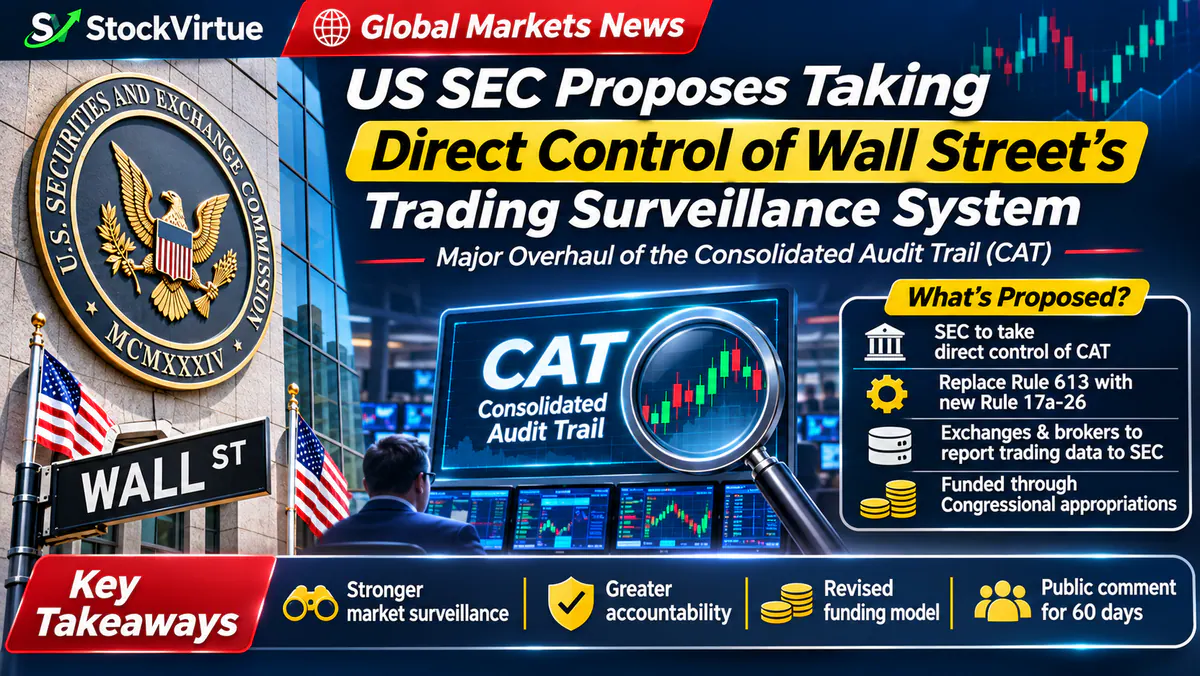
The United States Securities and Exchange Commission (SEC) has proposed a major restructuring of the system used to monitor trading activity across American stock and options markets.
On November 20, 2026, the regulator announced a proposal to bring the Consolidated Audit Trail (CAT) under its direct control, changing how the system is governed, funded and operated.
The CAT is an important part of US market surveillance infrastructure. It allows regulators to reconstruct trading activity by examining information about orders, order routing and executions across US-listed equities and options.
The proposed changes aim to address long-standing concerns about operating costs, fragmented governance and funding responsibilities.
For investors, brokers, exchanges and financial-market participants, the development raises an important question: how should a modern financial market balance effective surveillance, operational costs, data protection and regulatory accountability?
Here is what the SEC has proposed and why the announcement matters.
1. What Has the US SEC Announced?
The SEC has proposed restructuring the governance and funding model of the Consolidated Audit Trail.
Under the existing framework, securities exchanges and national securities associations are responsible for jointly establishing, implementing and maintaining the CAT through an industry-governed arrangement.
The new proposal would move the system towards direct SEC oversight.
The main proposed changes include:
Rescinding Rule 613 of Regulation NMS.
Introducing a new Rule 17a-26 under the Securities Exchange Act of 1934.
Requiring exchanges and broker-dealers to record and electronically report substantially the same required information to the SEC or its designated recipient.
Moving the CAT's governance away from the existing industry-administered structure.
Using funds appropriated by Congress to pay the SEC's costs associated with the system.
The regulator says the objective is to make the surveillance infrastructure more accountable, efficient and financially sustainable.
Important: This is a proposed regulatory change. It has not yet become a final rule. The SEC will consider public feedback before deciding whether to adopt the changes.
2. What Is the Consolidated Audit Trail (CAT)?
The Consolidated Audit Trail is a US financial-market surveillance system designed to help regulators understand how orders move through the securities market.
It was developed following the May 2010 US flash crash, when major US stock indices experienced an exceptionally rapid decline and recovered much of the movement within minutes.
The event highlighted the difficulty of reconstructing trading activity across different exchanges and market participants.
Regulators needed a more comprehensive way to understand:
When an order was submitted.
How an order was routed.
Where an order was executed.
How trading activity moved across market participants.
What happened to an order throughout its lifecycle.
The CAT was developed to provide a consolidated source of this information.
Why is this system important?
Modern securities markets involve several exchanges, brokers, trading firms, automated systems and different types of orders.
A single trading activity may involve multiple participants and electronic systems.
Without consolidated information, investigating suspicious trading patterns can become more difficult.
The CAT helps regulators reconstruct trading activity and supports investigations into potential misconduct, including insider trading and market manipulation.
It is a surveillance and investigative tool, not a system that automatically prevents every market violation.
3. Why Does the SEC Want to Change the Existing System?
The main reasons behind the proposal are governance, funding and operating costs.
Under the existing arrangement, the CAT is administered through an industry-based structure involving self-regulatory organisations.
The SEC says that this decentralised arrangement has created challenges in decision-making, management and financial accountability.
There have also been disagreements about the cost of developing and operating the system.
According to the SEC's November 20 announcement, earlier efforts to improve the CAT have already reduced projected annual operating costs by more than $100 million and eliminated the reporting of personally identifiable information to the system.
The regulator believes a more centralised structure could improve oversight and make the system easier to manage.
The central issue
The SEC is proposing that the organisation responsible for using and overseeing the surveillance infrastructure should also have greater responsibility for its governance and funding.
This is intended to align regulatory authority with financial accountability.
4. How Much Does the CAT System Cost?
The operating cost of the CAT has been a major point of debate.
Commissioner Mark Uyeda's November 20 statement provides historical cost estimates:
Period | Estimated annual operating cost |
|---|---|
2016, when the CAT NMS Plan was approved | Approximately $55 million |
2024 projected annual operating budget | Nearly $250 million |
Current operating cost cited by SEC | Approximately $137 million |
The SEC has said that recent changes have reduced annual operating costs by around 45% compared with 2024.
These figures illustrate why the regulator wants to reconsider the system's existing funding and governance arrangements.
Why do these costs matter?
Market surveillance systems require substantial technological infrastructure.
They need to process large amounts of information, maintain secure databases, support regulatory investigations and operate reliably.
The question is not simply whether a surveillance system is expensive.
The more important question is whether its operating model provides sufficient regulatory value, transparency and cost control.
The SEC believes that moving towards direct control and congressional appropriations could improve accountability.
However, the actual financial impact will depend on how the final framework is designed and implemented.
5. How Will the Proposed Funding Model Work?
One of the most important elements of the proposal is the change in funding responsibility.
Under the proposed approach, the SEC intends to use funds appropriated by Congress to cover its costs relating to the CAT's operation and maintenance.
The existing model relies on an industry-administered structure involving exchanges and other market participants.
The proposed system would instead place greater responsibility with the regulator.
Potential advantages
Greater accountability: The regulator would have more direct responsibility for the system it uses to oversee securities markets.
Improved cost oversight: Congressional appropriations would subject the funding to the government's budgeting and oversight process.
Simplified governance: A more centralised structure could reduce disagreements among different industry participants.
Potential challenges
Dependence on government funding: Annual appropriations could create uncertainty around future funding.
Budgetary interruptions: Congressional budget disagreements or government shutdowns could create operational challenges if funding is delayed.
Implementation complexity: Moving responsibilities from an existing industry-governed arrangement to a regulator-controlled structure would require careful coordination.
These are potential implications of the proposed model, not confirmed outcomes.
6. What Happens to Investor Privacy and Trading Data?
Privacy has been one of the major concerns surrounding the CAT.
A market surveillance system needs detailed information to reconstruct trading activity. However, collecting and storing sensitive personal information creates additional data-security responsibilities.
The SEC's November 20 announcement states that earlier reforms permanently eliminated the reporting of personally identifiable information to the CAT.
This is an important distinction:
The new proposal is primarily about governance, reporting responsibilities and funding. It should not be interpreted as an announcement that the regulator plans to expand the collection of personal identity information.
Investors and market participants will still want clear answers about:
What trading information must be reported?
Who can access the information?
How is the information protected?
How long is the information retained?
What controls prevent unauthorised access?
How will reporting requirements be enforced?
Effective market surveillance and appropriate data protection must operate together.
7. How Could the Proposed Changes Affect Stock Exchanges and Brokers?
The proposal would change the reporting relationship between market participants and the surveillance infrastructure.
Under the proposed Rule 17a-26, self-regulatory organisations and broker-dealers would be required to record and electronically report substantially the same information currently required under the CAT framework.
The key change is that the information would be reported to the SEC or its designee rather than to a CAT system independently administered by industry participants.
For exchanges and brokers, the transition could involve changes to:
Reporting infrastructure.
Data submission processes.
Compliance procedures.
Technology integration.
Operational responsibilities.
Regulatory reporting controls.
The actual compliance requirements will depend on the final rule and implementation arrangements.
The SEC's objective is to preserve the CAT's core surveillance functionality while changing how the system is managed.
8. What Does This Mean for Global Financial Markets?
The SEC's proposal applies to the US securities-market regulatory framework. It does not directly change India's NSE or BSE reporting requirements.
Nevertheless, the development is relevant to global financial markets for several reasons.
A. Stronger focus on market transparency
International financial markets increasingly depend on electronic trading systems.
Regulators need reliable information to investigate unusual activity and maintain confidence in market integrity.
Changes to the CAT could influence wider discussions about how large financial markets organise surveillance infrastructure.
B. Global brokers and financial institutions
International financial institutions that participate in US markets may need to follow any final changes to reporting and compliance arrangements.
Firms operating across multiple jurisdictions must manage different regulatory requirements, technology systems and reporting responsibilities.
C. Technology and regulatory infrastructure
The proposal highlights the importance of financial-market technology beyond trading platforms.
Modern markets depend on systems that can collect, process and analyse large quantities of trading information.
The ability to reconstruct market activity is an important part of maintaining investor confidence.
D. Regulatory accountability
The proposal also raises a broader policy question: should financial-market surveillance infrastructure be operated primarily by industry participants or directly by the regulator?
Different countries may adopt different approaches depending on their regulatory structures and market requirements.
9. What Is the Difference Between the Existing and Proposed CAT Framework?
Area | Existing framework | Proposed framework |
|---|---|---|
Governance | Industry-administered CAT NMS Plan | Greater direct SEC control |
Rule structure | Rule 613 of Regulation NMS | Proposed new Rule 17a-26 |
Reporting destination | CAT system administered under the industry plan | SEC or its designee |
Reporting participants | Exchanges and other covered market participants | SROs and broker-dealers |
Funding approach | Existing industry-administered funding model | SEC costs funded through congressional appropriations |
Regulatory objective | Consolidated trading surveillance | Preserve surveillance while restructuring governance and funding |
The proposal is designed to maintain substantially the same core reporting information while changing the system's administrative structure.
10. What Happens Next?
The SEC's November 20 announcement states that the public comment period will remain open for 60 days after publication of the proposal in the Federal Register.
During this period, exchanges, broker-dealers, investors and other interested parties can submit feedback.
The regulator can consider these responses before deciding whether to adopt a final rule.
The next important developments will include:
Publication of the proposal in the Federal Register.
The start and completion of the public comment period.
Responses from exchanges, brokers and other market participants.
Any revisions made by the SEC.
A final decision on whether to adopt the proposed changes.
Implementation arrangements, if the proposal becomes a final rule.
Until a final decision is made, the existing regulatory framework remains the relevant framework.
Conclusion: A Major Change Proposed for US Market Surveillance
The SEC's proposal to restructure the Consolidated Audit Trail represents an important development in US financial-market regulation.
By seeking direct control over the system and changing its funding model, the regulator aims to address long-standing concerns about operating costs, governance and accountability.
For investors, the CAT itself is not a trading platform or investment product. Its importance lies in helping regulators reconstruct trading activity and investigate potential market misconduct.
The proposal also highlights a broader lesson for modern financial markets: as trading becomes increasingly electronic and interconnected, reliable surveillance infrastructure is essential for maintaining market integrity.
The final outcome will depend on public feedback, regulatory decisions and the practical details of implementation.
StockVirtue Takeaway: Market transparency depends not only on fair trading rules but also on the technology used to monitor financial activity. The SEC's CAT proposal is a reminder that strong market infrastructure, effective oversight and responsible data governance are essential parts of investor protection.