
Global Markets
Global Markets Today: AI Sell-Off Deepens as Asian Stocks Head for Worst Week Since 2020, Wall Street Faces Growing Pressure
Global markets tumble as AI concerns hit technology stocks. Asian equities face their worst week since 2020 while Wall Street extends its losing streak.
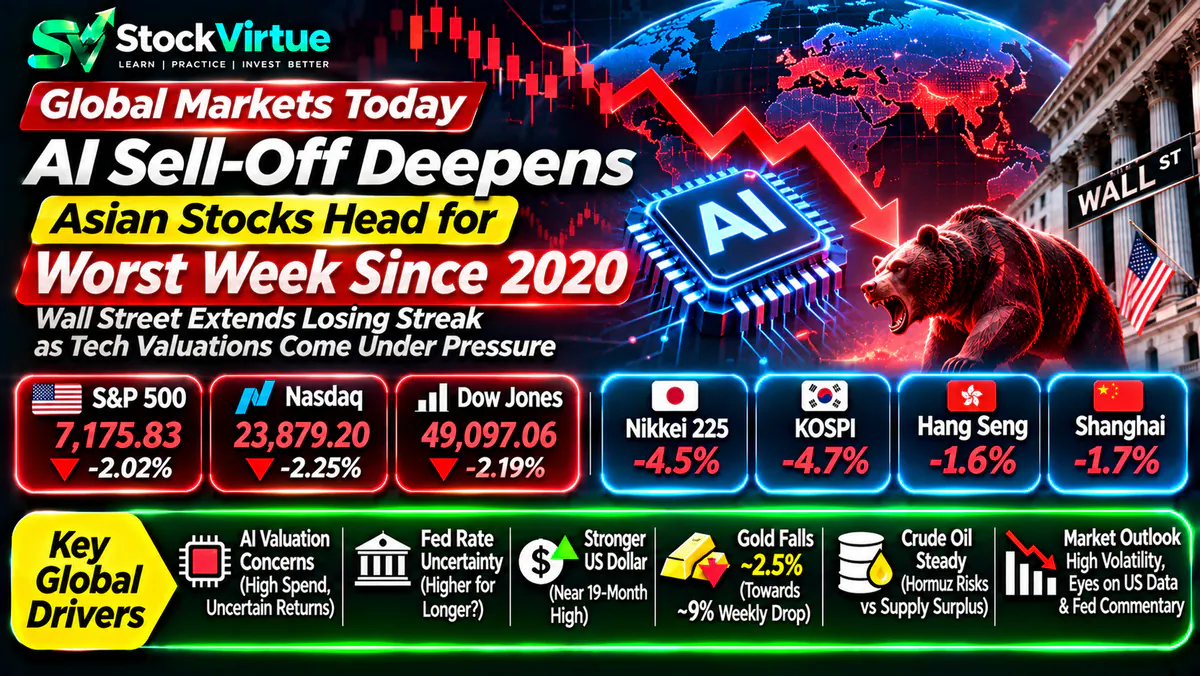
Global financial markets are facing a difficult end to the week as growing concerns about artificial-intelligence valuations trigger widespread selling across technology shares and major equity indices.
Asian markets tumbled on Friday, putting the region on course for its worst weekly performance since March 2020. The weakness followed another steep decline on Wall Street, where the S&P 500 recorded its sixth consecutive session of losses.
What makes the current correction particularly interesting is that it comes even after a major artificial-intelligence company, Anthropic, made a strong stock-market debut. Investors are increasingly questioning whether enormous investments in AI infrastructure, data centres and advanced computing will generate sufficient returns to justify current valuations.
The selling has also spread beyond technology companies, affecting broader market sentiment, small-cap stocks and several international indices.
Meanwhile, the US dollar has strengthened, gold has fallen sharply and crude oil remains caught between geopolitical risks and concerns about global supply.
For investors in India, the global correction matters because international market weakness can influence foreign investment flows, technology stocks, currency movements and overall risk appetite.
1. Asian markets head towards their worst week since 2020
Asian equities recorded another significant decline on Friday as investors continued reducing exposure to technology and semiconductor-related companies.
According to Reuters, the MSCI Asia-Pacific index excluding Japan fell approximately 3.2% during Friday's session. The index was heading towards a weekly decline of around 8.3%, its steepest weekly fall since March 2020.
Japan and South Korea were among the worst-affected markets.
Asian market snapshot – November 20, 2026
Index | Reported movement |
|---|---|
Japan Nikkei 225 | Around -4.5% |
South Korea KOSPI | Around -4.7% |
Hong Kong Hang Seng | Around -1.6% |
Shanghai Composite | Around -1.7% |
MSCI Asia-Pacific ex-Japan | Around -3.2% |
These are reported Friday-session observations. Index levels and percentage changes can vary depending on the reporting time.
Technology and semiconductor companies were among the biggest contributors to the decline.
The weakness in Asian equities reflects concerns about expensive technology valuations, uncertainty around future AI earnings and the possibility that the market has become overly concentrated in a relatively small number of high-growth companies.
2. Wall Street extends its losing streak
The pressure in Asia followed another difficult session in the United States.
US equities declined sharply on Thursday, November 19, with all three major benchmarks finishing lower.
The S&P 500 dropped approximately 2%, marking its sixth consecutive daily decline. The Dow Jones Industrial Average fell by more than 1,100 points, while the Nasdaq Composite declined over 2%.
US stock market closing data – November 19
Index | Closing level | Daily change |
|---|---|---|
S&P 500 | 7,175.83 | -2.02% |
Dow Jones | 49,097.06 | -2.19% |
Nasdaq Composite | 23,879.20 | -2.25% |
Russell 2000 | 2,655.11 | -2.18% |
More than 90% of S&P 500 constituents declined during the session, indicating that the selling was not limited to a handful of technology companies.
The decline in the Dow was particularly notable because it represented a loss of more than 1,100 index points in one session.
The broad-based nature of the correction suggests that investors are becoming more cautious about equity exposure across multiple sectors.
3. Why is the global AI trade suddenly under pressure?
Artificial intelligence has been one of the biggest investment themes in global financial markets.
Companies involved in advanced chips, cloud computing, data centres, software and AI infrastructure have attracted substantial investor interest.
However, the market is now asking a more difficult question:-
Are the future earnings from artificial intelligence sufficient to justify the enormous investment being made today?
Several concerns are contributing to the correction:-
A. High technology valuations
Many AI-related companies have experienced significant share-price increases over recent years.
Investors are now reassessing whether their valuations adequately reflect future earnings potential.
When expectations become too optimistic, even positive company announcements may fail to support share prices.
B. Rising AI infrastructure expenditure
Building AI infrastructure requires enormous spending on advanced processors, data centres, electricity, cooling systems and networking equipment.
Investors are increasingly focused on how quickly this expenditure will translate into revenue and profits.
If the returns take longer than expected, companies with high capital expenditure commitments could face valuation pressure.
C. Uncertainty about future competition
Competition in artificial intelligence is increasing.
Large technology companies are developing their own AI models, infrastructure and applications.
This could create pricing pressure and make it harder for individual companies to maintain high profit margins.
D. Regulatory and political uncertainty
AI infrastructure also requires significant electricity, land, data-centre construction and access to advanced semiconductor technology.
Regulatory scrutiny, export restrictions and political opposition to large data-centre projects could create additional uncertainty.
These factors are encouraging investors to reassess their exposure to the AI investment theme.
4. Anthropic's IPO fails to restore confidence in technology stocks
One of the most closely watched developments this week was the public-market debut of Anthropic.
The artificial-intelligence company completed a major initial public offering, attracting significant investor attention.
Its shares were priced at $83 and finished their first trading session at approximately $97.17, representing a gain of around 17.1%.
However, the successful debut did not restore confidence across the wider technology sector.
Anthropic shares subsequently came under pressure in after-hours trading, while several major technology and semiconductor stocks continued declining.
Nvidia, one of the most important companies in the global AI infrastructure ecosystem, fell approximately 3.3% on Thursday.
The market reaction highlights an important distinction: strong demand for an individual IPO does not necessarily mean investors are comfortable with valuations across the entire technology sector.
For global investors, the focus is shifting from AI enthusiasm towards actual profitability, cash flows and returns on investment.
5. US Federal Reserve concerns add pressure to global equities
Interest-rate expectations are another important factor influencing global financial markets.
Recent economic data and comments from Federal Reserve officials have strengthened concerns that US monetary policy may remain restrictive.
The latest data included:
Initial US jobless claims of approximately 203,000, above market expectations.
Philadelphia Fed manufacturing conditions declining to 6.3 in November from 20.9 in October.
Continuing jobless claims rising to approximately 1.763 million.
Investors are also paying close attention to comments from Federal Reserve policymakers regarding persistent inflation and the possibility of further monetary tightening.
Higher interest rates can create pressure on equity valuations because future corporate earnings become less attractive when discounted at higher rates.
They can also increase borrowing costs for companies, particularly businesses that require substantial investment to expand their operations.
The combination of uncertain growth expectations and tighter monetary-policy concerns is creating an uncomfortable environment for global equities.
6. US dollar strengthens while gold faces heavy selling
Another important development is the movement of money across different asset classes.
As investors become more cautious about equities, the US dollar has strengthened and moved close to a 19-month high.
The dollar has been supported by expectations of higher US interest rates and demand for relatively liquid assets.
However, gold has not benefited from the risk-off environment.
International gold prices fell approximately 2.5% on Friday and were heading towards a weekly decline of around 9%, according to Reuters.
Global asset-market snapshot
Asset | Market trend | Key factor |
|---|---|---|
US dollar | Strong | Interest-rate expectations and demand |
Gold | Sharp decline | Dollar strength and selling pressure |
Crude oil | Relatively steady | Shipping risks versus supply concerns |
US Treasury bonds | Demand improved | Investors seeking safer assets |
Global equities | Broad weakness | AI valuations and growth uncertainty |
This movement demonstrates that investors are not automatically moving into gold whenever stock markets fall.
Currency movements, bond yields, positioning and expectations about monetary policy can influence gold independently.
7. Crude oil remains caught between supply risks and demand uncertainty
Crude oil prices have also been affected by the changing global environment.
Brent crude remained relatively steady during Friday's trading session despite renewed concerns about shipping disruptions in the Middle East.
The Strait of Hormuz remains an important source of uncertainty because it handles a substantial share of globally traded oil.
At the same time, expectations of higher US inventories and a possible global supply surplus are limiting the upside in prices.
For oil-importing countries such as India, this situation has two competing implications.
Lower crude prices could reduce the import bill and ease inflationary pressure.
However, a prolonged decline driven by weakening global economic activity could also signal concerns about future industrial demand.
The direction of crude oil will therefore remain an important indicator of the global economic outlook.
8. What does the global sell-off mean for Indian investors?
India's stock market is closely connected to international financial conditions through foreign investment, currency movements, trade and commodity prices.
The current global correction could influence Indian markets through several channels.
Impact on Indian IT stocks
Indian IT companies generate a substantial portion of their revenue from international markets, particularly the United States and Europe.
A correction in global technology shares could affect sentiment towards Indian IT companies, even if their underlying business performance remains unchanged.
Investors will also watch whether global technology spending slows or shifts towards more efficient AI infrastructure.
Impact on foreign institutional investment
When international investors reduce risk exposure, emerging-market equities can experience selling pressure.
India could face additional volatility if foreign institutional investors reduce their positions.
However, domestic institutional participation and domestic economic conditions may provide some support.
Impact on the rupee
A stronger US dollar can put pressure on emerging-market currencies, including the Indian rupee.
Currency depreciation can increase the cost of imported commodities and create additional inflationary pressure.
Impact on gold and commodity investors
Gold and silver investors may experience additional volatility as international currency and interest-rate expectations change.
Crude oil traders will need to balance geopolitical risks against the possibility of weaker global demand.
9. Important global market indicators to watch next week
The global market correction may continue to influence investor behaviour during the coming week.
The following indicators deserve attention:
Indicator | Why it matters |
|---|---|
US technology earnings and guidance | Measures the commercial outlook for AI investment |
Federal Reserve commentary | Influences interest-rate expectations |
US Treasury yields | Affects equity valuations and capital allocation |
US dollar index | Important for global currencies and commodities |
Asian semiconductor stocks | Reflects demand and sentiment around AI infrastructure |
Gold and crude oil | Provide additional signals about inflation and global risk |
Foreign investment flows | Important for emerging markets such as India |
The most important question is whether investors are witnessing a temporary correction in expensive technology stocks or the beginning of a wider reassessment of global equity valuations.
10. Is this a buying opportunity or the beginning of a deeper correction?
A decline in global equity markets does not automatically mean that a major financial crisis is approaching.
Market corrections can occur when investors reassess valuations, earnings expectations and economic conditions.
There are arguments supporting both a recovery and further weakness.
Factors that could support a recovery:
Strong long-term demand for AI infrastructure.
Continued investment by major technology companies.
Better-than-expected corporate earnings.
A reduction in US interest-rate concerns.
Stabilisation in semiconductor and technology stocks.
Factors that could extend the correction:
Further declines in high-valuation technology companies.
Disappointing returns from AI infrastructure investment.
Higher interest-rate expectations.
Weakening global economic indicators.
Continued selling by institutional investors.
Investors should focus on company fundamentals, valuation and risk management rather than attempting to predict the exact bottom of the market.
StockVirtue — Learn | Practice | Invest Better
Disclaimer: This article is for educational and informational purposes only and does not constitute investment advice or a recommendation to buy or sell any security, commodity or currency. Market figures refer to reported observations from November 19–20, 2026, and may vary by reporting time. Global market conditions can change rapidly. Readers should verify live market data and conduct independent research before making financial decisions.