Stock Market Education
Stock Market for Beginners in India: Complete Guide to NSE, BSE, Investing, Trading and Risk Management
Learn the Indian stock market from scratch. Understand NSE, BSE, Demat accounts, order types, investing, intraday trading, F&O and risk management.

The Indian stock market provides individuals with an opportunity to participate in the ownership and growth of listed companies. Investors can purchase shares, build long-term portfolios and participate in corporate developments such as dividends, bonus issues and stock splits.
At the same time, the stock market also offers trading opportunities through short-term price movements, derivatives and other financial instruments.
For beginners, however, the market can initially appear complicated.
Questions about NSE, BSE, Demat accounts, trading accounts, market orders, limit orders, indices, settlement and risk management often create confusion.
Understanding these basics is important before investing or trading real money.
This StockVirtue guide explains how the Indian stock market works, how investors buy and sell shares, what influences stock prices and how beginners can develop their knowledge through practical learning.
1. What is the stock market?
A stock market is a marketplace where securities such as company shares are bought and sold.
When a company issues shares, it allows investors to own a portion of the business.
Investors who purchase shares become shareholders and may benefit if the company's value increases. They may also receive dividends if the company declares them.
However, share ownership also involves risk. If a company's financial performance weakens or market expectations change, its share price can fall.
The stock market therefore provides a mechanism for companies to raise capital and for investors to participate in business ownership.
2. What are NSE and BSE?
India has two major recognised stock exchanges:
National Stock Exchange (NSE)
The National Stock Exchange of India operates an electronic trading platform for equities, derivatives and other permitted financial products.
Its major equity benchmark is the Nifty 50.
Bombay Stock Exchange (BSE)
The Bombay Stock Exchange is one of India's oldest stock exchanges.
Its widely followed benchmark index is the Sensex.
Both exchanges provide platforms for trading listed securities under the applicable regulatory framework.
A company may be listed on NSE, BSE or both, subject to listing requirements.
Difference between NSE and BSE
Feature | NSE | BSE |
|---|---|---|
Full name | National Stock Exchange | Bombay Stock Exchange |
Major benchmark | Nifty 50 | Sensex |
Market | Indian securities market | Indian securities market |
Trading system | Electronic | Electronic |
Main role | Securities trading and market infrastructure | Securities trading and market infrastructure |
The Nifty 50 and Sensex are benchmark indices. They represent selected groups of listed companies and are used to understand broad market performance.
3. What is a stock market index?
An index measures the performance of a selected group of securities using a defined methodology.
For example, the Nifty 50 represents 50 selected companies listed on NSE.
The Sensex represents 30 selected companies listed on BSE.
Indices help investors understand the broader market direction without analysing every individual stock.
Other important Indian indices include:
Nifty Bank.
Nifty Financial Services.
Nifty Midcap indices.
Nifty Smallcap indices.
BSE 100.
BSE MidCap.
Example: Understanding an index movement
Suppose the Nifty 50 rises from 25,000 to 25,250.
The increase is:
[
\frac{25,250-25,000}{25,000}\times100=1%
]
The index has gained 1%.
This does not mean that every stock within the index has risen by 1%. Individual constituents can perform differently.
4. How do you start investing in the Indian stock market?
To invest in listed shares, an individual generally needs three important accounts or facilities.
A. Bank account
The bank account is used to transfer money to and receive money from the trading account.
B. Trading account
A trading account is provided by a SEBI-registered stock broker and allows investors to place buy and sell orders on recognised exchanges.
C. Demat account
A Demat account holds securities in electronic form.
In India, NSDL and CDSL are the two principal securities depositories.
The Demat account is where purchased shares are credited after settlement, subject to the applicable process.
Basic account-opening process
Select a SEBI-registered stock broker.
Complete the required KYC process.
Provide the necessary identity and address documents.
Complete bank-account verification.
Open or link the Demat account.
Activate the required trading segments.
Understand the broker's charges and risk disclosures.
Investors should verify the registration status of their broker before opening an account.
5. How does buying and selling a stock work?
Stock-market orders are routed through a broker to the exchange.
Consider a hypothetical example.
A company share is trading at ₹500.
An investor wants to purchase 10 shares.
The approximate order value is:
₹500 × 10 = ₹5,000.
If the order is successfully matched at the requested or available price, the trade is executed.
The investor's position is then reflected in the relevant trading records, and the securities are credited to the Demat account after settlement.
Example: Profit and loss
Suppose an investor purchases 10 shares at ₹500 each.
Total purchase value: ₹5,000.
Later, the investor sells all 10 shares at ₹550 each.
Sale value: ₹5,500.
Gross profit:
₹5,500 − ₹5,000 = ₹500.
This is before brokerage, taxes, exchange charges and other applicable costs.
If the investor instead sells at ₹450, the gross loss would be ₹500.
6. What are market orders and limit orders?
An order is an instruction given to the broker to buy or sell a security.
Understanding order types is essential because the execution price and certainty can differ.
Market order
A market order attempts to execute immediately against the best available price.
However, the actual execution price may differ from the last traded price, particularly when markets are volatile or liquidity is low.
Limit order
A limit order specifies the maximum price a buyer is willing to pay or the minimum price a seller is willing to accept.
For example, if a share is trading at ₹500 and an investor places a buy limit order at ₹490, the order will execute only at ₹490 or a better price, subject to available liquidity.
Execution is not guaranteed.
Stop-loss order
A stop-loss order is designed to trigger an order when a specified price condition is reached.
Traders often use stop-loss orders to help control potential losses.
However, a stop-loss trigger does not guarantee execution at the exact trigger price. Gaps and sudden price movements can result in a different execution price.
Order-type comparison
Order type | Main purpose | Important consideration |
|---|---|---|
Market | Seek immediate execution | Price may vary |
Limit | Control acceptable price | May not execute |
Stop-loss | Trigger an order at a specified level | Execution price is not guaranteed |
Stop-loss limit | Trigger a limit order | Can remain unexecuted |
Availability and exact order behaviour can depend on the broker and exchange rules.
7. What are delivery trading and intraday trading?
Delivery trading
Delivery trading involves purchasing shares and holding them beyond the trading session.
The shares are credited to the investor's Demat account after settlement.
Investors may hold them for days, months or years depending on their financial objectives.
Intraday trading
Intraday trading involves opening and closing positions within the same trading session.
Traders attempt to benefit from short-term price movements.
Intraday trading can involve substantial risk because prices can move rapidly and positions may need to be squared off before the market closes.
Key differences
Feature | Delivery | Intraday |
|---|---|---|
Holding period | Beyond the session | Within the same session |
Share ownership | Shares can be credited to Demat | Position generally closed within session |
Main objective | Investment or longer holding | Short-term price movement |
Main risk | Market and company risk | Market volatility and execution risk |
Intraday trading is not automatically safer or more profitable simply because positions are held for a shorter period.
8. What is the stock settlement cycle in India?
Settlement is the process through which securities and funds are exchanged after a trade.
India has adopted T+1 rolling settlement for the standard equity-market settlement cycle.
Here:
T represents the trade date.
T+1 represents the next applicable settlement business day.
For example, a normal eligible equity trade executed on Monday would generally settle on Tuesday, subject to exchange holidays and applicable settlement provisions.
The settlement process involves clearing corporations, brokers, banks and depositories.
Investors should also be aware that a separate optional T+0 settlement framework is available for eligible securities and participants under the applicable rules. Therefore, not every trade should be assumed to follow an identical settlement arrangement.
9. What makes stock prices rise or fall?
Stock prices are influenced by demand, supply, business performance and market expectations.
Several factors can affect a company's share price.
Company financial performance
Revenue growth, profitability, cash flow, debt and management performance can influence investor expectations.
Earnings announcements
Quarterly and annual results can trigger price movements when actual performance differs from market expectations.
Interest rates
Changes in interest rates can influence borrowing costs, business investment, consumer demand and stock valuations.
Inflation
Higher inflation can increase production costs and reduce consumer purchasing power.
Global markets
International developments can affect Indian equities through foreign investment flows, currency movements, commodity prices and investor sentiment.
Government policy
Tax changes, infrastructure spending, import duties and sector-specific regulations can influence company earnings expectations.
Institutional investment
Foreign and domestic institutional investors can influence demand for large-cap and other listed shares.
It is important to remember that the same economic development can affect different companies in different ways.
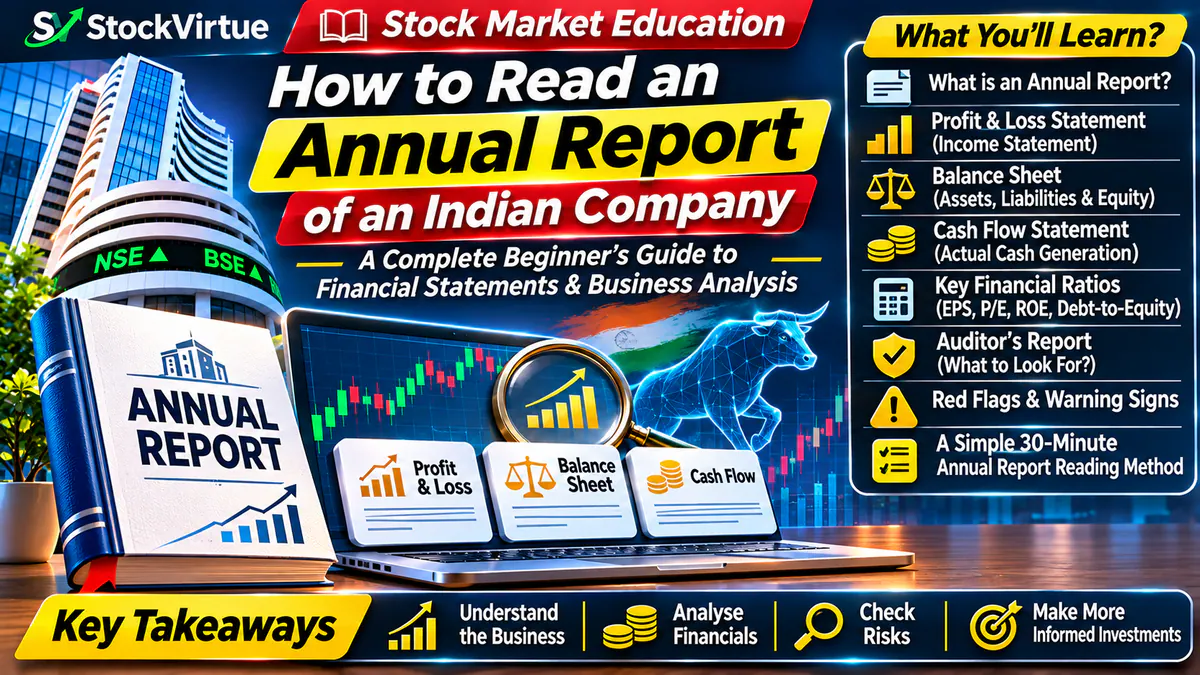
10. What is fundamental analysis?
Fundamental analysis involves studying a company's business and financial position to understand its underlying value and prospects.
Important financial indicators include:
Indicator | What it helps assess |
|---|---|
Revenue | Business sales and operating scale |
Net profit | Earnings after expenses and taxes |
EPS | Earnings attributable to each share |
P/E ratio | Share price relative to earnings |
P/B ratio | Market value relative to book value |
ROE | Return generated on shareholders' equity |
Debt-to-equity | Financial leverage |
Operating cash flow | Cash generated from business operations |
EBITDA margin | Operating profitability before certain expenses |
Example: Understanding the P/E ratio
Suppose:
Share price: ₹600.
Earnings per share: ₹30.
The P/E ratio is:
[
P/E=\frac{600}{30}=20
]
This means investors are paying ₹20 for every ₹1 of annual earnings per share.
A higher P/E does not automatically mean a stock is expensive, and a lower P/E does not automatically make it attractive.
Valuation should be assessed alongside earnings growth, business quality, debt, industry conditions and future expectations.
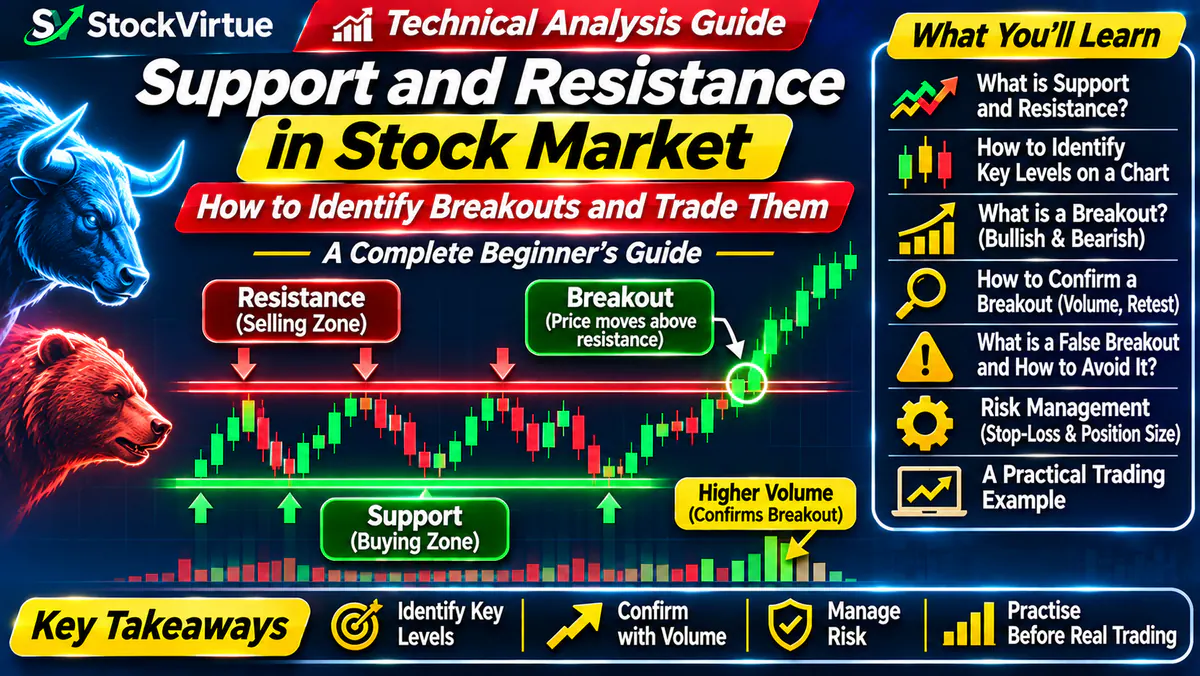
11. What is technical analysis?
Technical analysis studies historical price movements and trading activity to understand market behaviour.
Traders use charts and indicators to examine:
Price trends.
Support and resistance.
Trading volume.
Moving averages.
Momentum.
Volatility.
Candlestick patterns.
What are candlestick charts?
Candlestick charts represent price movement over a selected period.
Each candle generally displays:
Opening price.
Closing price.
Highest price.
Lowest price.
A green candle commonly indicates that the closing price was higher than the opening price, while a red candle indicates the opposite, depending on the chart's settings.
Technical analysis can help traders organise market observations, but no chart pattern or indicator guarantees a particular outcome.
12. What are futures and options?
Futures and options are derivative contracts whose values are linked to an underlying asset, such as a stock or index.
They are commonly known as F&O.
Futures
A futures contract creates an obligation to buy or sell the underlying exposure according to the contract terms.
Futures trading involves margin and can generate substantial losses if the market moves against a position.
Options
An option buyer pays a premium for a right, but not an obligation, under the contract.
A call option gives the buyer the right to buy the underlying exposure according to the contract terms.
A put option gives the buyer the right to sell the underlying exposure according to the contract terms.
Important option concepts include:
Strike price.
Expiry date.
Premium.
Intrinsic value.
Time value.
Implied volatility.
Delta, gamma, theta and vega.
F&O is more complex than ordinary equity investing. Beginners should understand contract specifications, margin, expiry, leverage and the possibility of substantial losses before participating.
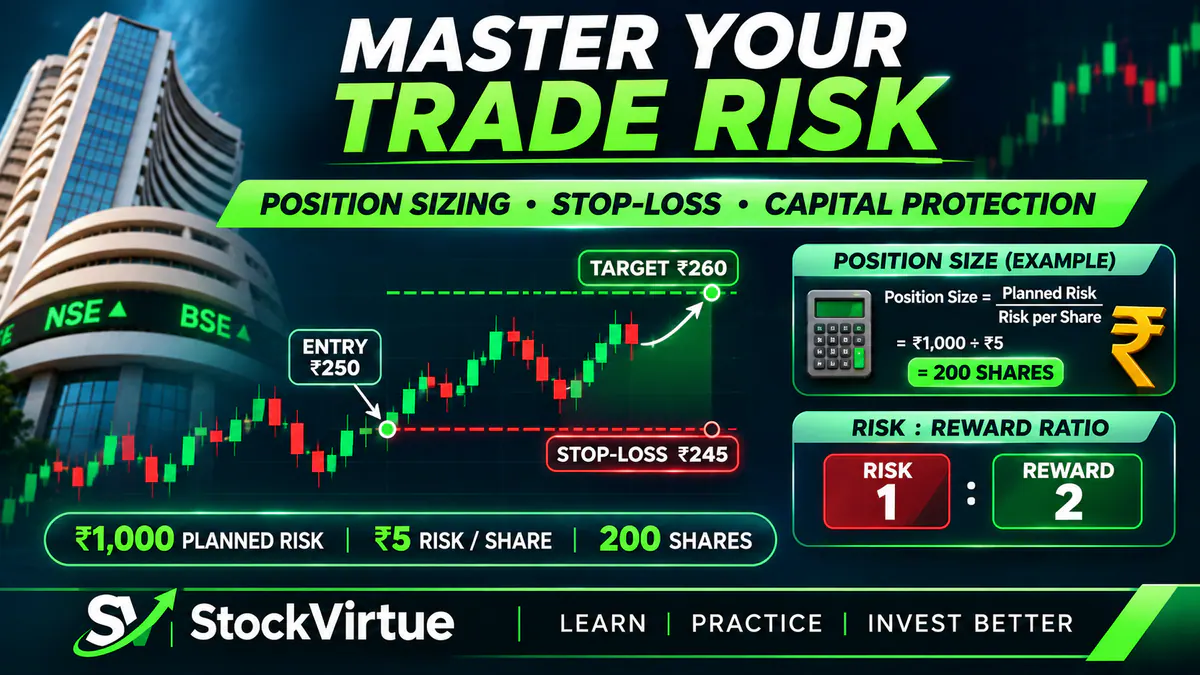
13. What is risk management in stock-market trading?
Risk management is the process of identifying and controlling potential financial losses.
A trading strategy should not focus only on how much money it could make.
It should also consider how much could be lost if the market moves in the opposite direction.
Some useful risk-management practices include:
Position sizing
Avoid committing an unnecessarily large amount of capital to one trade or company.
Stop-loss planning
Identify in advance the conditions under which a position should be closed.
Diversification
Avoid concentrating an entire portfolio in one company, industry or asset.
Risk-reward assessment
Compare the potential gain with the possible loss before entering a trade.
Trading journal
Record the reason for each trade, entry, exit, outcome and lesson learned.
Avoid excessive leverage
Borrowed exposure can magnify losses as well as gains.
Risk management does not eliminate losses. It helps traders make more structured decisions.
14. Common mistakes beginners should avoid
New market participants frequently make avoidable mistakes.
Common mistake | Better approach |
|---|---|
Buying because of social-media tips | Research the company and its financials |
Trading without understanding the product | Learn contract and order specifications |
Using excessive leverage | Understand exposure before trading |
Ignoring brokerage and taxes | Calculate total transaction costs |
Following every market rumour | Verify announcements through reliable sources |
Trading without an exit plan | Define risk conditions in advance |
Treating paper profits as guaranteed real profits | Understand the limitations of simulation |
Investing money needed for immediate expenses | Consider financial goals and risk capacity |
Learning to avoid poor decisions is an important part of becoming a more disciplined market participant.
15. How can beginners practise stock-market trading without real money?
Paper trading is a method of practising market transactions using virtual funds instead of actual investment capital.
It allows beginners to understand how orders, price changes and portfolio performance work without risking their savings.
A simple learning exercise could look like this:
Starting virtual capital: ₹1,00,000.
A learner decides to buy:
Stock | Simulated quantity | Illustrative price | Position value |
|---|---|---|---|
Stock A | 20 | ₹500 | ₹10,000 |
Stock B | 10 | ₹800 | ₹8,000 |
Stock C | 25 | ₹200 | ₹5,000 |
Total | ₹23,000 |
If the market prices change, the learner can calculate the updated value of the virtual portfolio and observe the resulting profit or loss.
Paper trading can help learners practise:
Market and limit orders.
Portfolio creation.
Position sizing.
Entry and exit planning.
Profit and loss calculations.
Trading discipline.
Reviewing previous decisions.
However, simulated trading does not fully reproduce real-market execution, slippage, liquidity, margin calls or the emotional pressure of risking actual capital.
16. How StockVirtue helps beginners learn the Indian stock market
StockVirtue is a virtual trading simulator designed to help users practise in Indian markets without risking real money.
Learners can use a simulated environment to understand market movements, test trading decisions and observe how virtual portfolios respond to changing prices.
The learning process can be organised into four stages:
Stage 1 — Understand the basics
Learn how NSE, BSE, indices, Demat accounts and trading accounts work.
Stage 2 — Practise order placement
Understand market orders, limit orders, stop-loss orders and other supported order types.
Stage 3 — Build a virtual portfolio
Practise selecting securities, managing virtual capital and monitoring portfolio performance.
Stage 4 — Review and improve
Analyse completed trades, identify mistakes and improve decision-making.
The objective is to build market knowledge and disciplined habits before making independent financial decisions.
Explore StockVirtue: Visit StockVirtue.
Frequently Asked Questions
1. Can beginners invest in the Indian stock market?
Yes. Beginners can start after completing the required account-opening and KYC procedures through an eligible SEBI-registered intermediary. They should understand the risks before investing.
2. What is the minimum amount required to invest?
There is no universal minimum investment amount for purchasing ordinary listed shares. The amount depends on the share price, quantity purchased, applicable charges and broker requirements.
3. What is the difference between NSE and BSE?
Both are recognised Indian stock exchanges. They have different benchmark indices, listing arrangements and market infrastructure.
4. What is a Demat account?
A Demat account holds securities in electronic form. It is used to maintain shares and other eligible securities.
5. What is the difference between investing and trading?
Investing generally focuses on owning assets over a longer period based on financial goals and business fundamentals. Trading usually focuses on shorter-term price movements.
6. Is intraday trading suitable for beginners?
Intraday trading can be difficult because it involves rapid price movements, execution risk and strict time constraints. Beginners should understand the risks and practise before considering real-money participation.
7. Can I learn trading without investing real money?
Yes. Paper trading and market simulations can help learners understand orders, portfolios and price movements using virtual funds.
8. Does technical analysis guarantee profits?
No. Technical indicators and chart patterns are analytical tools, not guaranteed predictions.
Final takeaway
The Indian stock market offers different ways to participate in financial markets, from long-term share ownership to short-term trading and derivatives.
However, successful market participation requires more than selecting a stock or identifying a chart pattern.
Beginners should understand how exchanges operate, how orders are executed, how settlement works, how companies generate profits and how risk can affect their portfolios.
The strongest starting point is education, followed by practical learning and disciplined decision-making.
StockVirtue — Learn | Practice | Invest Better
Disclaimer: This article is for educational purposes only and does not constitute investment advice or a recommendation to buy, sell or hold any security or derivative. Stock-market investments and trading involve risk, including the possibility of losing capital. Exchange rules, settlement procedures, charges and trading facilities may change. Always consult official exchange and SEBI resources and assess your financial circumstances before investing.