Stock Market Education
Risk Management in the Indian Stock Market: Position Sizing, Stop-Loss and Capital Protection Explained
Learn stock market risk management with practical examples of position sizing, stop-loss, risk-reward ratios and capital protection for Indian traders.
Introduction
Many beginners enter the stock market focusing on one question: Which stock should I buy?
Experienced market participants know that another question is equally important: How much can I afford to lose if my trade goes wrong?
A trading idea can be correct in the long run and still produce a loss on an individual trade. Unexpected news, market volatility, changing sentiment and sudden price movements can affect even carefully researched positions.
This is why risk management is an essential part of stock market education. It helps traders plan their exposure, control the potential impact of losses and avoid allowing one unsuccessful trade to damage their overall capital.
In this guide, we explain how position sizing, stop-loss orders, risk-reward ratios and portfolio exposure work in the Indian stock market, with practical examples that beginners can practise using virtual trading.
1. What Is Risk Management in Stock Trading?
Risk management is the process of identifying, measuring and controlling the financial risks associated with an investment or trade.
It does not mean avoiding every risky opportunity or guaranteeing that a trade will be profitable. Instead, it means understanding the possible downside before committing capital.
A basic trading risk-management plan should answer four questions:
How much capital is available?
What is the maximum acceptable loss on this trade?
At what price will the trading idea be considered invalid?
How many shares or contracts should be traded?
For example, imagine a trader has ₹1,00,000 in trading capital. Instead of using the entire amount on one stock, the trader first decides how much of that capital can be exposed to a potential loss.
This decision should come before placing the order, not after the market starts moving.
SEBI's investor education guidance also emphasises understanding investment risks, matching investments with financial goals and risk tolerance, and diversifying exposure.
2. What Is Position Sizing?
Position sizing determines the quantity of shares or contracts a trader should buy or sell.
It is one of the most important parts of a trading plan because the quantity directly affects how much money can be gained or lost when the price changes.
A trader may identify a good entry price and a logical stop-loss level, but choosing an excessively large quantity can still create an unnecessarily high financial risk.
Position sizing formula
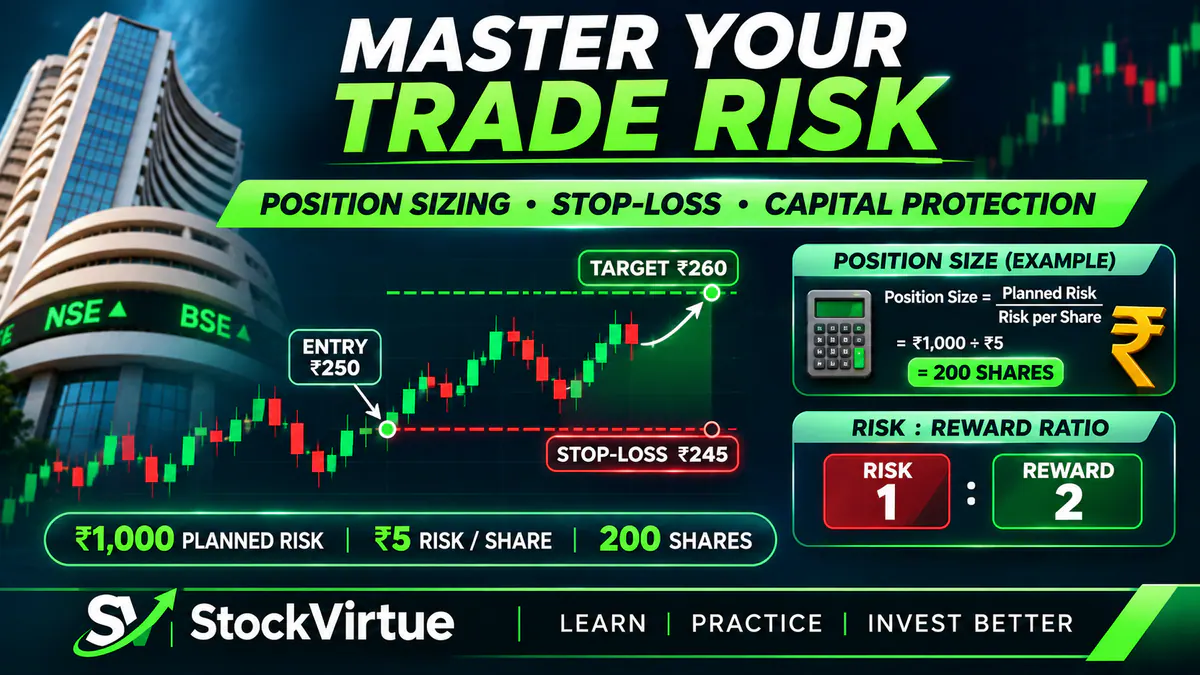
Number of shares = Maximum acceptable trade loss ÷ Risk per share
Where:
Risk per share = Entry price − Stop-loss price
For a short trade, calculate the difference between the stop-loss price and the entry price.
Practical example
Suppose a trader has the following plan:
Parameter | Example value |
|---|---|
Available trading capital | ₹1,00,000 |
Illustrative risk limit | 1% |
Maximum planned loss | ₹1,000 |
Stock entry price | ₹250 |
Stop-loss price | ₹245 |
Risk per share | ₹5 |
Now calculate the quantity:
₹1,000 ÷ ₹5 = 200 shares
The trader's planned position is 200 shares.
The total purchase value would be:
200 × ₹250 = ₹50,000
If the stock reaches the planned stop-loss price of ₹245 and the order executes at that price, the price-based loss would be:
200 × ₹5 = ₹1,000, excluding brokerage, taxes and other charges.
This example shows that position size should be calculated using the distance between entry and stop-loss, rather than simply using the maximum available capital.
Important: A 1% risk limit is an illustrative planning assumption, not a SEBI-prescribed rule or a guarantee of safety. Each participant must consider their financial circumstances and risk tolerance.
3. What Is a Stop-Loss and Why Does It Matter?
A stop-loss is a predefined price level at which a trader plans to exit a position to limit a potential loss.
It helps establish an exit discipline before emotions influence the decision.
For example:
Entry price: ₹500
Stop-loss price: ₹490
Target price: ₹520
The planned price risk is ₹10 per share, while the planned potential reward is ₹20 per share.
A stop-loss can be useful, but it does not guarantee that the trade will exit at the exact specified price. During sharp market movements, gaps, low liquidity or execution delays, the actual execution price may be different.
Common types of stop-loss orders
1. Fixed-price stop-loss
The trader chooses a specific price level in advance. It is simple to understand and useful for learning basic trading discipline.
2. Percentage-based stop-loss
The exit level is calculated using a fixed percentage of the entry price.
For example, a 2% stop-loss on an entry at ₹500 would be ₹490 for a long position.
3. Trailing stop-loss
The stop-loss level moves in the favourable direction as the market price rises. It is designed to help protect some unrealised gains while allowing a position to remain open.
A trailing stop does not eliminate the risk of gaps or slippage.
Where should a stop-loss be placed?
A stop-loss should be based on the trading idea, price structure, volatility and the point at which the original analysis is no longer valid.
Avoid selecting an arbitrary stop-loss simply because a particular percentage looks comfortable.
A stop that is too close may be triggered by ordinary market fluctuations. A very wide stop may require a much smaller position size to keep the planned rupee risk within limits.
4. Understanding the Risk-Reward Ratio
The risk-reward ratio compares the amount a trader is prepared to risk with the potential reward being targeted.
Consider this example:
Entry price: ₹500
Stop-loss: ₹490
Target price: ₹520
Potential risk per share = ₹10.
Potential reward per share = ₹20.
The risk-reward ratio is therefore 1:2.
This means the planned potential reward is twice the planned price risk.
More examples
Risk per share | Potential reward | Risk-reward ratio |
|---|---|---|
₹10 | ₹10 | 1:1 |
₹10 | ₹20 | 1:2 |
₹10 | ₹30 | 1:3 |
₹20 | ₹30 | 1:1.5 |
A higher potential reward relative to risk does not automatically make a trade profitable. The probability of reaching the target, transaction costs, execution quality and consistency of the strategy also matter.
Can a trader be profitable with more losing trades?
Yes, it is mathematically possible.
For example, imagine a hypothetical strategy with:
10 trades
4 profitable trades earning ₹2,000 each
6 losing trades losing ₹1,000 each
Total profits = ₹8,000.
Total losses = ₹6,000.
Net result before costs = ₹2,000.
However, this is only an illustration. Actual results depend on the strategy, market conditions, execution and trading costs. A favourable risk-reward ratio alone cannot establish that a strategy has an edge.
5. How Much Capital Should You Risk Per Trade?
There is no single risk percentage suitable for every trader.
Some traders use a small fixed fraction of their capital as a planning limit. Others use a lower amount depending on volatility, experience, financial obligations and the nature of the instrument.
The important principle is to decide the maximum acceptable loss before entering the position.
Consider an illustrative trading account of ₹2,00,000:
Illustrative risk limit | Planned loss per trade |
|---|---|
0.5% | ₹1,000 |
1% | ₹2,000 |
1.5% | ₹3,000 |
2% | ₹4,000 |
These figures are examples, not recommended limits for every investor.
Also remember that the amount risked on one trade is not the same as the total risk across an entire portfolio. Several positions can lose money together, particularly when they are exposed to the same sector or market event.
6. Why Diversification and Exposure Limits Matter
Diversification means spreading investments across different securities, industries or asset classes rather than concentrating everything in one position.
Suppose a portfolio contains shares from five different companies, but all five companies belong to the banking sector. The portfolio may appear diversified by company name, yet it remains exposed to similar industry-related risks.
A more balanced approach considers:
Sector concentration.
Exposure to individual companies.
Correlation between holdings.
Liquidity of the securities.
Investment time horizon.
Overall portfolio volatility.
Diversification cannot eliminate market-wide risk. When the broader market falls, many securities may decline together.
SEBI explains that diversification across assets and within asset categories can help manage certain investment risks, while systematic market risk cannot simply be diversified away.
7. Risk Management in Futures and Options
Futures and options require additional care because leverage can make the financial impact of price movements significantly larger relative to the margin or premium involved.
A relatively small amount of margin may represent exposure to a much larger underlying position.
Futures trading
In futures, the trader is exposed to changes in the underlying contract price. Losses can become substantial when the market moves against the position.
Before entering a futures trade, understand:
Contract lot size.
Contract value.
Applicable margin requirements.
Stop-loss distance.
Expiry and settlement conditions.
Potential mark-to-market obligations.
A trader cannot always select an exact quantity because exchange-traded contracts generally have fixed lot sizes. If one lot already exceeds the trader's planned risk limit, the responsible decision may be to avoid that trade.
Options trading
Option buyers pay a premium for the contract. The premium paid is generally the maximum loss for a fully paid long option position, excluding applicable costs.
However, options can lose value because of changes in the underlying price, time decay, implied volatility and other factors.
Option writers face different and potentially much larger risks. Some option-writing positions can carry theoretically unlimited losses.
SEBI's educational material explains the risks associated with derivatives, including leverage, liquidity and the possibility of substantial losses. NSE also advises investors to trade derivatives cautiously and understand the risks before participating.
For beginners, understanding the contract mechanics and practising without real money is preferable to entering leveraged positions without sufficient knowledge.
8. Five Common Risk-Management Mistakes
1. Trading without a stop-loss plan
Entering a position without defining an exit condition can lead to emotional decisions when prices move against the trade.
2. Increasing quantity after a loss
Trying to recover losses by taking larger positions can make an already difficult situation worse.
3. Moving the stop-loss further away
Repeatedly widening a stop-loss to avoid accepting a planned loss changes the original risk calculation.
4. Using excessive leverage
Leverage can magnify losses as well as potential gains. Margin requirements should never be mistaken for the maximum possible loss.
5. Ignoring trading costs
Brokerage, exchange charges, taxes, slippage and other applicable expenses can reduce actual returns. A strategy that appears profitable before costs may perform differently after them.
9. Practise Risk Management with Virtual Trading
Reading about risk management is useful, but applying the concepts is what helps build practical understanding.
A virtual trading simulator allows learners to practise decisions without placing real-money orders.
With StockVirtue's paper-trading environment, learners can use virtual trading capital to explore market movements, test order decisions and understand how position size affects a simulated portfolio.
A practical exercise for beginners
Try this example using virtual capital:
Starting virtual capital: ₹1,00,000
Stock entry price: ₹400
Stop-loss: ₹392
Target price: ₹416
Illustrative maximum planned loss: ₹1,000
Step 1: Calculate the risk per share.
₹400 − ₹392 = ₹8.
Step 2: Calculate the position size.
₹1,000 ÷ ₹8 = 125 shares.
Step 3: Calculate the position value.
125 × ₹400 = ₹50,000.
Step 4: Calculate the planned potential reward.
₹416 − ₹400 = ₹16 per share.
125 × ₹16 = ₹2,000.
The hypothetical trade therefore has a planned price risk of ₹1,000 and a potential price reward of ₹2,000, before costs and execution differences.
Now practise the same calculation with different entry prices and stop-loss distances. Observe how the permitted quantity changes.
Keep a trading journal containing:
Date and instrument.
Entry and exit prices.
Position quantity.
Stop-loss and target.
Reason for entering the trade.
Actual simulated result.
Mistakes and lessons learned.
The objective is not to achieve a high number of profitable trades in a short period. It is to learn how decisions affect capital and whether a trading process is consistent across different market conditions.
10. A Simple Risk-Management Checklist Before Every Trade
Before placing a simulated or real trade, ask yourself:
Have I understood the instrument and its risks?
Is my entry based on a clear trading plan?
Have I identified the price at which my trading idea becomes invalid?
Have I calculated the quantity using the stop-loss distance?
Is the planned loss acceptable?
Am I already carrying too much exposure to the same sector or market movement?
Have I considered transaction costs and possible slippage?
Am I entering because of analysis or because of fear of missing out?
If important questions remain unanswered, reconsider the trade rather than rushing into it.
Conclusion: Protecting Capital Is Part of Learning to Trade
Successful participation in the stock market requires more than identifying stocks that may rise. It also requires understanding uncertainty, controlling exposure and accepting that losses are part of market activity.
Position sizing helps determine how much to trade. Stop-loss planning establishes an exit condition. Risk-reward analysis compares potential outcomes, while diversification helps manage concentration.
None of these methods guarantees profits or prevents every loss. Their purpose is to make trading decisions more structured and informed.
For beginners, practising these principles through virtual trading can provide a useful learning environment before considering real-market participation.
StockVirtue Takeaway: Learn the risk before taking the trade. Build a process, practise with virtual capital and focus on improving your decisions rather than chasing quick profits.