Economy & Banking
RBI Announces ₹50,000 Crore VRRR Auction to Manage Banking System Liquidity
RBI announces a ₹50,000 crore one-day VRRR auction on November 3 to manage banking liquidity, with reversal scheduled for November 4, 2026.
RBI moves to absorb short-term surplus funds
The Reserve Bank of India has announced a one-day Variable Rate Reverse Repo (VRRR) auction worth ₹50,000 crore as part of its ongoing efforts to manage liquidity conditions in the banking system.
In a press release dated November 3, the central bank said the decision was taken after reviewing current and evolving liquidity conditions.
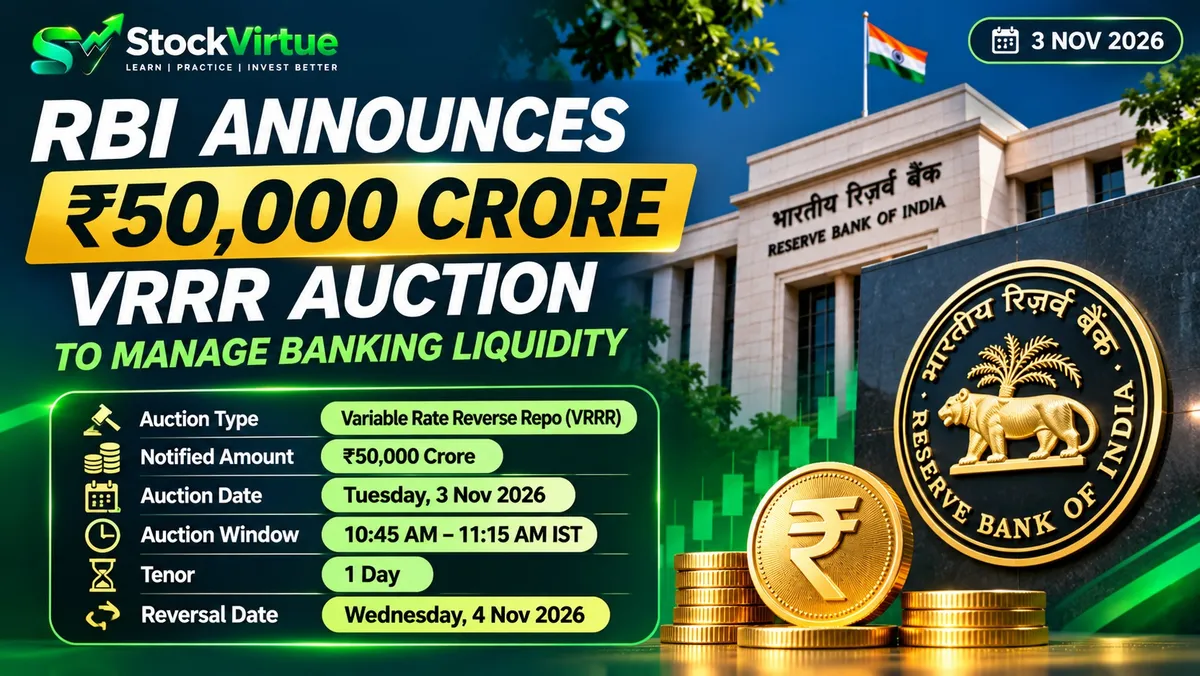
The auction was scheduled for Tuesday, November 3, between 10:45 AM and 11:15 AM IST, with a tenor of one day. The funds accepted through the operation are scheduled for reversal on Wednesday, November 4, 2026.
Key details of the RBI auction
Particulars | Details |
|---|---|
Auction type | Variable Rate Reverse Repo |
Notified amount | ₹50,000 crore |
Auction date | November 3, 2026 |
Auction window | 10:45 AM–11:15 AM |
Tenor | 1 day |
Reversal date | November 4, 2026 |
Conducting authority | Reserve Bank of India |
What is a VRRR auction and why does it matter?
A Variable Rate Reverse Repo auction is a liquidity management tool used by the RBI to absorb surplus funds from the banking system.
Under this arrangement, eligible banks place funds with the RBI for a specified period and receive interest at the auction-determined rate. The central bank uses this mechanism to temporarily withdraw excess liquidity from the market.
Unlike a fixed-rate operation, the interest rate in a variable-rate auction is determined through the bidding process.
By conducting such operations, the RBI can influence short-term liquidity conditions and help maintain orderly money market rates.
Why has the RBI announced this operation?
The central bank's announcement specifically refers to a review of current and evolving liquidity conditions.
The ₹50,000 crore notified amount indicates the maximum amount offered for this particular auction, not necessarily the final amount accepted. The actual outcome depends on banks' bids and the RBI's acceptance.
Since the operation has a one-day tenor, the funds are scheduled to return on November 4. This makes it a short-term liquidity management measure rather than a permanent withdrawal of money from the banking system.
What could this mean for financial markets?
Liquidity conditions are closely watched by banks, bond market participants and money market traders because they influence short-term borrowing costs and the availability of funds.
The latest VRRR announcement highlights the RBI's active management of banking-system liquidity.
However, the announcement alone should not be interpreted as a change in the central bank's monetary policy stance. Investors should monitor the auction results, overnight money market rates and subsequent RBI liquidity operations for a clearer picture of market conditions.
Market takeaway: The RBI has offered ₹50,000 crore through a one-day VRRR auction, reinforcing its focus on managing short-term banking-system liquidity. The next important date is November 4, when the operation is scheduled for reversal.
Sources
- Reserve Bank of India · Published 3 Nov 2026, 10:40 am IST