
F&O Trading
Nifty Expiry Today, November 9: 25,000 in Focus as 24,000 Put and 26,000 Call OI Shape Market Watch
Nifty expiry today, November 9: Check revised expiry date, 24,000 put and 26,000 call OI, PCR, max pain and important levels for F&O traders.
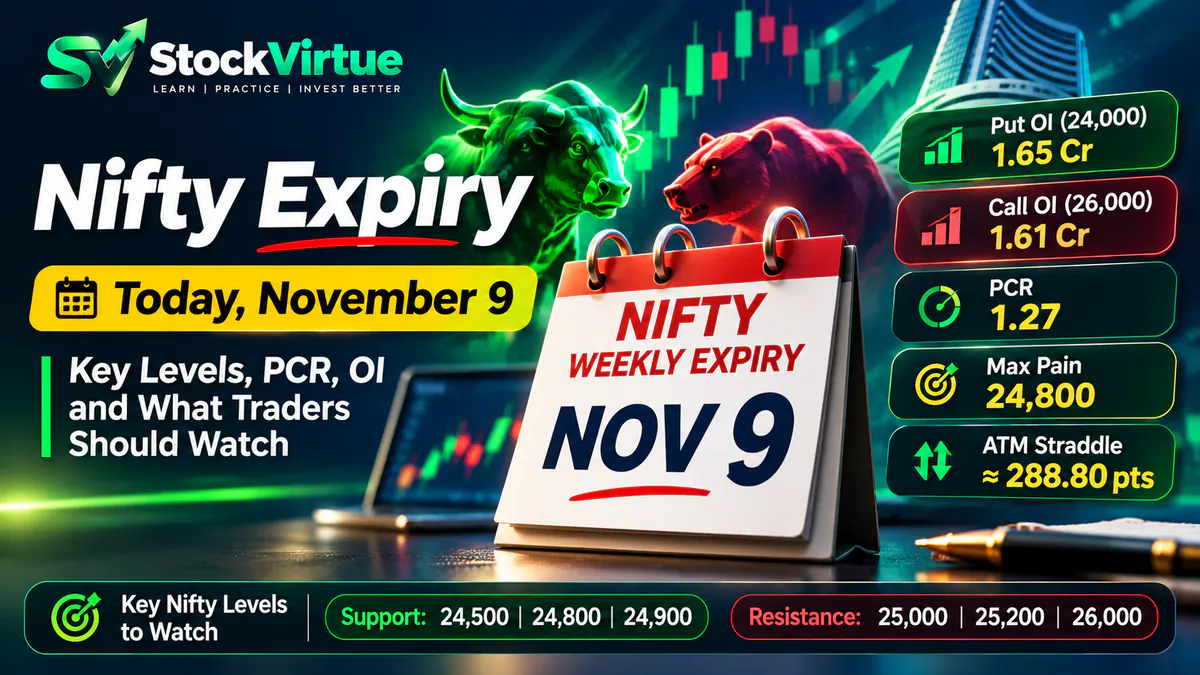
Indian equity derivatives traders are preparing for an important Nifty 50 expiry session today, Monday, November 9. The weekly expiry has been shifted from its usual Tuesday schedule because the stock market will remain closed tomorrow, November 10, for Diwali Balipratipada.
The Nifty 50 ended Sunday's special Muhurat Trading session at 24,986.40, just below the psychological 25,000 mark. Meanwhile, the latest available options data shows significant positioning around the 24,000 put and 26,000 call strikes.
The market will be watching whether Nifty can reclaim 25,000, how options positions change during the session and whether volatility increases as traders adjust or close their expiry-day positions.
1. Why is Nifty expiry happening on Monday?
Nifty weekly index options normally expire on Tuesday. However, November 10, 2026, is an NSE trading holiday for Diwali Balipratipada.
Under NSE's expiry rules, if the scheduled Tuesday expiry falls on an exchange holiday, the contract expires on the previous trading day.
As a result, the Nifty weekly expiry has moved to Monday, November 9.
Particular | Schedule |
|---|---|
Scheduled expiry day | Tuesday, November 10 |
Exchange holiday | Diwali Balipratipada |
Revised Nifty expiry | Monday, November 9 |
Regular equity derivatives trading | 9:15 AM – 3:40 PM IST |
Next Nifty weekly expiry | Tuesday, November 17 |
The November 9 contract is a weekly expiry, not the November monthly expiry. The monthly Nifty expiry is scheduled for November 23, following the holiday adjustment for November 24.
Source: NSE contract specifications and exchange holiday calendar.
2. Nifty 50 market snapshot before expiry
The latest completed trading session was Sunday's Muhurat Trading session.
Market indicator | November 8 close |
|---|---|
Nifty 50 | 24,986.40 |
Daily change | -43.95 points |
Daily percentage change | -0.18% |
Previous regular-session close (Nov 6) | 25,030.35 |
The index ended slightly lower after the strong rally seen during the previous week.
The 25,000 level is likely to remain an important psychological reference during Monday's expiry session.
3. Nifty options chain: Where is the highest open interest?
The latest available end-of-day options data for the November 9 expiry highlights two important strike prices.
Options indicator | Strike price | Reported open interest |
|---|---|---|
Highest Call OI | 26,000 CE | Approximately 1.61 crore |
Highest Put OI | 24,000 PE | Approximately 1.65 crore |
Max Pain | 24,800 | — |
Nifty closing level | 24,986.40 | — |
The data indicates substantial open positions at both the 24,000 put and 26,000 call strikes.
These levels may attract attention from traders monitoring options positioning. However, high open interest does not automatically establish support or resistance. Positions can be added, reduced or rolled over as market conditions change.
Source: November 8 Nifty options end-of-day data.
4. What does Nifty PCR indicate?
The Put-Call Ratio (PCR) compares put open interest with call open interest.
The latest available Nifty options report showed an overall open-interest PCR of approximately 1.27 across the chain.
A PCR above 1 means put open interest is greater than call open interest under the calculation used.
This may indicate relatively higher put positioning, but it should not automatically be interpreted as a bullish signal.
The interpretation depends on whether positions are being bought or written, how open interest is changing and how the underlying index is behaving.
Important data distinction: Some derivatives trackers report a different PCR when they calculate it only for the nearest expiry instead of the entire options chain. Always check the expiry and calculation scope before comparing PCR figures.
5. Max pain at 24,800: What does it mean?
The latest options analysis placed Nifty's max pain level near 24,800 for the November 9 expiry.
Max pain is a theoretical options-market calculation that identifies the index settlement level at which the aggregate intrinsic value payable to option buyers would be lowest, based on the open positions included in the calculation.
It is frequently monitored by derivatives traders, but it is not a price target.
The index does not have to move towards max pain. Fresh positions, market news, volatility and changes in open interest can alter the calculation during the session.
6. What is the options market pricing for expiry-day movement?
The 25,000 at-the-money call and put contracts together had a reported settlement value of approximately 288.80 points in the latest available data.
This is known as the at-the-money straddle.
It provides an approximate indication of the movement priced into those options for the remaining life of the contract.
For reference:
Nifty spot close: 24,986.40
Approximate ATM strike: 25,000
ATM straddle value: 288.80 points
Approximate percentage of spot: 1.16%
This is an options-pricing reference, not a prediction that Nifty will move exactly 289 points. Actual realised movement can be smaller or larger.
7. Important Nifty levels traders may monitor
Based on the latest spot close and options positioning, the following levels may attract attention:
Level | Why it matters |
|---|---|
25,000 | Psychological and near-ATM reference |
25,100–25,200 | Nearby upside strikes to monitor |
24,900–24,800 | Near-term downside reference and max-pain area |
24,500 | Lower support reference |
24,000 | Highest reported put OI strike |
These are market-monitoring levels, not confirmed technical support or resistance zones. Their significance can change as the index moves and fresh positions enter the market.
8. Why can expiry-day volatility increase?
Expiry sessions can see sharp movements in option premiums and the underlying index because traders adjust positions before contracts expire.
Some important factors include:
Option premium decay: Time value generally declines as expiry approaches, although changes in volatility and the underlying price can offset or accelerate that movement.
Open-interest changes: Large position closures or fresh positions can change the apparent concentration at particular strikes.
Gamma sensitivity: Options close to the money can become more sensitive to small movements in the underlying as expiry approaches.
Institutional hedging: Traders and institutions may adjust futures and options positions to manage their overall market exposure.
Sudden market news: Global cues, crude oil prices, currency movements and company-specific announcements can create sharp intraday changes.
Traders should be particularly careful with short-dated options because their premiums can change rapidly.
9. What should F&O traders watch today?
Before taking any position, traders should monitor:
Whether Nifty sustains above or falls below 25,000.
Changes in 24,000 put and 26,000 call open interest.
Whether the 24,800 max-pain reference changes.
Movement in India VIX and option implied volatility.
Whether Bank Nifty supports or weakens the broader market.
Fresh futures positioning and institutional activity.
Changes in option premiums and market liquidity as expiry approaches.
A single PCR reading or open-interest figure should never be treated as a standalone trading signal.
10. Important reminder: Market holiday on November 10
NSE and BSE are scheduled to remain closed on Tuesday, November 10, for Diwali Balipratipada.
Therefore, traders should check their broker's holiday schedule, expiry details, settlement requirements and available funds before placing orders.
The next Nifty weekly expiry is scheduled for November 17, 2026.
StockVirtue Market Takeaway
Nifty's November 9 expiry is taking place one trading day earlier than usual because Tuesday is an exchange holiday.
The index closed Muhurat Trading at 24,986.40, while the options market showed significant positioning at 24,000 puts and 26,000 calls. The 25,000 level and the 24,800 max-pain reference are among the key figures traders may monitor.
However, expiry-day price movements can be unpredictable. Open interest, PCR and max pain provide information about market positioning, not guaranteed direction.
For derivatives traders, understanding option premiums, volatility, position sizing and maximum potential loss is more important than attempting to predict every expiry movement.
StockVirtue — Learn | Practice | Invest Better