
Stock Market News
Stock Market Today: Global AI Sell-Off Triggers Caution as GIFT Nifty Falls 210 Points; Coal India, Paytm and Voltas in Focus
GIFT Nifty falls 210 points as global technology selling hits Asian markets. Check Sensex and Nifty levels, global cues and stocks to watch on November 20, 2026.
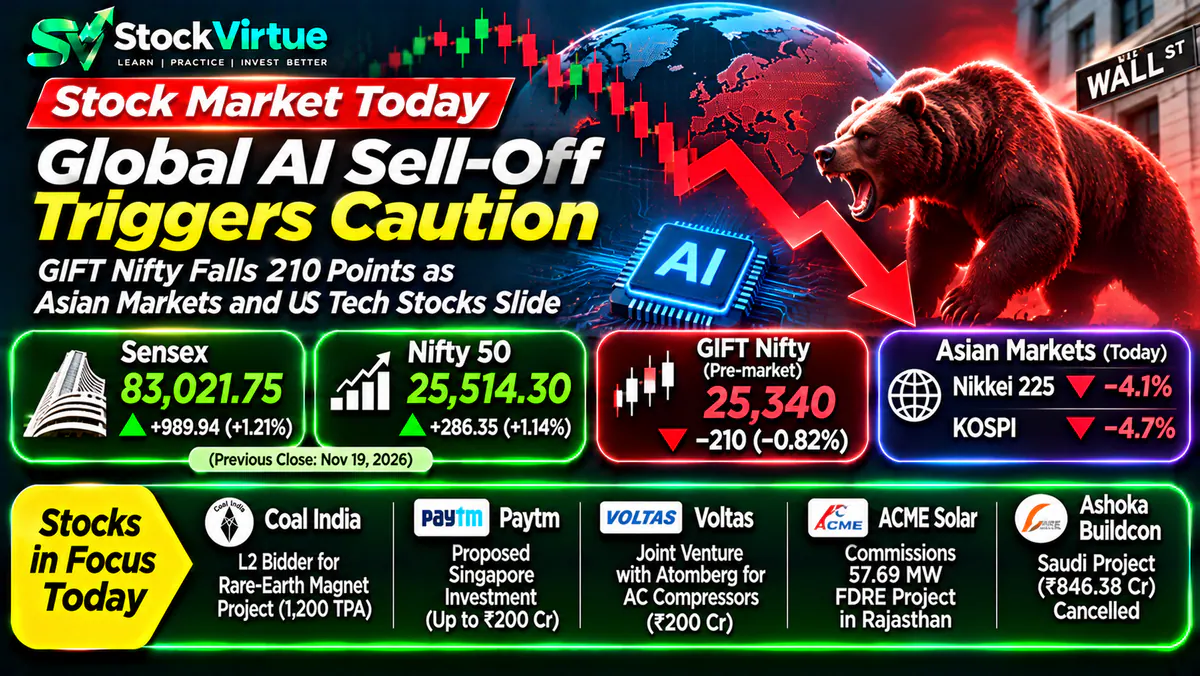
Indian stock markets are preparing for a potentially volatile Friday session as a global technology sell-off puts pressure on investor sentiment. After a powerful rally on Thursday pushed the Sensex above 83,000 and the Nifty 50 beyond 25,500, weakness across Asian markets and a sharp decline in US equities are raising concerns about whether domestic benchmarks can sustain their recent gains.
GIFT Nifty was trading near 25,340 around 7:43 AM IST, down approximately 210 points or 0.82%, indicating a potentially weak opening for Indian equities.
The pressure is coming primarily from global markets, where investors are reassessing the outlook for artificial intelligence-related companies, technology valuations and the possibility of higher US interest rates.
Meanwhile, several Indian companies, including Coal India, Paytm, Voltas, ACME Solar and Ashoka Buildcon, have announced business developments that could influence their individual share prices.
For investors, Friday's session will test whether domestic buying interest can absorb the pressure coming from international markets.
1. Thursday's rally: Sensex crosses 83,000, Nifty closes above 25,500
Indian equities staged a strong recovery on Thursday, November 19, after facing pressure earlier in the session.
The buying strengthened across automobile, banking, financial and consumer-related stocks, helping both benchmark indices finish firmly in positive territory.
Indian stock market closing data – November 19
Index | Closing level | Change |
|---|---|---|
BSE Sensex | 83,021.75 | +989.94 (+1.21%) |
Nifty 50 | 25,514.30 | +286.35 (+1.14%) |
Nifty Bank | 63,063 | Positive session |
Nifty IT | 30,919.45 | -1.10% |
The Sensex crossed the psychologically important 83,000 level, while the Nifty reclaimed 25,500.
The rally was particularly notable because the market recovered from earlier weakness and finished near the upper end of its trading range.
Automobile and consumer-durable stocks recorded strong gains, while banking stocks also contributed to the recovery.
However, the IT sector remained relatively weak, an important detail given the technology-led sell-off now spreading across international markets.
2. GIFT Nifty signals a weak opening
The biggest indication of Friday's possible market direction is coming from GIFT Nifty.
At approximately 7:43 AM IST, GIFT Nifty was trading near 25,340, down around 210 points or 0.82%.
This indicated that Indian benchmark indices could open below Thursday's closing levels.
A weaker GIFT Nifty does not guarantee that the NSE Nifty will open by exactly the same number of points. Actual opening levels can change as global markets, currency movements and institutional orders evolve.
Nevertheless, the indication suggests that traders should prepare for a cautious start.
3. Global technology sell-off hits Asian markets
International markets are experiencing renewed pressure as investors question the sustainability of the artificial intelligence investment boom.
Asian equities recorded significant losses on Friday.
Japan's Nikkei 225 declined approximately 4.1%, while South Korea's KOSPI fell around 4.7%. Regional Asian shares were down approximately 2.5% in the reported trading session.
The sell-off followed another difficult session on Wall Street.
US market closing snapshot – November 19
Index | Closing change |
|---|---|
S&P 500 | -2.02% |
Nasdaq Composite | -2.25% |
Dow Jones Industrial Average | -2.19% |
The Nasdaq's decline highlights the pressure on technology-oriented shares.
Investors are becoming more selective about companies whose valuations depend heavily on expectations of future AI-related growth.
The concern is not necessarily that artificial intelligence investment will stop. Rather, markets are questioning whether the expected growth and future profits justify the valuations of some technology businesses.
This reassessment has increased volatility across global equity markets.
4. US interest-rate expectations add another layer of uncertainty
The global equity correction is also being influenced by changing expectations about US monetary policy.
Recent Federal Reserve meeting minutes have strengthened concerns that interest rates may remain higher for longer, with the possibility of another rate increase in December being discussed by market participants.
Higher US interest rates can affect global capital allocation in several ways:
Dollar-denominated investments may become more attractive.
Emerging-market currencies can face additional pressure.
Foreign investors may become more selective about equity exposure.
High-valuation growth stocks may face greater valuation pressure.
For India, the movement of foreign institutional investors will be particularly important.
A continuation of foreign inflows could help domestic equities absorb international weakness, while renewed selling could increase pressure on benchmark indices.
5. Foreign investment remains a major support for Indian markets
Despite the global uncertainty, foreign investment has been an important source of support for Indian equities during November.
Reuters reported that overseas investors had purchased approximately $12.21 billion of Indian equities during the month, supporting the market's recovery.
This has helped Indian benchmarks remain relatively resilient compared with several international markets.
However, foreign investment flows can change quickly when global interest-rate expectations, currency movements or risk appetite shift.
Investors should monitor the latest provisional NSE and BSE institutional activity data rather than assuming that the previous inflow trend will continue.
6. Stocks to watch today – November 20
Several companies have reported developments that could attract attention during Friday's trading session.
Coal India
Coal India is in focus after a consortium led by the company, along with the Non-Ferrous Materials Technology Development Centre (NFTDC), was declared the second-lowest bidder (L2) under the government's scheme to promote manufacturing of sintered rare-earth permanent magnets.
The proposed facility is expected to have a manufacturing capacity of 1,200 tonnes annually.
The project could support Coal India's diversification into strategic materials used in electric vehicles, wind turbines and other advanced manufacturing applications.
However, L2 status means the consortium ranked second in the bidding process. It should not be confused with a confirmed contract award.
Paytm
One 97 Communications, the parent company of Paytm, is in focus following a proposed overseas investment by its Singapore subsidiary.
Paytm Singapore plans to invest up to ₹200 crore in businesses associated with Funding Societies.
The proposed investment includes approximately ₹162 crore for acquiring a 19.1% stake in CardUp, a payments subsidiary.
The development could support Paytm's international payments strategy, although the transaction remains subject to applicable conditions and approvals.
Voltas
Voltas has entered into a joint venture agreement with Atomberg Innovation for developing, manufacturing and commercialising room air-conditioner compressors.
The proposed arrangement involves Voltas acquiring a 50% equity stake in Atomberg Airtech.
Both companies are expected to invest ₹100 crore each in the joint venture.
The development is important for Voltas because it creates an opportunity to strengthen its position in the air-conditioning component and manufacturing ecosystem.
ACME Solar
ACME Solar Holdings is in focus after commissioning a 57.69 MW Firm and Dispatchable Renewable Energy (FDRE) project in Rajasthan.
The project includes solar capacity and battery energy storage infrastructure.
The development highlights the increasing importance of energy storage in India's renewable-energy expansion.
Ashoka Buildcon
Ashoka Buildcon is in focus after a Saudi Arabia-based project worth approximately ₹846.38 crore was cancelled.
The company stated that the cancellation was due to internal reasons attributable to the employer.
The development may attract attention because investors often assess order-book visibility and execution risks when evaluating infrastructure companies.
7. Nifty 50: Important levels to monitor
After Thursday's strong recovery, the Nifty 50 closed at 25,514.30.
The index has reclaimed the 25,500 level, but Friday's global weakness could test the strength of this breakout.
Market analysts have identified the following reference levels:
Technical level | Nifty 50 |
|---|---|
Immediate support | 25,200 |
Important support | 25,000 |
Psychological level | 25,500 |
Near-term upside reference | 25,800 |
Further upside reference | 25,900–26,000 |
A sustained move above 25,500 could keep the positive technical structure intact.
On the other hand, a failure to hold the 25,200 area could increase selling pressure.
These levels are technical reference points, not guaranteed targets. Traders should also watch market breadth, India VIX, banking stocks and heavyweight index constituents.
8. What should investors watch before making decisions?
Friday's market could be driven by a combination of international sentiment and domestic stock-specific developments.
The following indicators deserve attention:
Global technology stocks: Continued weakness could affect sentiment towards Indian IT companies.
GIFT Nifty: The pre-market indication may change before the NSE opening.
Foreign institutional flows: Continued overseas buying could provide support to domestic benchmarks.
Crude oil: Oil prices influence India's import bill, inflation and energy-sector profitability.
Rupee-dollar movement: Currency weakness could influence foreign investment sentiment and imported inflation.
Banking and automobile stocks: Their performance may indicate whether Thursday's domestic rally has broader support.
9. The bigger picture: Is the Indian market becoming more resilient?
The latest market developments highlight an important difference between domestic and global market sentiment.
Indian equities have benefited from strong institutional inflows, improving corporate earnings expectations and buying interest across several domestic sectors.
At the same time, global markets are facing uncertainty around technology valuations, interest rates and economic growth.
This means that the Indian market may not necessarily follow international markets in exactly the same direction every day.
However, a prolonged global sell-off can eventually affect emerging-market sentiment, foreign capital flows and domestic valuations.
For investors, the important question is whether India's domestic fundamentals remain strong enough to absorb external volatility.
StockVirtue — Learn | Practice | Invest Better
Disclaimer: This article is for educational and informational purposes only and does not constitute investment advice or a recommendation to buy or sell any security. Thursday's index values are closing data for November 19, 2026. GIFT Nifty and Asian market figures are pre-market observations for November 20 and may change. Corporate developments are based on reported announcements and may be subject to further conditions. Technical levels are indicative, not guaranteed. Investors should conduct independent research and assess their risk tolerance before making investment decisions.