Stocks in Focus
Paytm Gets RBI's Initial Nod for Wallet Revival: Shares Hit Record High of ₹1,960
Paytm receives RBI's in-principle wallet approval. Shares hit ₹1,960 as investors assess the regulatory breakthrough and future growth opportunity.
Stocks in this story
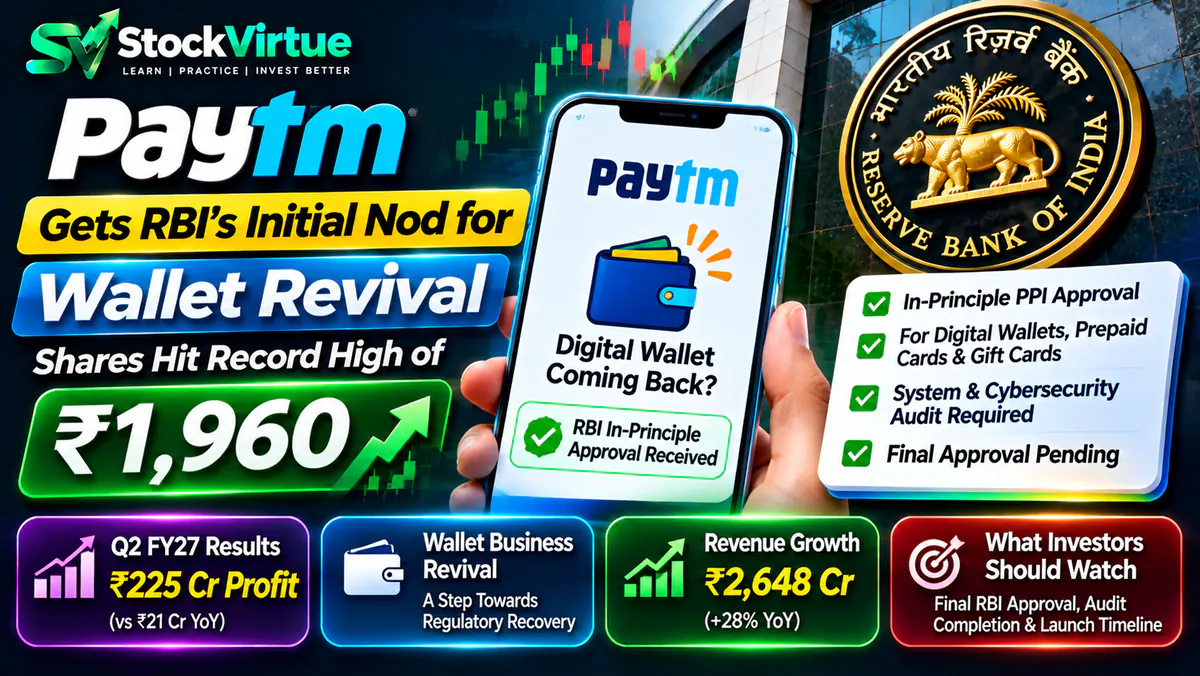
One 97 Communications Limited, the parent company of Paytm, has received an important regulatory boost after the Reserve Bank of India (RBI) granted in-principle authorisation to its wholly owned subsidiary, Paytm Payments Services Limited (PPSL), to issue prepaid payment instruments (PPIs), including digital wallets.
The development marks a significant step towards rebuilding Paytm's wallet business, which faced major disruption following regulatory restrictions on Paytm Payments Bank.
The announcement triggered a positive reaction in the stock market on Friday, November 13. Paytm shares climbed to an intraday record high of ₹1,960 on the NSE, while the stock closed at approximately ₹1,945 on the exchanges, according to reported market data.
However, the approval is not a final operating licence. PPSL must complete the required system and cybersecurity audit and obtain final authorisation from RBI before it can begin issuing wallets and other prepaid instruments.
For investors, the development represents progress in Paytm's regulatory recovery, but the actual business and earnings benefits will depend on successful execution.
1. What exactly has RBI approved for Paytm?
On November 13, 2026, Paytm disclosed that its wholly owned subsidiary, Paytm Payments Services Limited, had received an in-principle authorisation from RBI.
The authorisation allows PPSL to move towards establishing and operating a payment system for issuing prepaid payment instruments in India.
These instruments include:
Digital wallets.
Prepaid payment cards.
Certain gift cards.
Other eligible prepaid payment instruments.
The authorisation was issued under the Payment and Settlement Systems Act, 2007, subject to compliance with RBI's applicable Master Directions on Prepaid Payment Instruments.
This is important because it creates a regulatory route for Paytm to operate its wallet business through PPSL, independently of the former Paytm Payments Bank structure.
However, the company cannot immediately launch wallet issuance. It must first complete the conditions attached to the approval and obtain final authorisation.
2. What conditions must Paytm fulfil before launching wallets?
The RBI has attached important compliance requirements to the in-principle authorisation.
One of the major requirements is a comprehensive system audit, including a cybersecurity audit.
The audit must be conducted by an eligible auditor, such as a CERT-In-empanelled auditor or another qualified information-systems auditor recognised under the specified requirements.
Important regulatory conditions
Requirement | Details |
|---|---|
Regulatory authority | Reserve Bank of India |
Approved entity | Paytm Payments Services Limited |
Approval date | November 13, 2026 |
Authorisation | In-principle PPI approval |
Audit requirement | System and cybersecurity audit |
Audit deadline | Within six months of the RBI letter |
Final approval | Required before issuing PPIs |
Consequence of missing deadline | In-principle authorisation lapses automatically |
The six-month deadline is particularly important.
If PPSL fails to submit the required audit report within the prescribed period, the in-principle authorisation will automatically lapse.
Therefore, the next major milestone for investors is not simply the announcement of approval, but the successful completion of the audit and receipt of final RBI authorisation.
3. Why is this development important after the Paytm Payments Bank crisis?
To understand the importance of the latest approval, it is necessary to look at Paytm's regulatory history.
Paytm's wallet business was historically connected with Paytm Payments Bank. Over time, regulatory restrictions imposed on the payments bank disrupted several services, including wallet-related operations.
In January 2024, RBI announced restrictions on Paytm Payments Bank, including restrictions on accepting fresh deposits and credits after the prescribed deadline.
These restrictions significantly affected the company's payments ecosystem.
In April 2026, RBI cancelled Paytm Payments Bank's banking licence, and the bank subsequently entered the winding-up process.
The latest approval is different because it has been granted to Paytm Payments Services Limited, a separate wholly owned subsidiary of One 97 Communications.
This allows Paytm to pursue its prepaid payments business through a different regulated entity, subject to the central bank's conditions.
For the company, this represents an important step towards rebuilding its payments infrastructure without relying on the former payments bank.
4. Paytm share price reaction: Stock touches ₹1,960
The market responded positively to the regulatory announcement.
On Friday, November 13, Paytm shares rose as much as 1.8% to reach an intraday high of ₹1,960 on the NSE, compared with the previous closing price of ₹1,925.
The stock subsequently closed around ₹1,945, according to reported exchange-market coverage.
Paytm stock market snapshot
Indicator | Reported value |
|---|---|
Previous close | ₹1,925 |
Intraday high | ₹1,960 |
Reported closing price | ₹1,945 |
Intraday gain at high | Approximately 1.8% |
Closing gain | Approximately 1.0% |
The intraday high of ₹1,960 was notable because it moved above Paytm's November 2021 listing price of ₹1,950 for the first time since its market debut, according to market reports.
The positive reaction suggests that investors viewed the RBI's in-principle authorisation as a favourable regulatory development.
However, one trading session does not establish a long-term trend. Investors should examine subsequent price action, trading volumes and the company's financial performance.
5. Could the wallet business become a new growth opportunity for Paytm?
The wallet authorisation could create opportunities for Paytm to expand its digital payments business.
A successful return to wallet issuance could help the company strengthen its consumer payments ecosystem and potentially introduce additional financial products.
Some possible opportunities include:
Prepaid wallet services: Paytm could offer eligible users the ability to load money into digital wallets and make payments through the platform, after final authorisation.
Prepaid cards: The company could explore eligible prepaid card products and related payment services.
Merchant ecosystem: A broader payments offering could complement its existing merchant acceptance and payment solutions.
Customer engagement: Wallet functionality could provide additional reasons for users to remain active within the Paytm ecosystem.
Payments revenue: A larger product portfolio could create opportunities for future revenue generation, depending on transaction volumes, pricing and operating economics.
However, these opportunities should not be confused with confirmed earnings.
The business will need to complete regulatory requirements, launch services, attract users and build transaction volumes before the benefits become visible in its financial statements.
6. What do analysts think about the RBI approval?
Market commentary following the announcement was broadly positive.
Analysts cited the approval as a sign of reduced regulatory friction and an important step towards restoring Paytm's wallet business.
However, the revenue impact is expected to take time.
Reuters reported that the potential financial contribution may not become meaningful before FY2028.
This is a key point for investors: regulatory approval can improve sentiment immediately, but revenue and profit growth usually require a longer execution period.
The actual benefit will depend on the number of active wallet users, transaction frequency, merchant acceptance, operating costs and the competitive environment.
7. Paytm's financial performance: Why investors should look beyond the wallet news
The wallet approval is only one part of the investment story.
Investors should also examine Paytm's underlying financial performance.
The company reported a strong September-quarter performance for FY2027, with consolidated net profit rising to approximately ₹225 crore from ₹21 crore in the corresponding quarter of the previous year.
Revenue from operations increased 28% year-on-year to approximately ₹2,648 crore.
This improvement provides an additional reason why investors are monitoring the company's business recovery.
Nevertheless, investors should assess the sustainability of earnings, operating cash flows, contribution from different business segments and the quality of future growth.
The return of wallet services could add another business opportunity, but it should not be included in earnings forecasts until the company provides sufficient operating information.
8. Key risks investors should not ignore
Despite the positive regulatory development, Paytm's wallet revival still faces several challenges.
Final RBI authorisation: The company cannot begin issuing wallets merely on the basis of in-principle approval.
Cybersecurity compliance: The system audit must be completed within the prescribed period, and the company must satisfy the regulator's requirements.
Competition: Paytm competes with established payment platforms, banks and other fintech businesses.
User adoption: The company must demonstrate that it can attract and retain wallet customers after the regulatory disruption.
Profitability: Increased transaction activity does not automatically translate into higher profits. Costs, pricing and transaction economics will matter.
Regulatory oversight: Payments businesses operate under strict regulatory requirements, and future compliance remains essential.
9. What should PAYTM shareholders watch next?
The following developments could become important triggers for Paytm shares:
Completion of the system and cybersecurity audit.
Submission of the audit report within the six-month deadline.
Grant of final RBI authorisation or Certificate of Authorisation.
Official announcement of the wallet service launch.
Details about new prepaid card and wallet products.
Growth in active users and payment transaction volumes.
Quarterly revenue, profitability and cash-flow performance.
Until final authorisation is received, investors should treat wallet revival as a potential business opportunity rather than an already operational revenue stream.
StockVirtue Stock in Focus: Paytm
RBI's in-principle authorisation for Paytm Payments Services marks an important step in the company's regulatory recovery.
The approval provides a pathway for Paytm to rebuild its prepaid wallet business through a wholly owned subsidiary, following the regulatory difficulties faced by Paytm Payments Bank.
The immediate stock-market reaction was positive, with shares touching ₹1,960 during Friday's session.
However, the next phase will be more important than the initial announcement. Completing the cybersecurity audit, securing final RBI approval and successfully restarting wallet operations will determine whether the development becomes a meaningful contributor to Paytm's long-term business.
For investors, the story is no longer just about regulatory recovery. It is also about whether Paytm can convert that recovery into sustainable business growth and profitability.
StockVirtue — Learn | Practice | Invest Better
Disclaimer: This article is for educational and informational purposes only. It does not constitute investment advice or a recommendation to buy or sell One 97 Communications Limited shares. The RBI approval discussed is in-principle authorisation, not final permission to issue prepaid payment instruments. Market prices are historical observations from November 13, 2026, and should not be treated as live quotations. Verify the latest exchange filings and company disclosures before making investment decisions.