
Inflation & GDP
India Retail Inflation Hits 6.09% in October; Food Prices Rise 8.94% as RBI Faces Fresh Challenge
India's retail inflation rises to 6.09% in October 2026, breaching the RBI's upper limit. Explore food prices, interest rates and stock market impact.
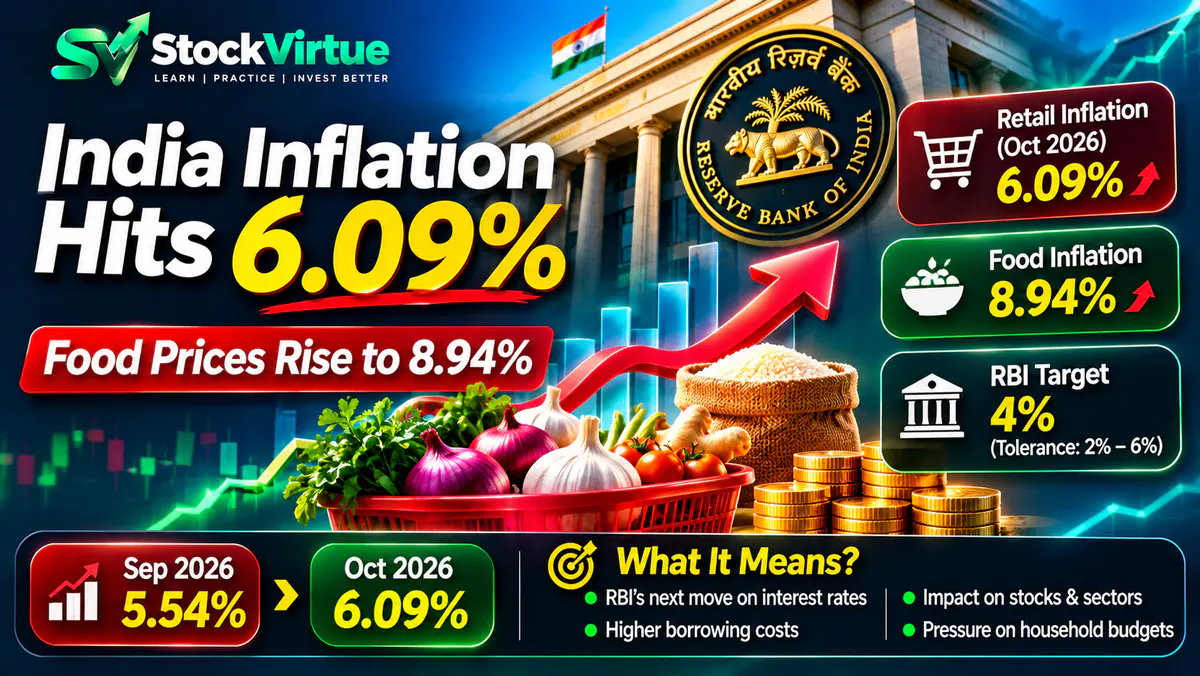
India's inflation outlook has come under fresh pressure after retail inflation increased to 6.09% in October 2026, moving above the Reserve Bank of India's upper tolerance limit of 6% for the first time in two years.
The latest figures, released by the Ministry of Statistics and Programme Implementation (MoSPI) on November 12, show that rising food prices were a major contributor to the increase. Food inflation accelerated to 8.94% in October from 7.74% in September.
The increase could have implications beyond household expenses. Persistent inflation may influence the Reserve Bank of India's monetary policy decisions, borrowing costs, consumer demand and the valuation of interest-rate-sensitive stocks.
For investors, the important question is whether October's increase will prove temporary or signal a more persistent inflation problem.
1. India's retail inflation rises from 5.54% to 6.09%
The Consumer Price Index (CPI)-based retail inflation rate increased by 0.55 percentage points between September and October.
The October figure is provisional and is based on the new CPI series with a base year of 2024.
India's latest CPI inflation data
Indicator | September 2026 | October 2026 |
|---|---|---|
Overall retail inflation | 5.54% | 6.09% |
Food inflation | 7.74% | 8.94% |
Rural retail inflation | 6.08% | 6.63% |
Urban retail inflation | 4.88% | 5.41% |
Rural food inflation | 8.06% | 9.09% |
Urban food inflation | 7.18% | 8.68% |
The data shows that inflation increased in both rural and urban areas. However, rural inflation remained higher than urban inflation.
This difference is important because households in rural areas can be particularly exposed to changes in food prices and agricultural conditions.
2. Food inflation is the biggest concern
Food prices remain one of the most important components of household inflation.
The Consumer Food Price Index (CFPI) recorded inflation of 8.94% in October, compared with 7.74% in September.
The increase suggests that pressure on household food budgets has intensified.
According to the October CPI release, some of the items recording particularly high year-on-year inflation included:
Item | October 2026 inflation |
|---|---|
Onion | 116.22% |
Garlic | 60.74% |
Silver jewellery | 52.39% |
Ginger | 48.32% |
Lemon | 47.30% |
These are individual item-level inflation rates, not the inflation rate of the entire food basket. Their contribution to overall CPI inflation depends on their respective weights in the index.
The sharp rise in selected food items highlights how supply disruptions, seasonal availability and changes in agricultural production can affect consumer prices.
3. Why is inflation important for the Indian economy?
Inflation measures the rate at which the prices of goods and services increase over time.
When inflation rises, consumers generally need more money to purchase the same basket of goods and services.
For example, if a household spends ₹10,000 on a particular basket of goods and its price rises by 6%, the same basket would cost approximately ₹10,600.
This simple illustration shows why sustained inflation can reduce purchasing power, particularly when household income does not increase at the same pace.
Higher inflation can also affect businesses through increased costs of raw materials, transportation, energy, wages and financing.
The impact is not identical across industries. Some companies can pass higher costs to customers, while others may experience pressure on their profit margins.
4. RBI's inflation target: Why crossing 6% matters
The Reserve Bank of India follows a flexible inflation-targeting framework.
The central inflation target is 4%, with a tolerance band of 2% to 6%.
This means the RBI aims to maintain inflation within that range over time, while also considering economic growth.
October's CPI reading of 6.09% has moved marginally above the upper boundary.
The development is significant because inflation has now moved outside the target band, potentially making monetary policy decisions more difficult.
The RBI's Monetary Policy Committee had already increased the policy repo rate by 25 basis points to 5.50% in its October 2026 meeting and changed its policy stance to calibrated tightening.
The latest inflation reading adds another factor for policymakers to consider.
However, one monthly reading does not automatically mean another interest-rate increase is certain. The RBI will need to assess the persistence of price pressures, food supply conditions, global energy prices, economic growth and future inflation expectations.
5. How could higher inflation affect interest rates?
Interest rates are one of the main tools used by central banks to manage inflation.
When inflation remains elevated, a central bank may maintain higher interest rates or consider further tightening to control demand and prevent inflation expectations from rising.
For consumers and businesses, this can affect the cost of borrowing.
Consider some possible effects:
Home loans: Higher lending rates can increase monthly EMI payments for borrowers with floating-rate loans.
Business loans: Companies may face higher financing expenses when borrowing costs increase.
Consumer spending: Higher household expenses combined with expensive credit can reduce discretionary spending.
Fixed-income investments: Higher interest rates can make certain fixed-income products more attractive relative to riskier investments.
The actual impact depends on how banks transmit policy-rate changes to customers and how inflation develops.
6. What does higher inflation mean for the Indian stock market?
Inflation can influence equity markets through interest rates, company earnings, consumer demand and investor expectations.
The impact varies across sectors.
Banking and financial services
Banks and financial institutions may face changes in funding costs, lending demand and credit growth when interest rates rise.
Higher rates do not automatically benefit or hurt every bank. The impact depends on deposit costs, loan repricing, asset quality and net interest margins.
Automobile sector
Vehicle manufacturers can face pressure if higher household expenses reduce consumer spending.
At the same time, companies with strong demand, pricing power and efficient cost management may be better positioned to manage inflationary pressure.
FMCG companies
Fast-moving consumer goods companies are sensitive to changes in raw-material prices and household purchasing power.
If input costs rise faster than selling prices, profit margins may come under pressure.
Real estate
Higher borrowing costs can influence housing affordability and demand.
Developers may also face changes in financing costs and construction expenses.
Oil and gas
International crude prices are important for India's inflation outlook because the country imports substantial quantities of crude oil.
Higher energy costs can increase transportation and production expenses across multiple industries.
7. Why investors should watch crude oil and the rupee
Domestic inflation is not influenced by food prices alone.
International energy prices and currency movements can also affect the cost of imported goods.
If crude oil becomes more expensive, India's import bill can increase. This may create additional pressure on fuel-related costs, transportation and industrial inputs.
A weaker rupee can make imported commodities more expensive in domestic currency terms, depending on international prices and hedging arrangements.
For investors, crude oil and the USD/INR exchange rate are therefore important indicators to monitor alongside CPI inflation.
8. What should investors watch next?
The October inflation report raises several important questions for the coming weeks.
November CPI data: Will inflation remain above the RBI's 6% upper tolerance limit?
Food prices: Will onion, garlic and other essential food prices moderate?
Crude oil: Will international energy prices create additional inflationary pressure?
RBI policy: Will the central bank maintain its calibrated tightening stance?
Consumer demand: Will higher household expenses affect discretionary spending?
Corporate earnings: Can companies protect their margins if input costs continue rising?
Rural inflation: Will the gap between rural and urban inflation persist?
MoSPI has scheduled the release of November 2026 CPI data for December 14, 2026, subject to the stated holiday adjustment.
That release will provide another important indication of whether inflationary pressure is continuing or beginning to ease.
StockVirtue Economic Takeaway
India's October retail inflation reading of 6.09% is an important development for both policymakers and financial markets.
Food inflation rising to 8.94% indicates that price pressure is becoming more visible in household spending. The increase also places additional responsibility on the RBI to balance inflation control with economic growth.
For stock market investors, the effects could appear through interest-rate expectations, borrowing costs, consumer demand and company profitability.
The key issue is not simply that inflation crossed 6% in October. It is whether the increase continues in the months ahead.
Investors should monitor upcoming CPI releases, RBI policy decisions, crude oil prices and corporate earnings before drawing conclusions about the market's longer-term direction.
StockVirtue — Learn | Practice | Invest Better