Economy & Banking
India Retail Inflation Hits 6.09%: RBI Rate Hike Fears Return as Sensex and Nifty Retreat
India's October retail inflation rises to 6.09%, crossing the RBI's upper limit. Understand the impact on interest rates, Sensex, Nifty and key sectors.
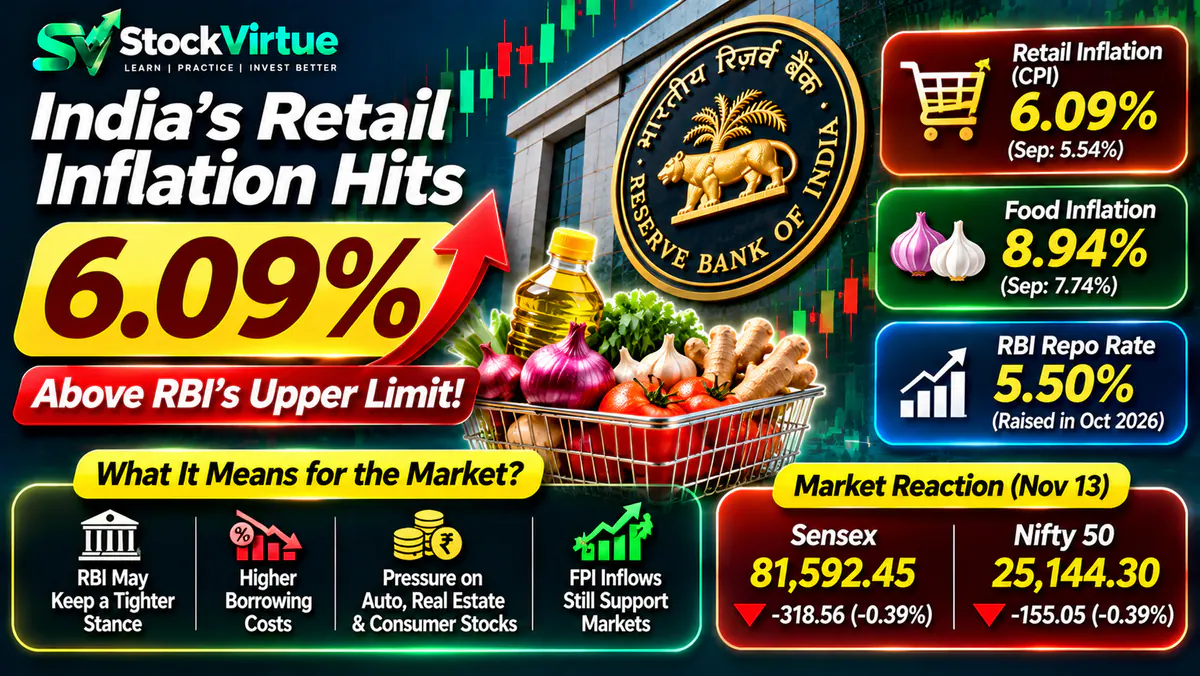
India's inflation outlook has become a fresh concern for financial markets after retail inflation climbed to 6.09% in October 2026, moving above the Reserve Bank of India's (RBI) upper tolerance limit of 6%.
The increase has raised questions about the direction of monetary policy, particularly as the RBI had already raised its policy repo rate to 5.50% in October and shifted towards a calibrated tightening stance.
The inflation announcement also came at a sensitive time for the stock market. On Friday, November 13, the Sensex declined 318.56 points to close at 81,592.45, while the Nifty 50 dropped 155.05 points to settle at 25,144.30.
For investors, the concern is not limited to higher grocery bills. Persistent inflation could influence borrowing costs, corporate margins, consumer spending and stock-market valuations in the coming months.
1. India's retail inflation rises to 6.09% in October
According to data released by the Ministry of Statistics and Programme Implementation (MoSPI) on November 12, India's Consumer Price Index (CPI)-based retail inflation increased to 6.09% in October, compared with 5.54% in September 2026.
This is the first time in two years that retail inflation has crossed the RBI's upper tolerance limit.
Food prices were a major contributor to the increase. Inflation based on the Consumer Food Price Index (CFPI) rose to 8.94% in October from 7.74% in September.
India's inflation snapshot
Indicator | September 2026 | October 2026 |
|---|---|---|
Retail inflation (CPI) | 5.54% | 6.09% |
Food inflation (CFPI) | 7.74% | 8.94% |
Rural retail inflation | 6.08% | 6.63% |
Urban retail inflation | 4.88% | 5.41% |
The data also shows that inflation remains higher in rural areas than in urban markets.
This difference matters because food and essential commodities account for a significant share of household spending, particularly among rural consumers.
2. Why are food prices pushing inflation higher?
Food inflation has become one of the biggest concerns in the latest CPI report.
Several essential food items recorded substantial price increases during October.
Onion inflation reached 116.22% year-on-year, while garlic inflation stood at 60.74%. Ginger and lemon also recorded significant increases.
These increases can affect household budgets and reduce the amount of money consumers have available for discretionary spending.
When families spend more on essential items, they may postpone purchases of vehicles, electronics, clothing and other non-essential products.
This creates a potential challenge for companies that depend on strong consumer demand.
However, not every food item became more expensive. Potato prices remained in deflation, showing that inflationary pressure was concentrated in particular categories rather than uniform across all food products.
3. Why does inflation above 6% matter for the RBI?
The RBI's inflation target is 4%, with a tolerance range of 2% to 6%.
October's reading of 6.09% has therefore moved inflation above the upper boundary of the target range.
This creates a challenge for monetary policymakers.
If inflation remains elevated, the RBI may need to maintain restrictive financial conditions or consider additional rate increases to bring price pressures under control.
The RBI had already increased the repo rate by 25 basis points to 5.50% at its October 2026 policy meeting.
It also changed its policy stance to calibrated tightening.
The next Monetary Policy Committee meeting is scheduled for December 2–4, 2026.
The October inflation reading will be an important input into the committee's assessment, although the eventual decision will depend on incoming inflation, growth, liquidity and global economic data.
Important: A December rate hike is a possibility discussed by market participants, not an announced RBI decision.
4. How could higher inflation affect the Indian stock market?
Inflation can influence stock prices through several channels, including interest rates, corporate profitability, consumer demand and investor expectations.
The effect is not identical across sectors.
Banking and financial services
Banks and financial companies are particularly sensitive to changes in interest rates and liquidity conditions.
If lending rates rise, borrowers may face higher EMIs and businesses may reconsider expansion plans.
Higher borrowing costs could also affect loan demand and repayment capacity.
On the other hand, the impact on bank margins can vary depending on deposit costs, loan repricing and the composition of each lender's balance sheet.
Investors should monitor large banks, NBFCs and housing finance companies for changes in credit growth, deposit costs and asset quality.
Automobile sector
The automobile industry depends heavily on consumer financing.
Higher interest rates can increase vehicle loan costs and potentially discourage some customers from purchasing cars and two-wheelers.
If inflation also reduces disposable income, demand for discretionary purchases may weaken.
Companies with strong product demand, healthy order books and pricing power may be better positioned to manage these pressures.
Real estate
Real estate is another interest-rate-sensitive sector.
Higher home loan rates can affect housing affordability and influence demand for residential properties.
Developers may also face higher financing costs, although the impact differs depending on their debt levels, cash flows and project mix.
FMCG and consumer companies
Fast-moving consumer goods companies can face pressure when the cost of raw materials, transportation and packaging increases.
If companies cannot pass these expenses on to customers, profit margins may narrow.
At the same time, rising food inflation can reduce the purchasing power of consumers, making demand conditions more challenging.
IT and export-oriented companies
The impact on information technology companies is less direct.
Currency movements, global demand, wage costs and overseas client spending are generally more important drivers.
A weaker rupee could support the rupee value of overseas revenue, although higher domestic costs and global economic uncertainty may offset some of that benefit.
5. Sensex and Nifty fall as inflation concerns return
The stock market reacted cautiously on Friday, November 13, following the inflation announcement.
Both benchmark indices ended lower, snapping a three-session winning streak.
Friday's market closing
Index | November 13 close | Daily change |
|---|---|---|
BSE Sensex | 81,592.45 | -318.56 points |
NSE Nifty 50 | 25,144.30 | -155.05 points |
The Nifty declined 0.61%, while the Sensex lost 0.39%.
Selling pressure was visible across several sectors, including banking, financial services, real estate and automobiles.
However, the weekly picture remained positive. The Sensex and Nifty still recorded gains for the week, despite Friday's decline.
This distinction is important: one weak trading session does not necessarily indicate that the broader market trend has reversed.
6. Foreign investors are returning, but inflation remains a concern
One interesting development in the Indian market is the return of foreign portfolio investors (FPIs).
According to market reports, foreign investors had brought approximately $8 billion into Indian equities during November up to the latest reported session.
This represented the strongest monthly inflow since December 2020 at that point in the month.
The renewed foreign buying has provided support to Indian equities.
However, investors are now balancing two competing developments:
Stronger foreign investment flows can support market liquidity and valuations.
Higher inflation can increase expectations of tighter monetary policy and put pressure on equity valuations.
The market's next direction may depend on which of these forces becomes stronger.
7. What does this mean for Indian investors?
For long-term investors, rising inflation is a reason to reassess business fundamentals rather than react emotionally to a single market decline.
Companies with strong balance sheets, manageable debt, stable demand and the ability to protect margins may be better positioned during an inflationary environment.
Investors should pay particular attention to:
Companies with high borrowing requirements.
Businesses dependent on discretionary consumer spending.
Companies exposed to food, energy and raw-material costs.
Banks and NBFCs with changing funding costs.
Companies with strong pricing power and cash generation.
For short-term traders, RBI policy expectations, bond yields, crude oil prices and the rupee may become important market-moving indicators.
Avoid assuming that every interest-rate-sensitive stock will move in the same direction. Individual company fundamentals still matter.
8. What should investors watch before the December RBI policy?
The coming weeks could be important for understanding whether the October inflation increase is temporary or part of a broader trend.
The following indicators deserve attention:
November inflation data: The next CPI reading will help determine whether price pressures are continuing or beginning to moderate.
Food prices: Onion, garlic, vegetables and other essential commodities could influence the next inflation reading.
Crude oil prices: India imports a substantial portion of its crude oil requirements. Higher international prices can increase domestic fuel and transportation costs.
Rupee movement: A weaker rupee can make imported commodities more expensive.
Government bond yields: Rising yields may reflect changing expectations about inflation and future interest rates.
RBI commentary: Statements from policymakers could provide further clues about the central bank's priorities ahead of the December meeting.
StockVirtue Market Takeaway
India's October retail inflation of 6.09% has introduced a fresh challenge for financial markets by moving above the RBI's upper tolerance limit.
The increase in food inflation is particularly important because it affects household purchasing power and can influence demand across several industries.
For the stock market, the central concern is whether higher inflation will force the RBI to maintain a tighter monetary policy for longer.
Banking, automobiles, real estate and consumer companies could remain sensitive to changing interest-rate expectations, while businesses with strong pricing power and healthy balance sheets may be better equipped to manage cost pressures.
The next major event for investors will be the RBI's December 2–4 policy meeting, alongside the release of the next inflation data.
For now, investors should focus on company fundamentals, inflation trends and monetary-policy signals rather than treating one day's market decline as a definitive trend reversal.
StockVirtue — Learn | Practice | Invest Better
Disclaimer: This article is for educational and informational purposes only and does not constitute investment advice or a recommendation to buy or sell any security. Inflation figures for October 2026 are provisional. Market prices refer to the November 13, 2026 closing session and are not live quotations. Monetary-policy expectations are not confirmed RBI decisions. Please verify official data and exchange disclosures before making investment decisions.